Introduction
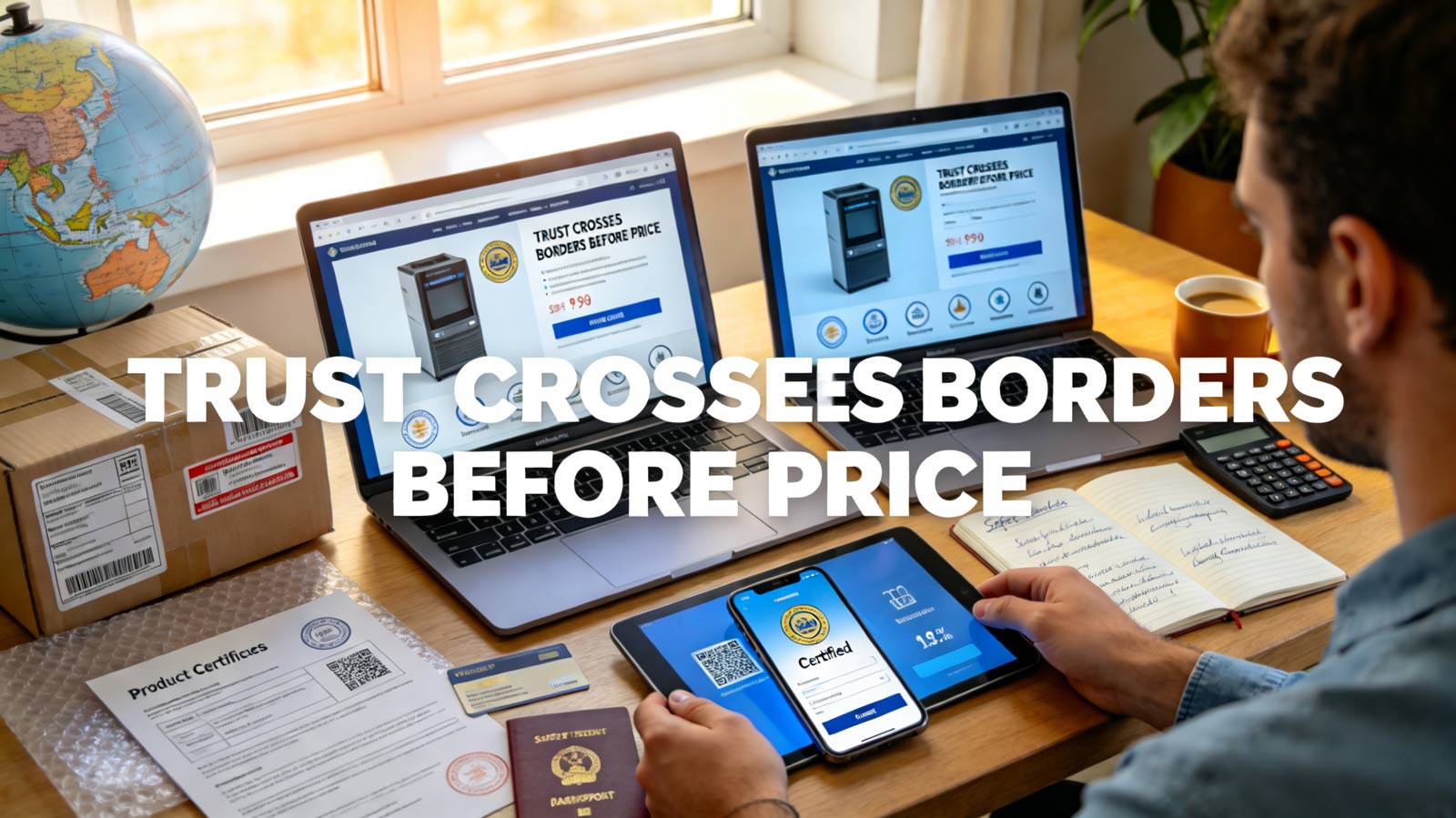
A discount tells a cross-border shopper what the product costs. A certification tells them what the product is. For first-time buyers ordering from another country, that difference matters more than most stores realize. Price can be compared in seconds, but risk takes longer to evaluate. Shoppers must decide whether the product is safe, whether it meets local standards, whether the seller is credible, and whether a problem after delivery will be easy to resolve. A visible certification compresses those questions into a single trust signal. It gives the buyer a reason to stop comparing and start purchasing.
Certification is no longer a technical detail buried in a specification sheet. It has become part of the checkout decision itself. In cross-border ecommerce, the buyer often cannot inspect the product, test the seller, or rely on familiar local protections. The certification mark becomes a proxy for all three. This article examines why certified products now convert faster than discounted ones, how compliance signals shape international purchase behavior, and how stores can turn certification from passive documentation into active conversion infrastructure.
Certification Is a Conversion Signal, Not Decoration
Certification matters because it changes what the buyer believes about risk:
-
It replaces unknown safety with visible assurance. A cross-border shopper cannot physically examine the product before purchase. Certification marks, testing labels, and compliance badges answer a question the buyer is already asking: “Is this safe enough to bring into my home?”
-
It validates the seller, not only the product. A store that displays relevant certifications signals operational seriousness. It suggests the business understands destination-market requirements, supplier documentation, and product liability—three concerns that anonymous international sellers often fail to address.
-
It reduces post-purchase uncertainty. Buyers worry about customs delays, incompatible standards, rejected returns, and unsupported claims. Clear certification reduces the chance that the product will create problems after delivery, making the full-price purchase feel less risky than a cheaper but unverified alternative.
-
It protects margin by strengthening trust. Discounts lower the price of uncertainty. Certifications remove part of the uncertainty itself. That is why stores with strong compliance presentation can often preserve healthier margins than stores that rely on markdowns to win international traffic.
The practical result is simple: a certified product gives the shopper permission to value certainty over savings. An uncertified product, even at a lower price, leaves the buyer wondering what risk is being discounted.
Reading the Pattern by Where Certifications Appear
Not every compliance badge carries the same weight. Placement determines whether certification influences the decision or remains invisible background information:
-
Product-Page Certifications: These shape initial product evaluation. Safety icons, materials disclosures, testing standards, and regulatory marks near the title or buying button help shoppers classify the product before they reach the price comparison stage.
-
Checkout Certifications: These influence the final risk calculation. At checkout, buyers are thinking about payment, delivery, returns, and dispute resolution. Certifications displayed here work best when tied to destination-country compliance, product safety, or authenticity rather than generic trust language.
-
Packaging and Post-Purchase Certifications: These confirm that the store’s promises survived fulfillment. When the physical package displays the same marks shown online, the buyer receives proof that the claim was real, not merely a conversion tactic.
-
Support and Warranty Certifications: These extend trust beyond delivery. If the store can connect compliance documentation with warranty terms, return handling, and local support processes, certification becomes part of the ownership experience rather than a one-time pre-purchase signal.
The pattern matters because shoppers do not treat all trust signals equally. A badge shown only in a footer may be ignored. A certification tied to the exact product, destination, and use case becomes part of the reason to buy.
The Certification Discipline Test
Compliance only improves conversion when it is specific, credible, and consistent. A store can pass the certification discipline test by asking four questions:
-
Is the certification relevant to the destination market? A mark that matters in one country may be meaningless in another. Cross-border conversion improves when the store shows jurisdiction-specific compliance rather than displaying every badge it can find.
-
Is the claim easy to verify? Buyers trust certifications more when they can click through to documentation, testing standards, or certification details. A badge without context looks decorative; a badge with proof looks operational.
-
Is the message consistent across the funnel? If the product page claims certified safety, the cart should not raise doubts, the packaging should repeat the claim, and support should be able to explain it. Inconsistency turns certification into suspicion.
-
Does the certification reduce a real buyer concern? The strongest badges address actual anxiety: electrical safety, ingredient integrity, child safety, materials compliance, authenticity, or environmental standards. Weak stores display certifications because they look impressive. Strong stores display them because they remove hesitation.
This test works because certification is difficult to fake well. A polished landing page can create desire, but credible compliance requires documentation, supplier control, market knowledge, and operational follow-through.
What the Compliance Conversion Math Looks Like
The financial case for certification is not that badges magically create demand. It is that they improve the quality of demand already arriving at the store:
-
Higher-quality traffic: Certification-led positioning attracts buyers who value safety, legitimacy, and product fit. These shoppers are often less price-elastic than visitors arriving only through discount-led acquisition.
-
Stronger first-order conversion: Benchmark stores that present relevant certifications near the buying decision often see first-time cross-border conversion lifts of 5-12%, particularly in categories where safety or standards anxiety is high.
-
Lower hesitation at checkout: Compliance signals reduce last-minute uncertainty. That can lower abandonment among international shoppers who might otherwise leave to search for a local seller with clearer documentation.
-
Better margin protection: When certification supports the product’s value, stores have less need to compete through permanent markdowns. The badge becomes a reason to buy now, not a reason to wait for a cheaper alternative.
-
Reduced post-purchase friction: Clear standards and documentation can decrease disputes over product expectations, compatibility, and use. Fewer misunderstandings mean fewer refunds, fewer chargebacks, and fewer expensive service interventions.
-
The discipline: Certification does not replace a weak offer. If the product is overpriced, poorly described, or badly reviewed, no badge will rescue it. Certification strengthens an already credible product; it cannot compensate for a fundamentally unattractive one.
Turning Certification Signals into Commercial Intelligence
For cross-border sellers, certification should be treated as both a compliance requirement and a merchandising asset:
-
Identify which risks block international conversion. Reviews, abandoned-cart surveys, support tickets, and destination-level conversion gaps often reveal whether shoppers hesitate over safety, materials, compatibility, customs, or authenticity. Certification should address the specific concern, not simply decorate the page.
-
Match certification depth to market sensitivity. Highly regulated categories need detailed proof and jurisdiction-specific messaging. Lower-risk categories may need only clear materials and standards information. The goal is confidence, not badge accumulation.
-
Use certification to segment price strategy. Products with strong documented compliance can support premium positioning, while uncertified alternatives may need sharper pricing. This helps the store avoid discounting products that already carry stronger trust.
-
Audit competitor trust gaps. If competing stores hide compliance information, bury it in PDFs, or rely on vague claims, a clearer presentation can become a visible conversion advantage. In crowded markets, certainty often differentiates faster than design.
-
Connect certification to retention. Post-purchase documentation, care instructions, warranty registration, and replacement support extend the trust created before checkout. A certified product that is easy to own becomes easier to reorder and recommend.
The strategic value of certification comes from alignment. The right badge, shown at the right moment, supported by the right documentation, can move the buyer from comparison to commitment before price becomes the deciding factor.
Conclusion
Cross-border ecommerce has changed the function of trust. Buyers no longer assume that a lower price means a better deal or that a polished storefront means a reliable seller. They look for evidence that the product will meet expectations after it crosses a border, clears customs, enters their home, and becomes part of daily use. That evidence increasingly comes in the form of certification.
Certified products convert faster than discounted ones because they answer a deeper question. Discounts address cost; certifications address risk. In international shopping, risk is often the larger obstacle. The stores that understand this stop treating compliance as a back-office burden and start presenting it as a visible commercial asset—clear, relevant, verifiable, and aligned with the buyer’s real concerns. In the cross-border checkout, trust is not an add-on to the offer. Increasingly, trust is the offer.