Introduction
Every trust badge is a confession. It admits the store knows exactly why you're hesitating — and that hesitation is where you attack. Badges, guarantee seals, review widgets, and media logo walls aren't decoration; they're a store's anxieties rendered in pixels, placed where the funnel bleeds. Learn to count them, and a competitor's product page becomes a diagnostic chart of its weakest conversions. This guide gives you a ten-minute audit protocol, a decoding map from badge patterns to underlying panic, and the one cross-check that separates real anxiety from careful maintenance.
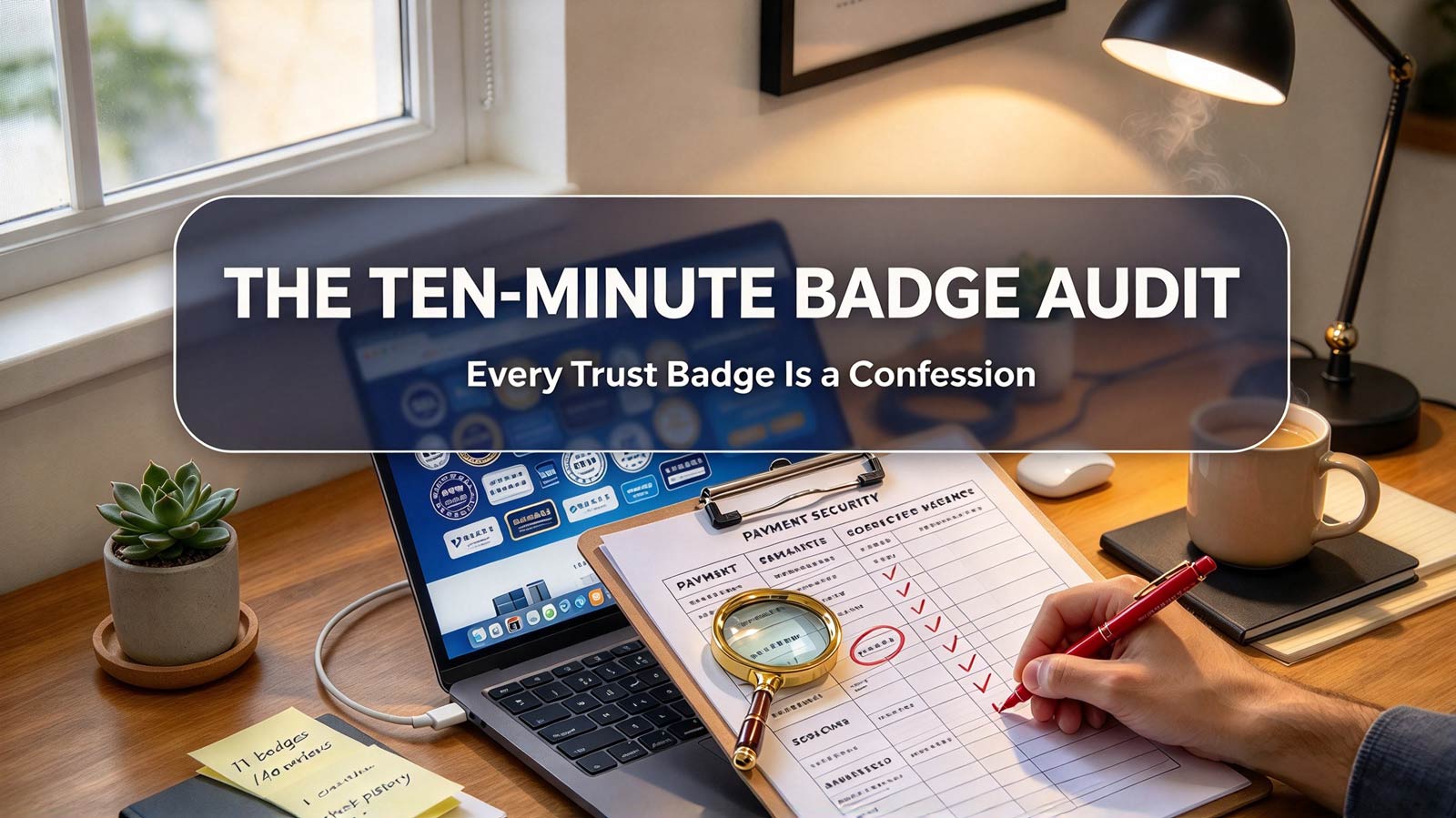
The Ten-Minute Badge Audit
Run the same pass on every competitor. Sort everything on the page into four buckets:
- Payment security — SSL seals, secure checkout badges, payment processor logos.
- Guarantees — money-back promises, warranty seals, satisfaction badges.
- Borrowed authority — media logo walls, certification seals, "as featured in" strips.
- Manufactured urgency — "X people bought this today" widgets, live-view counters, recent-purchase popups.
Now count three things: badges per bucket, placement (homepage hero, product page, checkout), and total density. Ten minutes, one sheet, per store. The raw counts matter less than the pattern — and the patterns decode cleanly.
The Decoding Map
- Checkout stacked with payment security badges. Fighting cart abandonment. Open with a visibly simpler checkout and one clear security statement.
- Guarantee badges in hero positions. Doubts its own quality, or returns are eating it alive. Open with durability comparisons that make the guarantee look like an apology.
- Urgency widgets on every page. Organic trust too weak to convert without pressure — the borrowed-credibility pattern from our social proof breakdown. Open with long-form, unfiltered customer content.
- Media logo wall above the fold. Renting authority on a PR budget: expensive acquisition economics. Earn with product what it pays for.
- Many badges, thin reviews. A paper shield converting on promises, losing on delivery. Its refund-wary base is primed to switch.
- A category leader with zero badges. Brand moat. Differentiate on product or audience, not trust.
- New or rearranged badges. Check page history: a badge appearing right after a traffic dip is a panic move — conversion bleeding, judgment already slipping. Time your move while it's distracted.
Cross-Check the Anxiety Against the Data
Badge counts are claims; traffic is evidence. Reconcile them with a store intelligence tool like ShopFindBiz before acting. Heavy urgency widgets paired with falling traffic means the bleeding is current, not historical. Badges intensifying while paid traffic share climbs means the store is buying visitors to plug leaks it can't fix structurally — acquisition costs rising on its side, your relative cost advantage widening on yours.
The same audit works at category level. If every rival in your niche stacks badges, trust is the declared battleground and the least-anxious-looking store wins by default. If nobody carries any, the first store to build genuine, quiet confidence — good products, real reviews, clean checkout — collects the trust dividend unopposed.
A Walkthrough: Two Stores, Two Opposite Openings
A realistic scenario based on typical patterns: a seller in the home fitness niche audits two competitors. Store A's homepage carries eleven badges — guarantee banner, media logos, two urgency widgets — with barely forty reviews behind it all. Diagnosis: anxiety exceeding substance, converting on promises it can't back. The play: comparison content and unfiltered customer footage that makes the gap between promise and proof the story.
Store B, the category leader, carries no badges at all and pulls an estimated seven-figure monthly traffic. Diagnosis: brand moat; trust attacks bounce off. The play: don't fight its credibility — out-position it with a sub-audience its generic trust can't speak to, where a niche badge (say, physio-endorsed) outranks its silence. One audit sheet, two opponents, zero wasted ad spend.
Fortify Your Own Shelf
Remember the direction this cuts: your competitors can run the same ten-minute pass on your store tonight. So run it on yourself first. Count your badges, check your review depth behind them, and look at your page history — if you've been quietly stacking seals after slow months, you've been broadcasting panic. Strip back to the badges that answer your customers' real top objections, let the reviews carry the rest, and make sure what a rival reads on your page is discipline, not anxiety.
Conclusion
A store's badges are its tell. Count them by bucket, map them to the fear they answer, timestamp their changes, and verify the story against the traffic — and you'll know exactly which doubt to press before you spend a dollar attacking. The stores with the most badges aren't the strongest; they're the most worried. Worry is a strategy leak, and leaks are where games are won.