Introduction
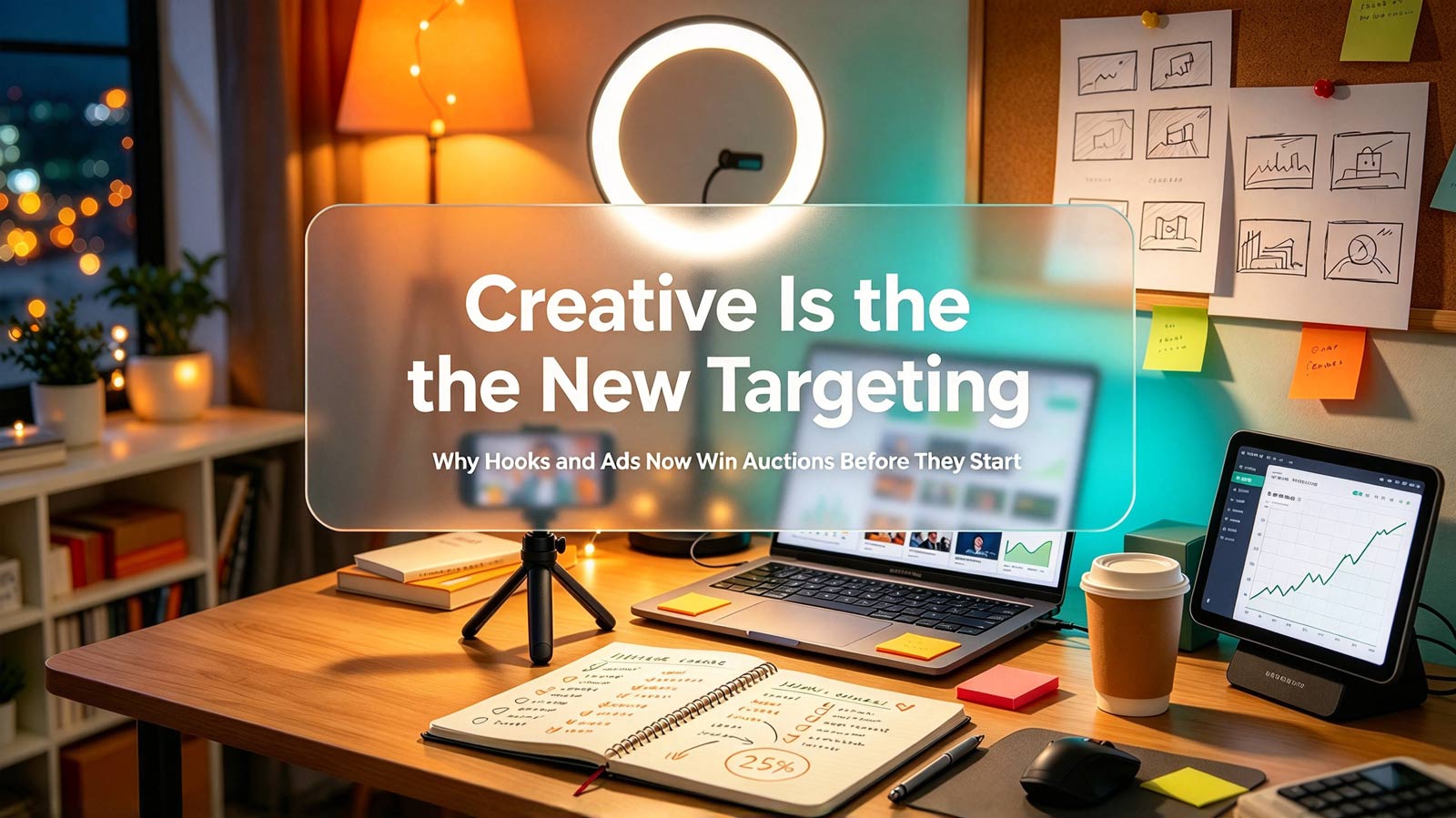
Meta no longer lets you choose who sees your ads. Since Apple's privacy changes, the platform's answer to every audience question is the same: use broad targeting and let Advantage+ decide. Google's Performance Max works the same way, and TikTok's GMV Max is following the same path. Advertisers lost control of who — and the only lever left to steer the machine is what: the creative itself. Your ads now win or lose before auctions start, because the material you upload is the targeting signal the algorithm uses to go find your buyers.
The Mechanism Shift: Platforms Took Targeting Back
The old model was explicit: you picked interests, lookalikes, and demographics, and creative was mostly decoration on top of your targeting choices. That model died with signal loss. In its place, platforms now run consolidated campaigns — Advantage+ Shopping on Meta, Performance Max on Google, GMV Max on TikTok — where the system controls audience selection, placement, and even bidding in one black box.
This changes the physics of advertising in one crucial way: the algorithm learns who your customer is from how people respond to your creative. Feed it a video that young mothers engage with, and it will hunt for young mothers. Feed it a hook that gym-goers watch to the end, and it will hunt for gym-goers. Same product, same campaign settings, same budget — a completely different audience, decided entirely by the asset.
That's why creative now functions as targeting. You don't tell the machine who to find. You show it what your customer looks like, in pixels and hooks, and it does the rest.
Why Creative Also Decides Whether You Can Afford the Auction
Creative quality isn't just a signal — it's auction economics. Platforms score every ad on predicted engagement and post-click experience, and those scores price your access. Strong material earns cheaper delivery: industry analyses have long attributed the majority of campaign performance to creative, and platform diagnostics reward high-engagement ads with lower costs per result. Weak material pays a tax — the same impression costs more, gets shown less, and dies faster.
This is why polished brand films keep losing to rough UGC-style clips on 9:16. The feed rewards native texture and a hook in the first second; production value barely registers. The auction doesn't care what your ad cost to make. It cares what thumbs do when it appears.
The Testing Framework That Wins Auctions
If creative is targeting, then creative testing is audience research. Winning teams run it like a production line:
-
Volume first. Five to ten new assets a week, thirty to fifty a month. You're not polishing ads; you're fishing for signals.
-
Hook rate is the gate. On TikTok, a thumbstop rate under 25% — viewers stopping to watch past the first second — means the hook failed and the rest of the video doesn't matter. On Meta, the first frame decides most of the outcome. Kill weak hooks before you spend a dollar judging the offer.
-
Test angles, not cosmetics. Three genuinely different audience angles (the problem, the skeptic, the aspirational user), each with a dozen hook variations. Changing a CTA button color is not a test; it's procrastination.
-
Fatigue has a number. When frequency passes 2–3 and CPA climbs 20% with no campaign changes, the asset is worn out. Refresh creative — don't raise bids into a dying ad.
-
Judge like an analyst. CTR above 2.5% and CPC under $0.90 on US traffic keeps a candidate alive; below that, it goes back to the edit bench. (The same benchmarks we use to read any store's traffic quality apply to your own ads.)
A practical note on production: AI tools now draft variants at scale, which is genuinely useful for volume — our earlier breakdown of how AI is rebuilding the seller's workflow covers where that fits. But volume without a testing structure is just spam. The framework above is the difference.
A Walkthrough: Twelve Hooks, Three Angles, One Winner
A realistic scenario based on typical patterns: a supplements seller launches Meta Advantage+ with three angles — the energy-slump problem, the skeptical label-reader, and the active-parent lifestyle. Twelve hooks per angle, UGC-style 9:16, shot on a phone over one afternoon.
Week one: the problem angle's thumbstop rates cluster around 31%, the skeptic angle at 22%, the lifestyle angle at 18%. Lifestyle hooks are cut. Week two: within the problem angle, one hook — a mid-yawn close-up with "3pm crash?" as on-screen text — runs a 4.1% CTR at $0.62 CPC. The seller duplicates its structure across five new openings and lets Advantage+ consolidate. By week four, frequency on the original hits 2.8 and CPA rises 18% — fatigue, exactly on schedule. The replacement batch is already in testing. Total creative produced: 47 assets. Total audience decisions made by the seller: zero. That's the job now.
Reading the Creative Arms Race
The same lens works on competitors. Meta's Ad Library shows every active ad a brand runs — scroll a rival's history and you can date its creative iterations and spot which angles it keeps returning to. Layer in traffic estimates from a tool like ShopFindBiz: if a competitor's visits spike two weeks after it swaps creative angles, you've watched its targeting signal work in real time. The sellers losing this arms race are the ones whose Ad Library hasn't changed in ninety days.
Conclusion
Targeting didn't disappear — it moved inside the creative. The platforms took audience selection back, and the advertisers still winning are the ones who understood what they were given in exchange: direct control of the only signal the machine reads. Feed it volume, gate it with hook rates, and refresh it on schedule. And remember this isn't the only shift repricing your growth — where your traffic comes from and where your ad budget belongs are moving too, and the three questions compound each other. Treat creative as the targeting it has become, and the auction starts tilted in your favor.