Introduction
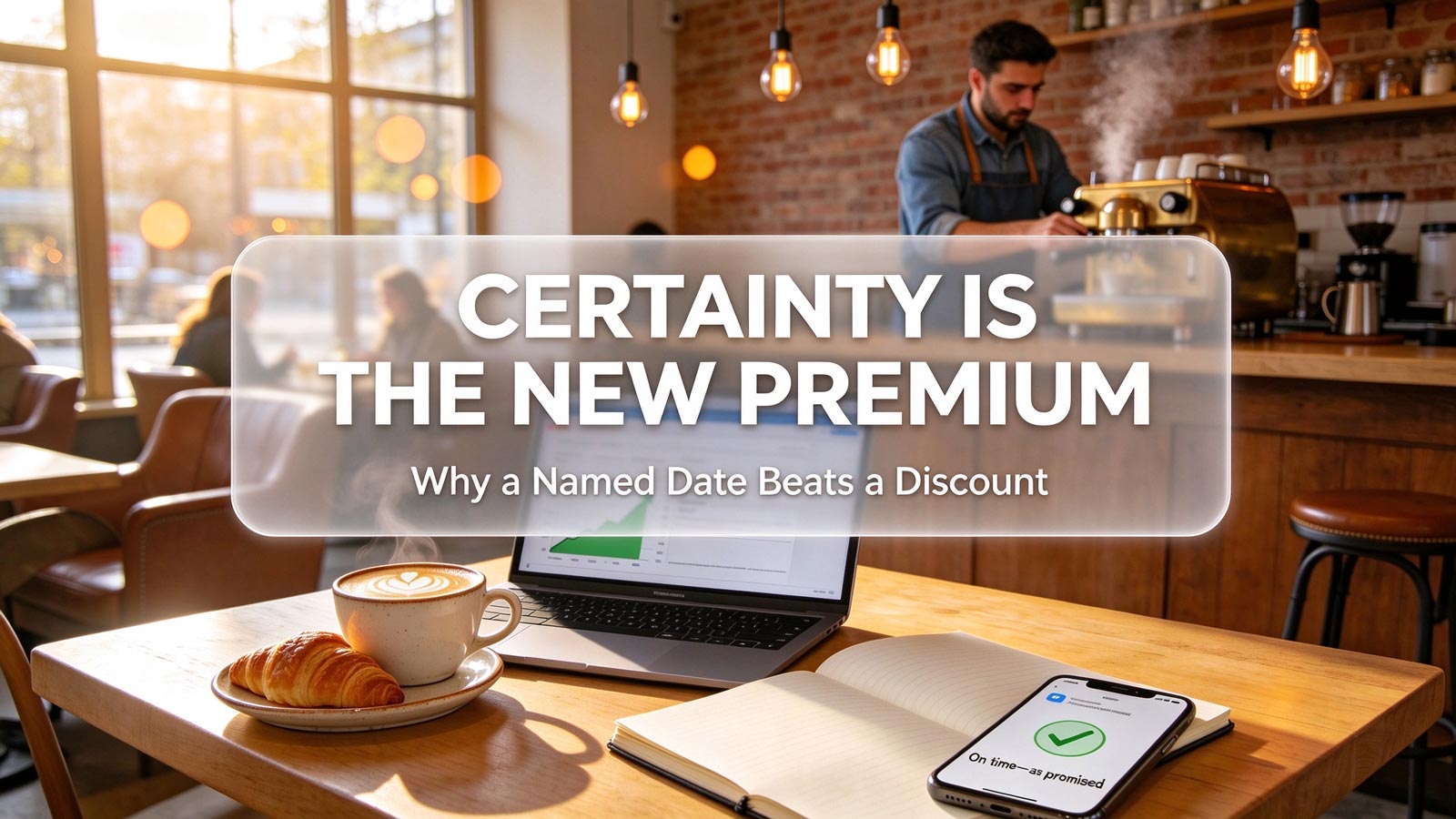
Two stores list the same product at the same price. The first promises "fast shipping" in a banner nobody reads. The second displays a calendar date—"Arrives Thursday, November 12"—above the buy button. The second store wins the cart, and it is not close. Somewhere between the supply-chain shocks of the early 2020s and the algorithmic delivery promises of 2026, the definition of premium changed. Shoppers no longer pay extra for speed as a luxury; they pay for certainty as insurance. The store that can name the day is no longer competing on logistics. It is competing on risk—and in a market where every discount gets matched within hours, risk is the one margin lever competitors cannot copy.
Why Certainty Became the New Premium
For a decade, shipping strategy meant one trade-off: pay more, get it faster. That frame is dead. The 2026 shopper evaluates delivery the way an investor evaluates a bond—not by the yield, but by the variance:
-
Speed Lost Its Meaning: "Express" and "priority" lost semantic value after every carrier adopted them. When everything is fast, nothing is—shoppers have learned that an unnamed promise of speed is just an unnamed risk with a logo on it.
-
Certainty Has a Price Signal: Displaying a specific date is a costly commitment. A store only writes "Arrives Thursday" on the product page if its fulfillment operation can survive the promise being tested thousands of times a month. Certainty is credible precisely because it is expensive to fake.
-
Discounts Are Copyable, Dates Are Not: A competitor can match a 10% discount in an afternoon. Matching a guaranteed delivery date requires warehouses, carrier contracts, and inventory positioned near demand—months of operational work. Certainty is a moat; discounts are a costume.
The premium of 2026 is not "how fast." It is "how sure."
The Data Behind the Delivery Date
Strip away the branding and the pattern is consistent across store dashboards and carrier reports:
-
Named Dates Outperform Named Speeds: Conversion data from high-volume stores shows product pages displaying a specific delivery date converting materially higher than identical pages promising "fast" or "free" shipping without a date. Certainty converts; adjectives do not.
-
Guaranteed Badges Move the Mid-Funnel: Shoppers abandon at the shipping step when the delivery window widens—"7–14 business days" reads as "we don't know." Stores that replaced vague ranges with firm dates recovered a meaningful share of those hesitating buyers before they ever reached checkout.
-
Uncertainty Tax Exceeds the Shipping Fee: Ask a shopper to pay $4 for guaranteed delivery or offer free delivery with a vague window, and a decisive share choose the fee. The psychological cost of not knowing is priced higher than the logistical cost of shipping—a pricing insight most stores still leave on the table.
-
Post-Purchase Anxiety Drives Returns: Orders with ambiguous delivery promises generate disproportionately higher "where is my order" tickets and return rates. The doubt starts at the product page and compounds until the box arrives—or goes back.
Vague delivery language is not neutral. It is an active conversion leak measured in percentage points.
The Operations Behind the Promise
Any store can write a date on a page. Only an operation can keep it. The gap between the two is where most sellers fail:
-
Inventory Position Decides What's Promisable: A delivery date is only as good as the warehouse nearest the buyer. Stores running single-origin fulfillment are promising dates they cannot keep for half their traffic; distributed inventory is what turns a date from marketing copy into a repeatable fact.
-
Carrier SLAs Are Product Features: Guaranteed-date promises live or die by carrier service-level agreements, yet most sellers negotiate shipping like a cost line instead of merchandising it like a feature. The stores winning on certainty treat their carrier contracts as part of the product spec.
-
The Promise Must Survive Peak Season: A date displayed in October and broken in November costs more conversions than no date at all—broken certainty converts trust into resentment at scale. Stores that hold dates through BFCM treat peak capacity as a constraint they engineer around, not a surprise they apologize for.
-
Real-Time Data Separates Confident from Careless: The difference between a store that guesses its delivery dates and one that commits to them is visibility—live inventory, live carrier performance, and live demand by region. Commitment without telemetry is gambling with the brand's most valuable new asset: its word.
A delivery date is not a website feature. It is an operational report card displayed to every visitor before they pay.
What Sellers Should Do Before the Next Peak
Certainty is a strategy, not a badge. The stores capturing the premium run it as a system:
-
Replace Ranges with Dates Everywhere They Appear: Product page, cart, checkout, confirmation—every instance of "5–10 business days" is a conversion tax. Where a firm date cannot be given, say why and say when it will be known; managed uncertainty converts better than unmanaged vagueness.
-
Price the Certainty, Not Just the Shipping: If a segment of buyers demonstrably pays to remove doubt, charge for the removal. Expedited shipping framed as "guaranteed by [date]" consistently outperforms the same service framed as "faster shipping"—the buyer is purchasing certainty and receiving speed as a side effect.
-
Engineer Peak Dates in Q3, Not Q4: Guaranteed dates are won months before they are displayed—inventory positioned, carrier capacity locked, fallback lanes contracted. Stores that treat delivery certainty as a peak-season project always launch it one season late.
-
Audit the Promise Like a P&L Line: Track promised-date accuracy, broken-promise refunds, and WISMO ticket volume with the same rigor as ad spend. A delivery promise is a financial instrument; manage it like one, and it pays like one.
Conclusion
The 2026 shopper has been trained by years of broken promises to read every shipping banner as a question: can I trust this? The store that answers with a date—its own name on the line, its own operation behind the words—collects a premium no discount can undercut. Speed was the premium of the logistics era. Certainty is the premium of the trust era. And trust, unlike shipping rates, is something no competitor can match with a coupon code.