Introduction
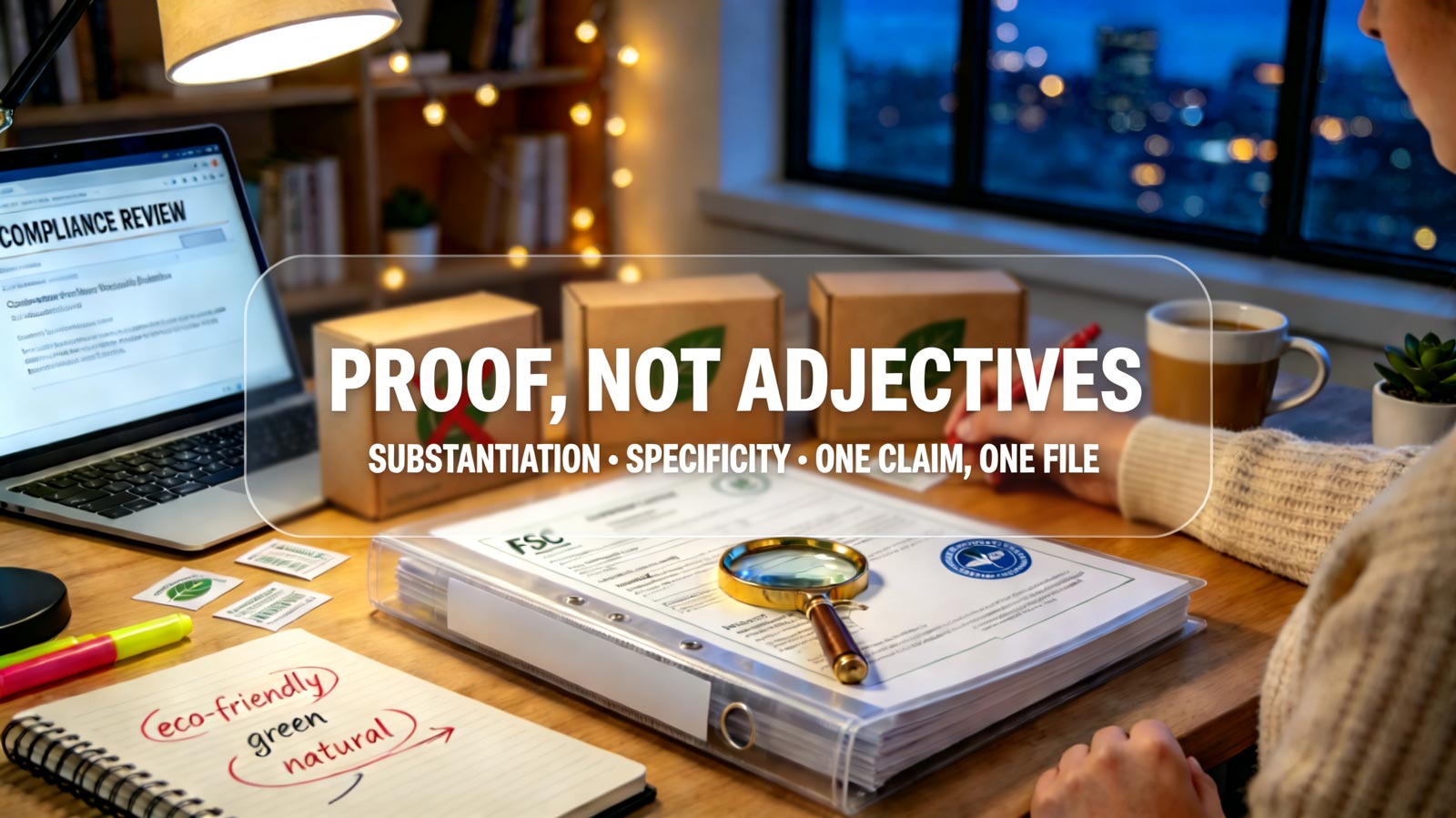
For a decade, "eco-friendly" was free marketing. It cost nothing to print a leaf icon on packaging, add "sustainable" to a product title, and let the connotation do the selling. That era is closing. Regulators across Europe — and increasingly beyond it — have moved from guidance to enforcement, and the first wave of fines is landing on exactly the kind of vague, feel-good claims that once felt harmless. This guide breaks down why generic green language is now a legal liability, what regulators actually test for, and how to keep marketing green — with proof, not adjectives.
Why Vague Claims Are Now a Legal Risk, Not Just Marketing Fluff
Three shifts turned soft eco language into a compliance problem:
-
The rules finally have teeth. The EU Green Claims Directive is working through the legislative pipeline, and national laws have jumped ahead: France's AGEC law already bans generic terms like "biodegradable" or "environmentally friendly" without certified proof, and the UK's CMA Green Claims Code has moved from polite guidance to active investigations. "Everyone does it" stopped being a defense.
-
Enforcement targets language, not just products. Regulators no longer need to prove a product damages the environment. They only need to prove the claim can't be substantiated. "Eco-conscious," "planet-safe," "green" — none of these survive a substantiation test, because none of them mean anything specific.
-
Fines scale with revenue. Modern green-claims regimes calculate penalties as a percentage of turnover, not a flat fee. For a mid-sized store, one viral complaint — from a competitor, an NGO, or a disappointed buyer — can cost more than an entire year of packaging redesign.
The label that cost nothing to add can now be the most expensive word on the listing.
What Regulators Actually Test For
The enforcement logic is surprisingly consistent across jurisdictions. Five patterns draw scrutiny fastest:
-
Generic absolutes. "Eco-friendly," "natural," "clean," "green" — words with no measurable definition fail immediately. If a claim can't be expressed as a number or a certified standard, assume it's already non-compliant.
-
Selective truth. Highlighting one green attribute while the product's overall footprint is dominated by another — a "plastic-free" label on an item shipped with heavy carbon intensity — is treated as misleading by omission.
-
Future promises sold as present facts. "On the way to carbon neutral," "committed to 2030 targets." Regulators distinguish what a product is from what a company hopes — and only the first may appear on the label.
-
Self-created seals. Invented badges and logos that look like third-party certification are treated as deceptive certification marks — one of the fastest routes to a penalty.
-
Unqualified comparisons. "Greener than regular alternatives" requires the comparison to be specific, current, and substantiated. "Better for the planet" is neither.
Notice what survives: claims tied to measurable, verifiable facts — "made with 92% recycled aluminum," "FSC-certified packaging," "replaces 500 single-use wipes." Specificity is compliance.
What Green Compliance Looks Like in Practice
A realistic scenario based on typical patterns: a seller in the home-goods niche has built its brand on warm earth-tone photography and copy sprinkled with "sustainable," "conscious," and "low-impact." Sales are steady until a competitor reports the listings to a national consumer authority — a tactic that has become routine in crowded categories. The review doesn't hinge on whether the products are good; it hinges on one question: can you prove the words?
The seller survives the audit — barely — because of one habit: every claim in their copy maps to a document. FSC certificates on file for the packaging. Lab reports for the recycled-content percentage. A supplier declaration retained for the organic cotton line. Each claim gets either a substantiation file or a rewrite. "Sustainable materials" becomes "GOTS-certified organic cotton cover." The leaf icon comes off the listings that can't carry it. Marketing loses some poetry and gains a defense file — and ironically, conversion holds, because specific claims outperform vague ones with the exact buyers green marketing targets. The stores that fail these audits aren't the ones with dirty supply chains; they're the ones with clean products and sloppy adjectives.
The Claims Discipline
Compliance is a documentation habit, not a one-time cleanup. Four rules keep you green without the risk:
-
Adopt a "one claim, one file" rule. Every environmental statement in your listings links to a substantiation document — certificate, lab report, supplier attestation. If a claim can't survive that link, it doesn't ship.
-
Rewrite before you regret. Audit copy for the five failure patterns above and replace absolutes with specifics before a regulator, platform, or competitor does it for you. Self-revision is cheap; enforcement is not.
-
Watch the enforcement frontier in your category. Green-claims scrutiny moves by sector — fashion, cosmetics, and electronics have already seen waves. Scan what claims competitors are quietly deleting from their listings; a store intelligence tool like ShopFindBiz can surface claim changes across a niche faster than manual checking.
-
Extend the audit to packaging and ads. Fines rarely start with the website. They start with a product box, an email banner, or a paid ad where an old claim survived the last redesign. Compliance is only as strong as its least-updated surface.
Reading Your Own Listings
Run the self-audit this week. Open your catalog and look for three patterns:
-
The word cloud problem. If your eco vocabulary repeats across every product regardless of what's actually different about them — "sustainable," "conscious," "planet-friendly" — you have decoration, not information, and decoration is what regulators index on.
-
The orphan badge. A seal, leaf, or icon with no certifying body behind it. Either attach it to a real certification or remove it; self-created marks are among the fastest tickets to penalties.
-
The time-travel claim. Copy about future targets presented as current fact. Move ambition statements to the About page with dates and scope, and keep product pages in the present tense of what's verifiable today.
Conclusion
The green claims crackdown isn't a war on sustainability marketing — it's a war on evidence-free adjectives. Regulators aren't asking brands to stop talking about the environment; they're asking them to say something checkable. The sellers who adapt won't just avoid fines — they'll convert better, because a specific claim ("92% recycled aluminum") outperforms a fog of virtue every time. In a market where one vague word can invite an audit, the most sustainable marketing asset isn't the leaf icon. It's the file folder that proves it.