Introduction
Every store's homepage fights for attention—the hero image screams, the sale banner flashes, and the countdown timer pressures. But the navigation bar operates in a different register. It is the one piece of real estate where every category, every collection, and every link had to earn its position in a finite horizontal strip, usually through months of watching what actually converts. A store's homepage shows what it wants to sell. Its menu shows what it actually sells. Analysts who audit the hero section learn what a store is promoting. Analysts who audit the navigation order learn what a store is surviving on.
Why the Menu Is the Store's Accidental Org Chart
The homepage is a campaign; the menu is a structure. Nobody redesigns the navigation bar without data, and no template default survives contact with real analytics. That deliberateness is exactly what makes it valuable:
-
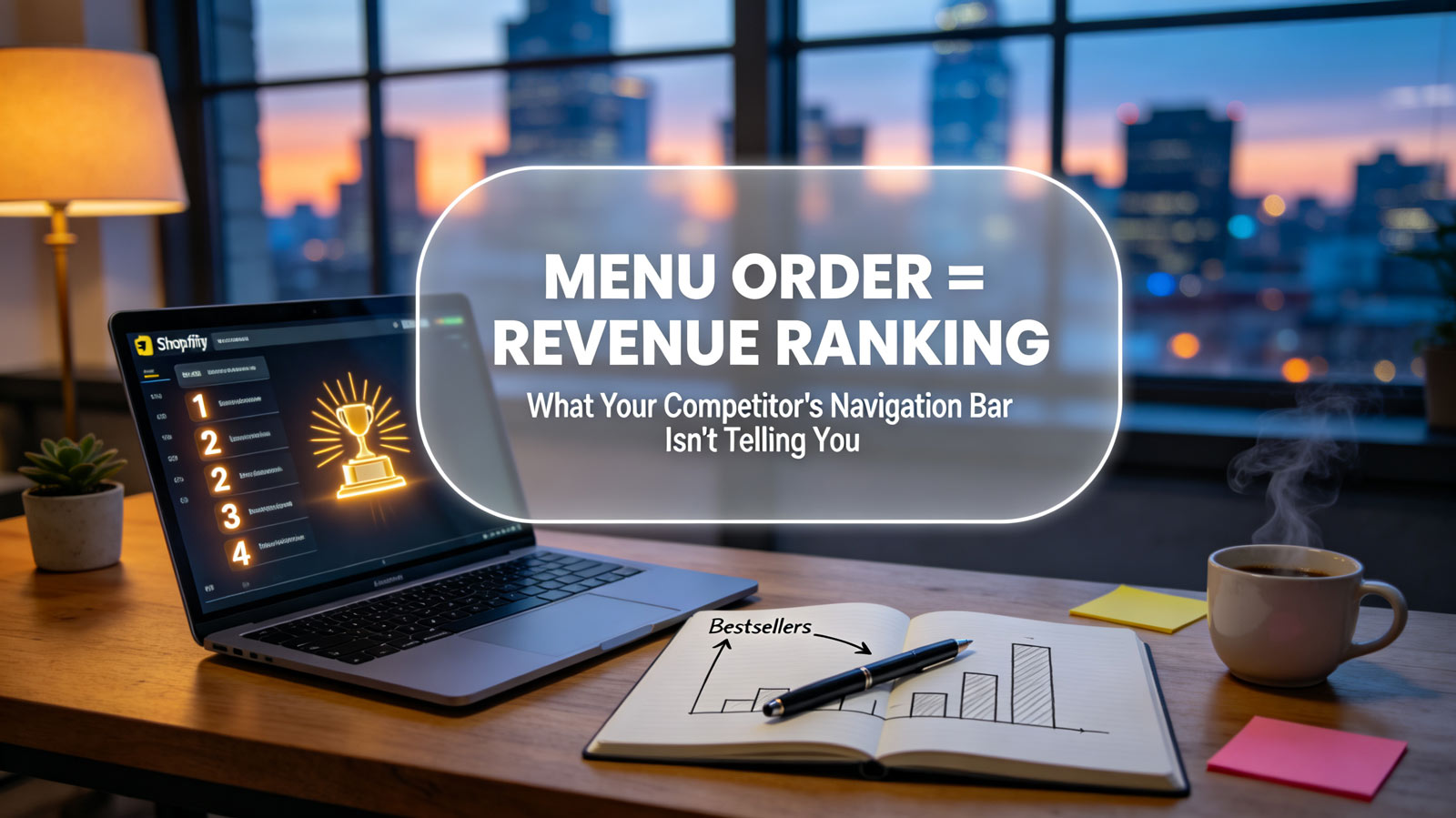
Position Equals Priority: Eye-tracking and click studies converge on the same pattern: leftmost items and the far-right "account/cart" cluster absorb the most attention. Whatever sits in the first two menu slots is what the store's analytics say pays the bills—not what the brand story claims.
-
Reorder History Is Revenue History: Menu order changes rarely because they are high-stakes. When a buried link climbs leftward, it means that collection's revenue share forced the move. When a category slides right, it is being quietly demoted while still saving face on the homepage.
-
The Bar Is a Zero-Sum Game: A navigation bar holds five to seven items comfortably. Every slot given to a new category was taken from an existing one. Reading the order is reading the result of internal resource fights—because every menu position has a revenue number attached to it.
-
Invisible to the Store's Own Narrative: A store never advertises "gifting drives 35% of our December revenue" or "our clearance section outperforms our new arrivals." The menu discloses both, because the menu is built from checkout data, not from brand decks.
The pages designed to persuade are unreliable narrators. The bar designed to convert is not.
First Slots and Buried Links: Reading the Revenue Hierarchy
A single row of five to seven words compresses the entire P&L into a few dozen pixels:
-
The First Two Slots Reveal the Core Business: Whatever opens the menu—"Bestsellers," "New In," a flagship category—is the traffic engine the store cannot afford to demote. A store leading with "Sale" is managing inventory or cash flow anxiety. A store leading with "Collections" is a brand business protecting margin over volume.
-
Hidden Dropdowns Hide High-Margin Business: Subscription links, wholesale portals, gift-card entries, and "corporate gifting" pages almost never appear top-level, yet frequently represent outsized revenue per visitor. If a store buries a link three levels deep, it is protecting a channel from casual browsers—or hiding it from competitors.
-
Seasonal Slots Betray Cash-Flow Rhythm: A "Holiday" or "Back to School" item appearing in the permanent bar signals a business with hard seasonal dependence, not a promotional one-off. Permanent seasonal real estate means the off-season revenue genuinely cannot support the operation without it.
-
Menu-Homepage Mismatch Flags Misaligned Strategy: When the hero pushes one category and the menu ranks another first, the store is in transition: marketing chasing a dream, analytics reporting reality. The menu version of the story is the one backed by bank deposits.
Shoppers see a directory in the menu. Analysts see a revenue ranking written in link order.
The Dead Ends: What Missing Menu Items Reveal
Absence in the navigation bar is as informative as presence. What a store chooses not to feature discloses its constraints:
-
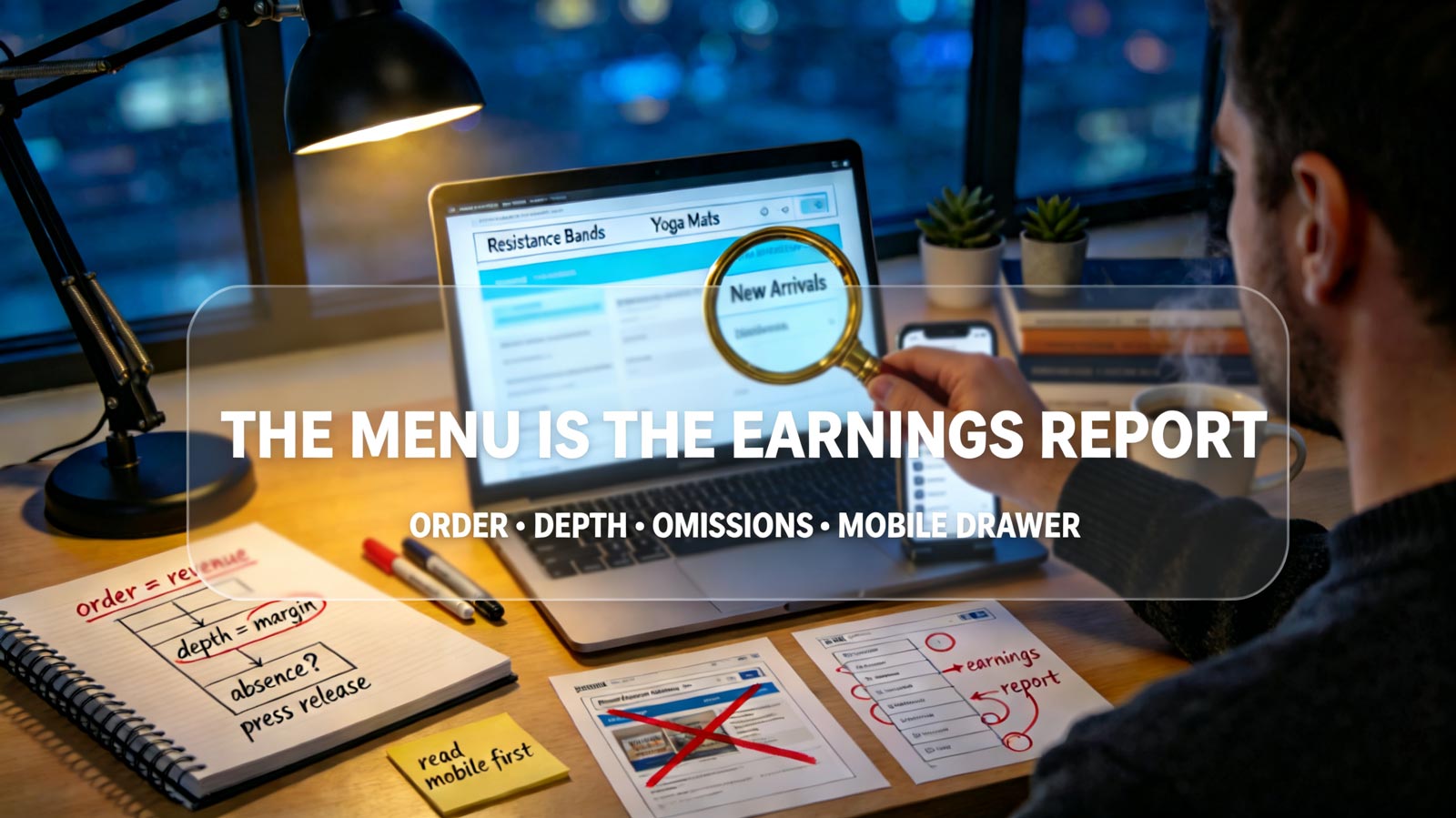
No "New Arrivals" Means Thin or Stale Inventory: A store without a freshness slot is either a curated single-line brand or an operation that replenishes slowly and cannot afford to spotlight how rarely it changes. Fast-moving stores always promote newness; stagnant ones cannot.
-
No Sale Section Signals Margin Discipline—or Fragility: Absence of clearance real estate suggests either premium positioning with the margin to sustain it, or a dropshipper with no warehouse to liquidate. The surrounding signals—price points, review depth—resolve which.
-
No Gifting or Registry Link Undervalues Its Own Buyers: Stores without gift-oriented navigation are leaving repeat, high-AOV, low-return traffic unmonetized. For a competitor, that gap is a positioning wedge: the market already buys this store's products to give away, and the store itself has not noticed.
-
Menu Length Maps Operational Maturity: A five-item bar with tight, named collections belongs to a focused operation with deliberate inventory. A sprawling fifteen-item mega-menu betrays either a general store with no center, or a catalog business where navigation itself is the product strategy.
What a store leaves out of its most valuable real estate tells you what it cannot afford to show.
Reading the Competitor's Menu Before Copying Its Strategy
Menu forensics turns one minute of observation into a strategic briefing:
-
Replicate the Order, Not the Products: A competitor's menu sequence is a free A/B test report run on your shared customer base. If "Bestsellers" leads their bar and your store buries its equivalent, the fix costs one theme edit, not one product cycle.
-
Find the Channel They Cannot See: Their buried wholesale link, missing gift navigation, or absent subscription entry is an underserved demand segment they have already proven with their own traffic—still unclaimed in your store, in your market.
-
Time Your Entry Against Their Rhythm: Permanent seasonal slots reveal exactly when their cash flow peaks and their attention slips. Launching competing products just before their seasonal slot gets its annual promotion catches them flat-footed, every year, on schedule.
-
Cross-Check with Live Data: Menu order tells you what they believe; store analytics tell you what is true. Pull their real-time traffic and product data to verify whether the first menu slot is genuinely their revenue engine or a legacy position they have not dared to change.
The menu is a hypothesis. The data is the confirmation. Use one to decide where to look with the other.
Conclusion
The navigation bar is the most expensive sentence a store ever writes, priced in forgone clicks for every word it leaves out. First slots rank the revenue hierarchy, buried links hide the high-margin channels, and missing items confess the constraints no homepage will admit. None of this requires access, tools, or inside knowledge—only the discipline to read the bar before the banner. Every competitor's hero section describes the store it wishes shoppers would see. Its menu order describes the store its own checkout data has already proven.