Introduction
A sustainability claim used to be a story a brand could tell once the product had already won attention. In 2026, the sequence has inverted. Shoppers increasingly examine the wrapper, box, insert, label, refill path, and disposal instruction before they decide whether the claim deserves belief. Packaging is no longer the last layer of the message. It is the first piece of evidence.
This shift is easy to miss because the visible market still rewards big claims: carbon neutral, ocean bound, plastic negative, compostable where facilities exist. But the customer has become more procedural. The question is no longer only “does this brand care?” It is “what exactly did they change, what material is this, can I verify it, and what happens to it after I open it?” Packaging now answers those questions before customer service ever gets the chance.
The result is a new conversion hierarchy. Product still opens the door. Packaging decides whether trust survives the threshold.
The Material Audit Has Moved Upstream
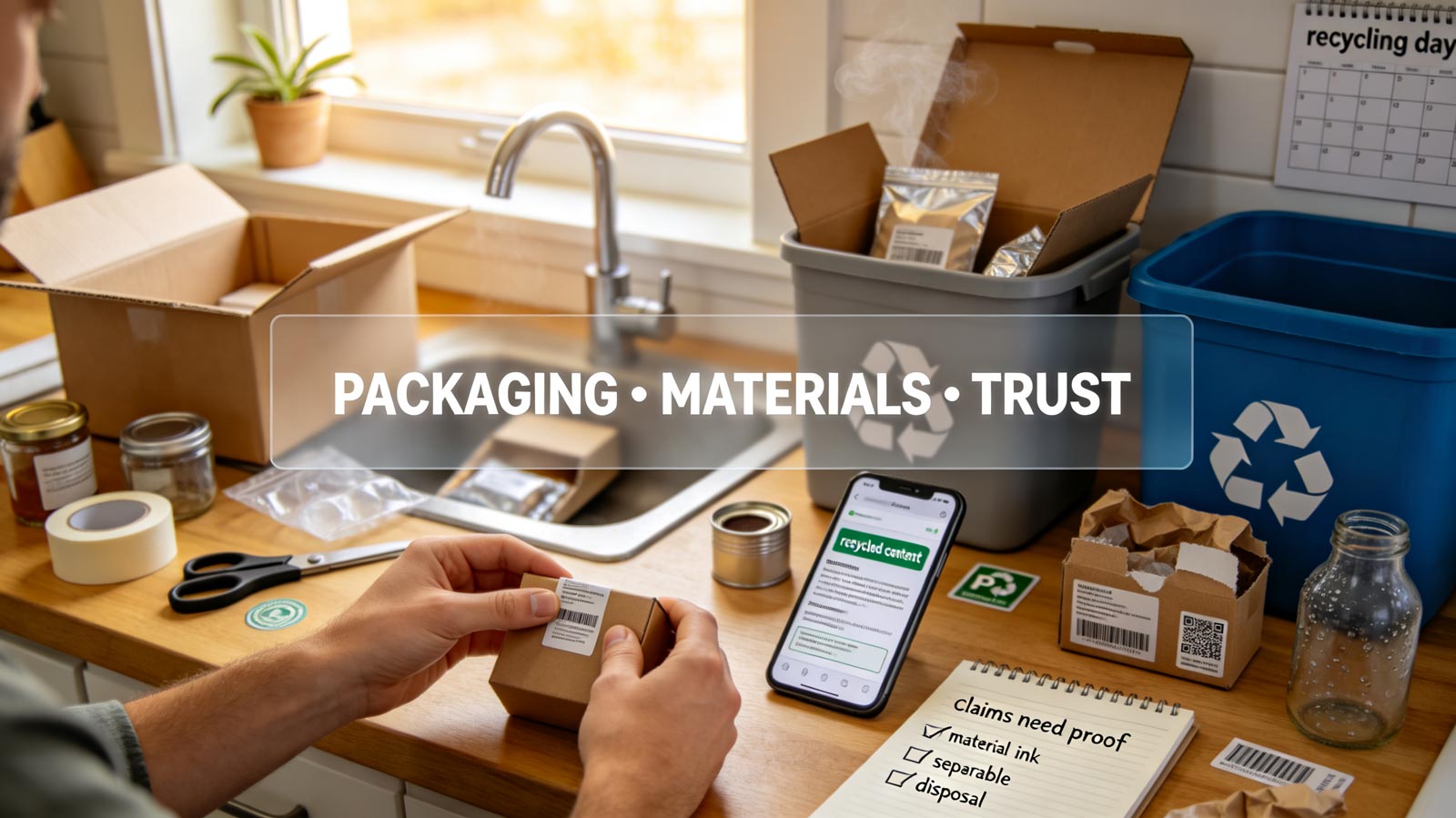
The audit used to happen after disappointment. A customer would buy, use, notice waste, and then judge the brand. Now the inspection happens at the shelf, in the unboxing video, in the review filter, and in the recycling bin.
-
The Bin Test: A shopper holding packaging over the recycling bin is performing a brand audit in real time. If the material is mixed, coated, dyed, or glued in a way local facilities cannot process, the claim loses credibility instantly.
-
The Label Test: Vague language now reads as risk. “Eco-friendly” creates more doubt than a plain material statement because the customer knows the phrase is doing work that specifics should do.
-
The Weight Test: Excess packaging feels louder than it used to. A tiny item in a rigid box, wrapped in plastic, inside another box does not merely look wasteful; it looks careless. Carelessness undermines claims about intention.
-
The Refill Test: Reusability is judged by the second purchase. If the refill is hard to find, expensive, or packaged worse than the original, the sustainability message collapses into a premium trap.
The audit is not always articulate. Many shoppers will never say “I rejected this because the mono-material claim was not credible.” They will simply describe the product as “not really sustainable,” return it, or quietly choose the competitor whose packaging looks easier to defend.
Green Claims Are Now a Conversion Risk
For years, sustainability language was upside: if some customers loved it, others ignored it. That balance has weakened. Claims now carry exposure because customers are looking for proof and regulators are looking for precision.
-
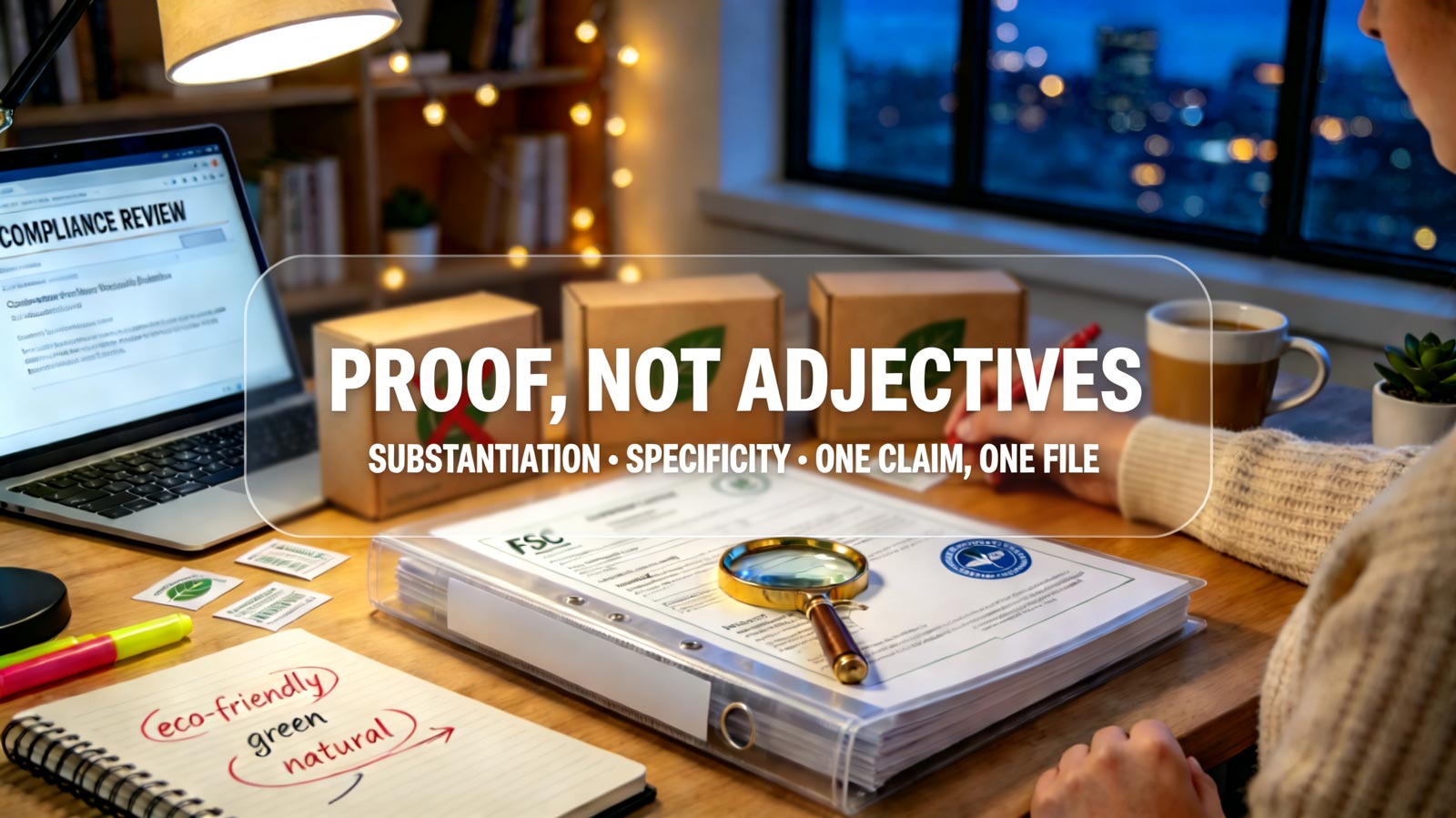
Generic Claims Are Liabilities: Broad phrases invite skepticism from buyers and scrutiny from platforms. The safer copy is narrower: recycled percentage, material source, reduction versus prior packaging, end-of-life instruction.
-
Proof Must Be Local: A package described as recyclable in one region may be landfill in another. The customer does not blame the municipality; the customer blames the brand for speaking globally while acting abstractly.
-
Mismatch Becomes Evidence Against the Product: A compostable mailer around a non-recyclable mixed-material product reads worse than ordinary plastic, because the contrast suggests the brand knows what good looks like and chose theater instead.
-
Reviews Are Packaging Reviews Now: “Great product, ridiculous box” is no longer a minor complaint. It is a sustainability verdict repeated in public, indexed by search, and remembered by the next buyer.
The practical consequence is blunt: packaging can raise conversion only when the claim and the object agree. When they diverge, the same package that once signaled values now signals manipulation.
What Shoppers Actually Check
The audit is not mystical. It follows a sequence, and each step creates a place where trust is either earned or lost.
-
Material Identity: What is this made of? Paper, glass, aluminum, PCR plastic, bio-based film, mixed laminate. Shoppers do not need a chemistry degree, but they recognize opacity. A label that names the material plainly beats a badge that celebrates intention.
-
Construction: Can this be separated? Is the window glued to the paperboard? Is the pump metal and plastic fused? Is the pouch layered? Recyclability is often lost at the joint, not in the material.
-
Ink and Finish: Heavy coatings, metallic foil, soft-touch laminates, and dark dyes can make even paper feel less recyclable. Finish is now part of the sustainability read.
-
Right-Sizing: Does the packaging match the product’s vulnerability? Customers accept protection; they reject performance. A dented mailer can be forgiven. A shoe-sized box for earrings cannot.
-
End-of-Life Instruction: “Recycle me,” “check locally,” “compost industrially,” “remove pump before recycling.” Instruction is not fine print anymore. It is part of the product experience.
-
Consistency Across the Line: One honest SKU does not save a portfolio of overpackaged variants. Customers generalize. A brand is judged by its worst visible habit.
None of these checks requires perfection. They require legibility. Shoppers are not asking every brand to become circular overnight. They are asking whether the brand knows the difference between a claim and a fact.
The New Packaging Economics
Packaging used to be evaluated as cost per unit and damage rate. It now has a third dimension: claim credibility.
-
Cheaper Can Be More Expensive: A laminate that reduces freight damage but blocks recycling may protect the product while taxing conversion. The savings show up in operations; the loss shows up in hesitation, returns, and review language.
-
Minimalism Needs Precision: Removing packaging is powerful only when the product still arrives intact. The sustainability winner is not the brand with the emptiest box. It is the brand with the least material that still performs.
-
Verification Is Becoming Part of Merchandising: Certifications, batch language, QR codes, material breakdowns, and supplier notes are moving from compliance folders to product pages. The customer wants the receipt before the purchase.
-
Premium Packaging Must Justify Itself: Luxury still has permission to be beautiful, but beauty now needs a reason. Reusable rigid boxes, keepsake tins, and refillable vessels earn their cost by extending life. Single-use grandeur is being repriced by the customer.
This changes sourcing conversations. Packaging is no longer a procurement afterthought delegated to the factory default. It is a visible product feature with consequences for CAC, conversion, repeat rate, and review velocity.
ShopFindBiz Perspective
Through a store-analysis lens, packaging credibility is visible before a customer ever buys. Product pages increasingly carry the evidence hierarchy: material callouts near the title, end-of-life instructions near the add-to-cart button, certifications in the image stack rather than buried in policy pages, and review filters that surface “packaging,” “waste,” “plastic,” and “box.” Stores winning this shift make proof easy to find. Stores losing it make the customer excavate.
The competitive tell is often in the review language. When buyers start praising “minimal packaging,” “paper tape,” “no plastic,” “recyclable everything,” or “refill actually works,” the message has moved from compliance to moat. Conversely, when a product’s best feature is repeatedly paired with packaging regret, the store has a silent conversion tax that ads cannot diagnose.
Benchmark the category. If leaders are publishing material percentages, removal instructions, refill economics, and local recycling guidance, vague claims will begin to look older than they are. If nobody in the niche is doing it well, the opening is larger: the first store to make packaging proof legible can own trust before it owns share.
From Shelf Signal to Operating Change
The response is not to decorate the box with greener language. It is to make packaging evidence easier to audit.
-
Name the Material Plainly: Replace slogans with facts. Say what the package is, what percentage is recycled, what part must be removed, and where it goes next.
-
Design for Separation: Favor structures that can be taken apart by a normal person in under ten seconds. If separation requires tools, scissors, and optimism, design again.
-
Right-Size by Damage Data: Cut volume using actual transit performance, not aspiration. A smaller package that arrives broken is not sustainable.
-
Make Refills Easier Than Rebuys: If the model depends on repeat use, the refill must be cheaper to find, simpler to order, and cleaner to dispose of than the original.
-
Bring Proof Forward: Put material facts in the first image, the first bullet, and the FAQ. Do not make a motivated customer hunt for the reason to believe.
-
Audit Review Language Monthly: Treat “packaging,” “plastic,” “waste,” and “box” as conversion keywords. They reveal whether the promise and the object agree.
The test is simple: can a skeptical shopper explain, after thirty seconds, what the packaging is made of and what to do with it? If yes, the claim has become proof. If no, the store is still asking for trust it has not packaged yet.
Conclusion
Packaging has crossed from message to evidence. Shoppers no longer separate the promise from the object that carries it; they judge the claim by the material, the construction, the finish, the size, and the disposal path in their hands. This is not a niche preference. It is becoming a default filter through which modern products earn belief.
The winners will not be the brands with the loudest sustainability language. They will be the brands whose packages can survive inspection in the kitchen, the bin, the review box, and the reorder. In e-commerce, where touch is delayed, packaging is often the first physical sentence a brand speaks. Make it factual, make it separable, make it right-sized, and make it easy to dispose of correctly. Proof does not need to be dramatic. It needs to be checkable.