Introduction
Every price a store has ever charged is public information. Yet most sellers never look at it.
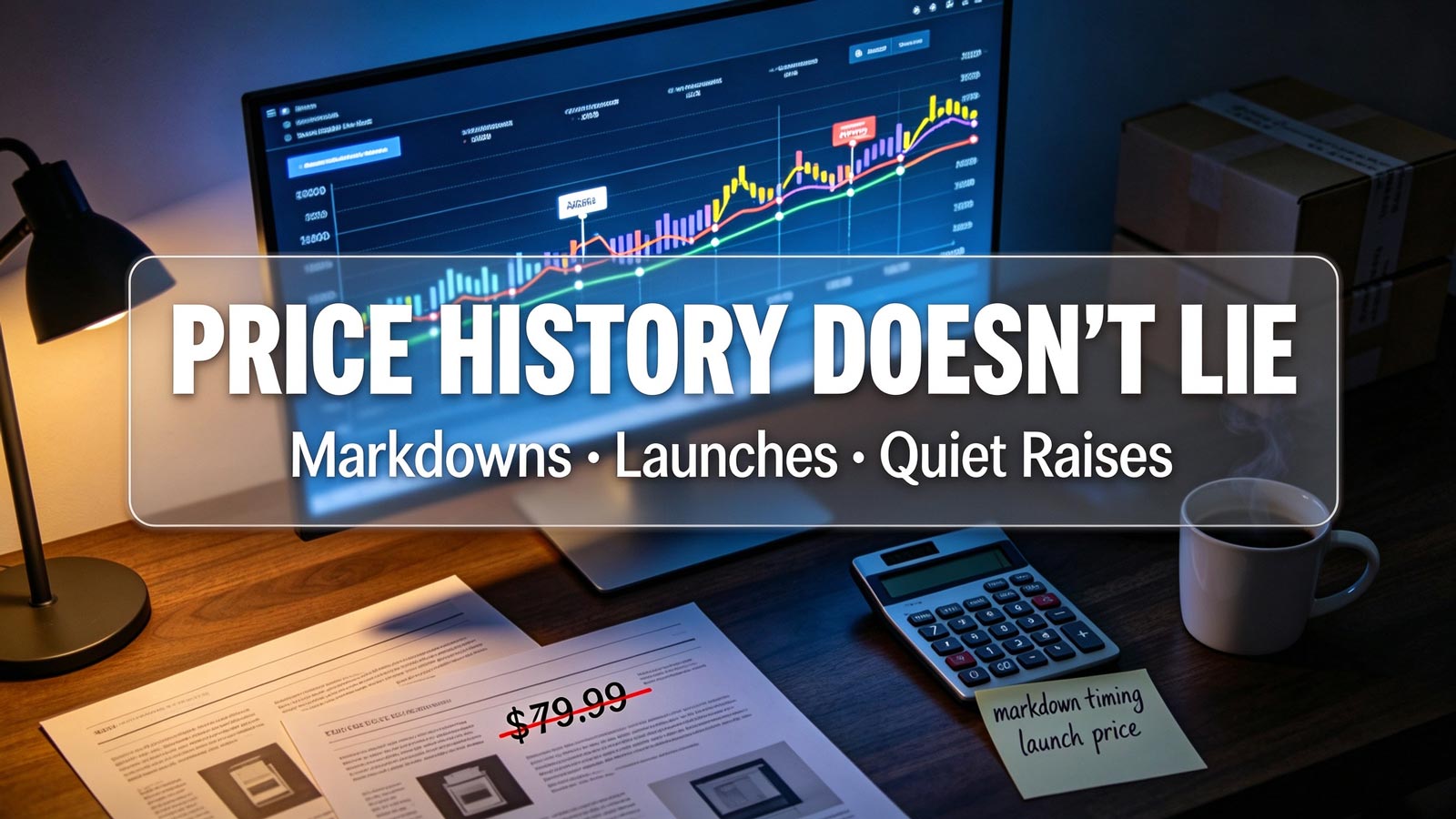
That competitor's mug was $29 last week. Today it's $19. Most sellers see a sale. Analysts see ten dollars of intelligence. Every price change a store makes — a markdown, a launch price, a quiet $1 bump — is a confession. It reveals margin structure, inventory pressure, and how much faith the brand has in its own product. The problem isn't access to this data. It's that most sellers never think to read it.
This article breaks down the three pricing moves every serious store makes: how they time markdowns, how they price launches, and how they raise prices without anyone noticing. For each one, we'll cover what the move actually tells you — and how to turn a competitor's pricing trail into your own competitive advantage.
The Psychology Behind Retail Pricing Moves
Before decoding specific tactics, it helps to understand the psychological machinery underneath them.
Anchoring is the engine behind almost every markdown. When a store shows "$49.99 ~~$79.99~~," it's not selling a $50 product — it's selling the gap. The original price exists to make the current price feel like a win, not a transaction.
Charm pricing isn't about looking cheaper. Research consistently shows odd endings signal "deal," while round numbers signal "premium." Watch when a store switches between them — that transition is one of the most underrated signals in price history data, and we'll come back to it.
Decoy pricing uses a deliberately expensive option to make the mid-tier look reasonable. A store offering Basic at $19, Pro at $49, and Premium at $129 doesn't expect anyone to buy Premium. It's there to defend the $49 tier.
Bundle pricing obscures per-unit value, making price comparisons harder for both customers and competitors. When a store starts bundling aggressively, it often means the standalone product isn't converting — or margins are being squeezed and they need to protect perceived value.
None of these are secrets. The secret is the timing — and timing is exactly what price history exposes.
Markdowns: Reading the Inventory Confession
Every markdown answers one question: why now?
Different industries follow distinct markdown rhythms, and each rhythm tells you something different:
-
Apparel typically cuts 4–8 weeks after launch, with deeper drops at season changes. A fast first markdown signals weak sell-through or an overconfident purchase order. A slow, deep markdown signals a brand protecting its positioning until the last possible moment.
-
Electronics runs the reverse curve: launch high, hold, then slide as the next model approaches. The slope of that slide tells you how much inventory is left. A steep late-stage drop almost always means "we're clearing the warehouse."
-
Grocery and consumables fluctuate weekly, tied to stock age and local competition. Frequent shallow discounts suggest inventory discipline problems. Infrequent deep ones suggest strong demand or a deliberate scarcity play.
Here's the seller application: if a competitor's hero product has been at full price for 90 days and suddenly drops 30%, that's not a sale — that's a cash-flow event. Something upstream broke. It might be the moment to push your competing product, because their margin cushion just vanished and they can't afford to match your price.
Launch Pricing: Why New Products Never Start Cheap
This is the move most sellers misread, because they price their own launches emotionally and assume everyone else does too.
Top stores almost never launch at their intended long-term price. They launch high, and for a specific reason: the launch price isn't a revenue tool — it's an information-gathering tool.
An $89 launch that quietly becomes $69 after six weeks accomplishes three things. First, it captures maximum revenue from early adopters, who are the least price-sensitive buyers a product will ever have. Second, it establishes an anchor that makes the eventual $69 feel like a deal rather than the real price. Third, and most useful for you: the timing of that drop reveals their real margin structure.
If a store holds launch price for months, they're either confident in demand or burning cash on ads and need the margin. If they discount quickly, the launch underperformed — which means the product, the angle, or the audience targeting missed.
For dropshippers and product researchers, this is gold. A competitor's failed launch pricing tells you more than their winning ads do: it tells you what the market wouldn't pay — the most expensive lesson they just paid for, and you got it free.
Quiet Raises: The Price Changes Nobody Notices
The most instructive moves in any price history are the smallest ones.
Stores raise prices constantly — just never all at once. The standard playbook:
-
Micro-increments under 5%, spaced out so no single change triggers complaint thresholds
-
Packaging changes as cover — new label, same product, +$2
-
Shrinkflation in consumables: less product, same price, higher per-unit margin
-
Loyalty program pricing, where "member prices" quietly become the real prices and list prices drift upward
Why does this matter to you as a seller? Because a competitor who is raising prices is telling you something valuable: their demand is inelastic, their brand equity is working, or their costs went up and they can pass them through. Any of those three means the market will tolerate a higher price than you're currently charging.
Conversely, if a store is quietly raising prices while losing review velocity, they're milking a dying product. That's your window.
Watch also for the charm-pricing flip we mentioned earlier: when a store moves from $39.99 to $40, or from $49.95 to $50, they've made a deliberate branding decision to trade "deal signal" for "premium signal." That rarely happens by accident — it usually precedes a repositioning or a new product line at higher price points.
How to Actually Track This (Without a Spreadsheet Addiction)
Everything above is only useful if you can see these patterns across dozens of competitors without manually checking product pages every morning.
This is exactly what ShopFindBiz's Price History Tracking (Pro) was built for. Instead of screenshotting product pages and hoping you remember to follow up, you can:
-
Add competitor stores or products to your tracking list and get their full pricing trail
-
Set alerts for price drops or increases on specific products, so a competitor's markdown shows up in your inbox instead of in their ad creative two weeks later
-
Compare pricing timelines across competitors in the same niche — when three stores discount in the same week, that's usually a supplier-level or seasonal signal, not a coincidence
-
Correlate price changes with launch dates using Store Created Date data, so you can see the full launch-to-markdown lifecycle of products in your niche
The goal isn't to spy for spying's sake. It's to stop discovering competitor moves through their Facebook ads — which is how you find out when it's already too late to react.
Conclusion
Price history is the closest thing e-commerce has to a competitor's diary. Markdowns confess inventory problems. Launch pricing confesses margin structure and confidence. Quiet raises confess demand strength.
Most sellers will keep reading competitor ads. The better move is reading the numbers the ads are trying to distract you from. Pull the price history on your top five competitors today — the patterns are already there, dated and documented, waiting for someone to take them seriously.