Introduction
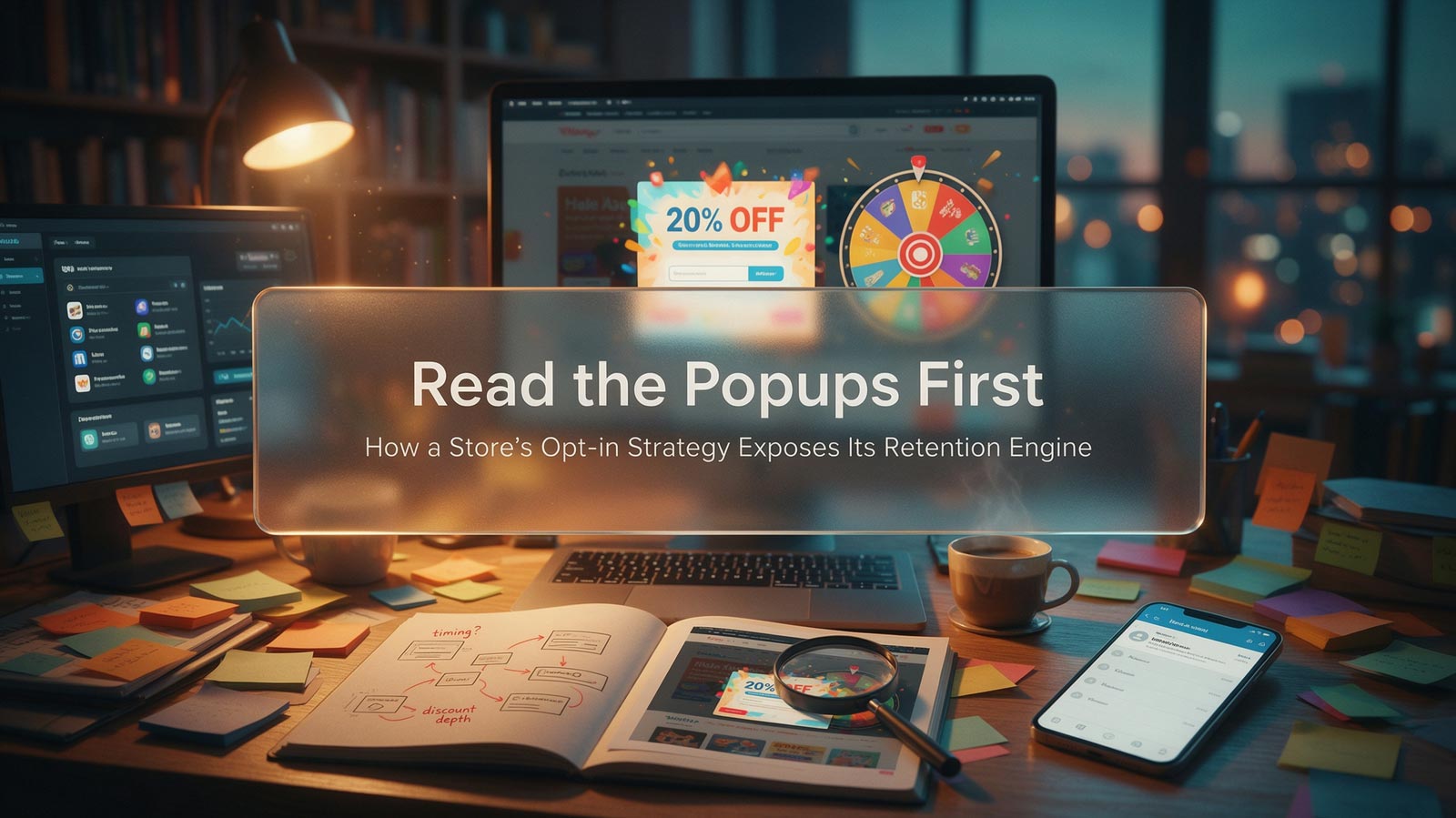
A popup is the closest thing e-commerce has to a public financial statement. Every discount depth, trigger timing, and opt-in offer is a deliberate economic decision — and it's sitting on your competitor's storefront, visible to anyone who knows how to read it. Before you tear down a store's ads or pricing, read its overlays: they'll tell you whether that store profits from repeat buyers or bleeds cash renting new ones, and exactly where its defenses are weakest.
Why Overlays Reveal the Retention Engine
Every store with real margins eventually faces the same question: do we re-acquire customers or keep them? The answer shapes everything downstream — email infrastructure, discount policy, even catalog design. And because opt-in prompts are the front door of that machine, the machine's condition shows through them.
A store that profits from repeat buyers can afford restraint: modest offers, patient timing, polished post-signup flows. A store that churns customers must compensate at the front door — deeper discounts, aggressive timing, anything to convert the visitor it already paid to acquire. In other words: the more desperate the overlay, the leakier the retention engine behind it. That's the lens. Here's the field guide.
The Field Guide: What Each Pattern Reveals
- Discount depth. A 5% offer means the store just wants your address — list-building mode. A 25% offer means one of two things: margins thick enough to absorb it, or acquisition costs so high that surrendering a quarter of the first order beats losing the customer. Both are useful intelligence; the second tells you its paid traffic is expensive.
- Trigger timing. Entry overlays say the store can afford to annoy visitors — its traffic is cheap or its brand is strong. Exit-intent-only says the opposite: every visitor is precious, so traffic likely costs real money. A 30-second delay with scroll conditions says someone there runs experiments and reads data.
- Spin-to-win wheels. Almost always a sign of a cash-hungry list build. The emails collected convert poorly, which the store either doesn't know yet or doesn't care about — both reveal inexperience.
- Email + SMS double capture. A store only asks for your phone number when lifetime value justifies the intrusion — think consumables and replenishment categories. If a store in your niche is doing this, its repeat-purchase economics are proven.
- No overlay at all. Either direct and organic traffic dominate (a brand moat you can't out-shout) or nobody owns retention (an open door). Five minutes in an email-testing tool tells you which.
- The promise vs. the delivery. Subscribe with a throwaway address and watch what happens. No welcome email within an hour? The retention engine is decorative — the store talks retention and runs none. A five-email welcome sequence with segmentation? That's a real machine, and it will defend its customers.
What the Tech Stack Confirms
The overlay itself is one signal; the software powering it is another. A store intelligence tool like ShopFindBiz shows you the apps running behind any storefront. A Klaviyo-powered flow means a serious monthly software spend — retention is a budget line, not an afterthought. A bare-bones free tool usually means the founder is doing email manually or barely at all. Combined with total app count, theme quality, and traffic estimates, you can place a competitor's retention maturity on a scale in a single scan — before you've read a single email.
A Walkthrough: Reading a Store in Ten Minutes
Here's the process end to end — a realistic scenario based on typical patterns. A seller is sizing up a competitor in the supplements niche.
First visit: an entry overlay offering 20% off plus a spin-to-win for "extra prizes," capturing email and phone together. First read: expensive traffic, aggressive list build, proven replenishment economics. Second check: ShopFindBiz scan shows a mid-range theme, seven apps, no visible email platform — the overlay is a free popup tool, not Klaviyo. Third test: a throwaway signup produces a single 10% code email, then silence for a week.
The diagnosis writes itself: this store acquires hard and retains almost nothing. Its customers bought once at 20% off and were never seen again — which means a warm audience with proven category spend and zero loyalty holding it. The attacking seller builds the welcome sequence, the replenishment reminders, and the loyalty offer the competitor never bothered with, and courts that orphaned customer base directly.
From Diagnosis to Action
Reading overlays only matters if it changes what you do:
- Engine is decorative (aggressive prompt, no follow-through): its customers are your prospects. Out-retain it — win on welcome flows, post-purchase care, and replenishment timing — and you don't need to outspend its ads.
- Engine is a real machine (polished sequence, serious stack): don't fight it on its turf. Compete on product differentiation, community, or price structure instead.
- Nobody in the niche does retention: this is the common case, and it's the opportunity. The first store in a category to build a genuine email and loyalty engine quietly harvests the repeat-purchase profit everyone else leaves on the table.
Then point the same lens inward. Subscribe to your own store with fresh eyes and time the welcome email. Whatever you find is what your competitors find when they read yours.
Conclusion
You can learn more about a store's business model from thirty seconds on its homepage than from an hour in its ad library — the overlay has already confessed its CAC, its margins, and the state of its retention engine. Read the prompts before you read the products. The stores that look loudest are often the ones retaining least, and their customers are waiting for someone — maybe you — to treat them better.