Introduction
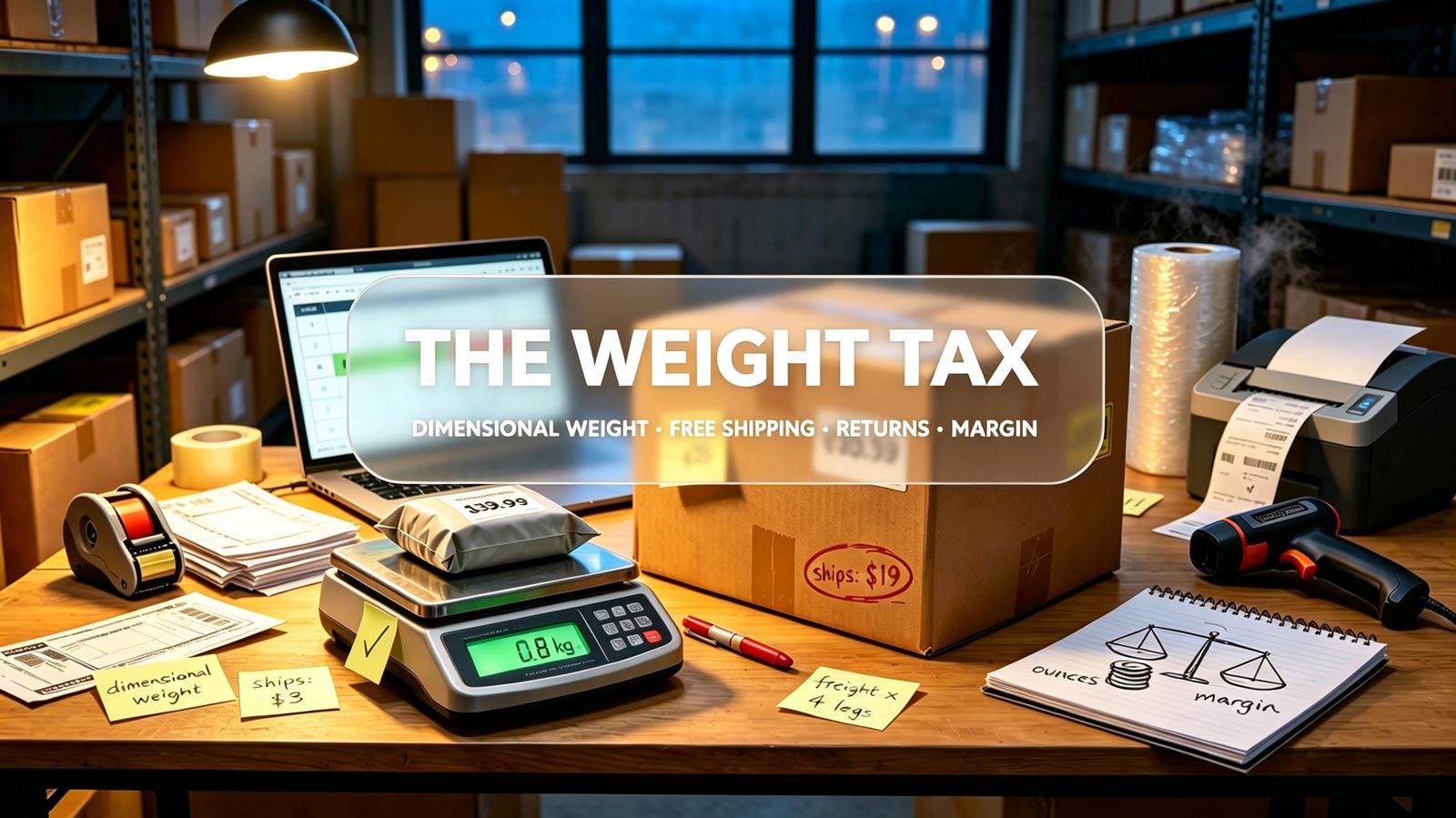
Two products can share the same price tag, the same ad account, and the same conversion rate — and deliver opposite margins. The difference is never on the product page. It's on the scale. Shipping weight works like a silent tax that compounds at every stage of the business: inbound freight, fulfillment, the free-shipping expectation, and the return that comes back at your expense. This guide breaks down why the lightest products in your niche often carry the healthiest margins, where the weight tax actually compounds, and how to make ounces part of your sourcing criteria — before the freight invoice makes the decision for you.
Why Weight Is a Margin Variable Most Sellers Ignore
Price is visible. Weight is buried. That's exactly why it quietly decides profitability:
-
Carriers price volume, not just mass. Dimensional-weight pricing means a large, light box can cost as much to ship as a dense, heavy one — and a genuinely heavy product pays both penalties at once. Sellers who model shipping by product weight alone routinely underestimate the real cost by 30% or more.
-
The tax repeats at every leg. Factory to port. Port to warehouse. Warehouse to customer. Customer back to warehouse on the return. Every leg multiplies the same number, which is why heavy products don't just cost more to ship — they cost more everywhere, all the time.
-
Free shipping moved the cost onto you. Buyers now treat "free shipping" as a default setting, not a perk. On a lightweight product, absorbing it is a rounding error. On a heavy one, it's often the entire margin of the order — which forces either a price hike that kills conversion or a subsidy that bleeds quietly with every sale.
The bestseller list doesn't rank products by margin. It ranks them by sales — and heavy products can top the revenue chart while quietly losing the profitability one.
Where the Lightweight Advantage Actually Compounds
Read the same business through a lighter lens and the advantages stack:
-
More margin per order, same AOV. A $39.99 silicone kitchen set and a $39.99 cast-iron set convert identically. One ships for a few dollars; the other ships for the price of a second product. The difference lands directly in contribution margin — every order, forever.
-
Returns stop bleeding. Return shipping on heavy items is where profit margins go to die: the product comes back at your expense, often unsellable, and the refund includes shipping you can never recover. Light products keep return economics survivable — sometimes cheap enough that generous return policies become a conversion weapon instead of a liability.
-
Freight flexibility opens doors. Lightweight products qualify for air freight, ePacket-style economy lines, and overseas fulfillment options that heavy goods simply can't use. That means faster restocking, smaller test batches, and the ability to validate a product with hundreds of units instead of thousands.
-
Bundles and samples get cheaper to build. Adding a lightweight accessory to every order costs cents and lifts AOV. Sending samples to creators costs little. Every growth tactic that involves moving physical goods gets cheaper when the goods are light.
Two sellers running identical stores can end the year with opposite P&Ls — and the scale in the warehouse explains most of the gap.
What Weight-First Sourcing Looks Like in Practice
A realistic scenario based on typical patterns: a seller narrowing down two kitchen-category finalists, both retailing at $39.99 with similar supplier quotes. Option A is a four-piece cast-iron cookware set — visually premium, strong reviews on competitor listings, an obvious "hero product" on paper. Option B is a foldable silicone baking-mat set with measuring guides — less glamorous, similar demand signals.
The seller runs the weight math before falling in love with either. Option A: 9.5 kg packed, dimensional weight unfavorable, inbound freight quote painful, and a return would cost nearly the product's margin to ship back. Option B: 800 g packed, qualifies for economy air, bundles a $7 recipe-guide accessory for cents, and a return is a cheap envelope. Twelve months in, the two listings convert within a few points of each other — but the silicone set carries roughly double the contribution margin per order, survives its returns at near-zero cost, and restocks in days instead of months. The cast-iron listing looks better in screenshots. The silicone listing pays better in the bank account.
The Weight-First Discipline
Ounces belong in your sourcing checklist, next to margin and demand. Four rules keep them there:
-
Weigh before you commit. Ask every supplier for the packed weight and carton dimensions — not the product weight — and price shipping on dimensional weight, not hope. A product that only works at imaginary freight rates doesn't work.
-
Model the full journey, not the first leg. Freight, fulfillment, the free-shipping subsidy, and the average return cost all multiply the same weight. If the math only holds when returns are zero, the math doesn't hold.
-
Use weight as a research filter. When comparing candidates, screen by grams-per-dollar-of-retail-price early, before creative work and listing builds make the decision emotional. Lightweight is a pre-filter, not an apology.
-
Let data confirm the demand side. Weight tells you the cost structure; store intelligence tells you the demand. A tool like ShopFindBiz can show whether the lightweight candidates in your niche actually sell — so you keep the margin advantage without stepping into a demand desert.
Reading Your Own Catalog
Run the audit on what you're already selling:
-
Your heaviest SKU is a margin audit waiting to happen. Pull its true all-in shipping and return costs. If the contribution margin is thinner than you assumed, the fix is usually positioning it as a bundle anchor — paired with something light — rather than discounting it into more volume.
-
Your lightest sellers are under-leveraged. Lightweight products are your cheapest bundle riders, samples, and giveaways. If they aren't attached to heavier orders, you're paying full freight on packages that could have carried free profit.
-
The gap between the two lists is your next test. Compare your best margin-per-order products against your best sellers. If the sets don't overlap, the winners-by-revenue are subsidizing the winners-by-margin — and the fix is a weight-aware refresh of the catalog.
Conclusion
Shipping weight is the most honest line item in e-commerce — it can't be negotiated by copywriting, upsold by photography, or optimized by an app. It compounds quietly at every stage of the journey, rewarding light products and taxing heavy ones with perfect neutrality. The sellers winning on margin aren't always the ones with the best products or the biggest ad budgets. They're the ones who put the product on the scale before it went in the cart — and let ounces vote on every sourcing decision.