Introduction
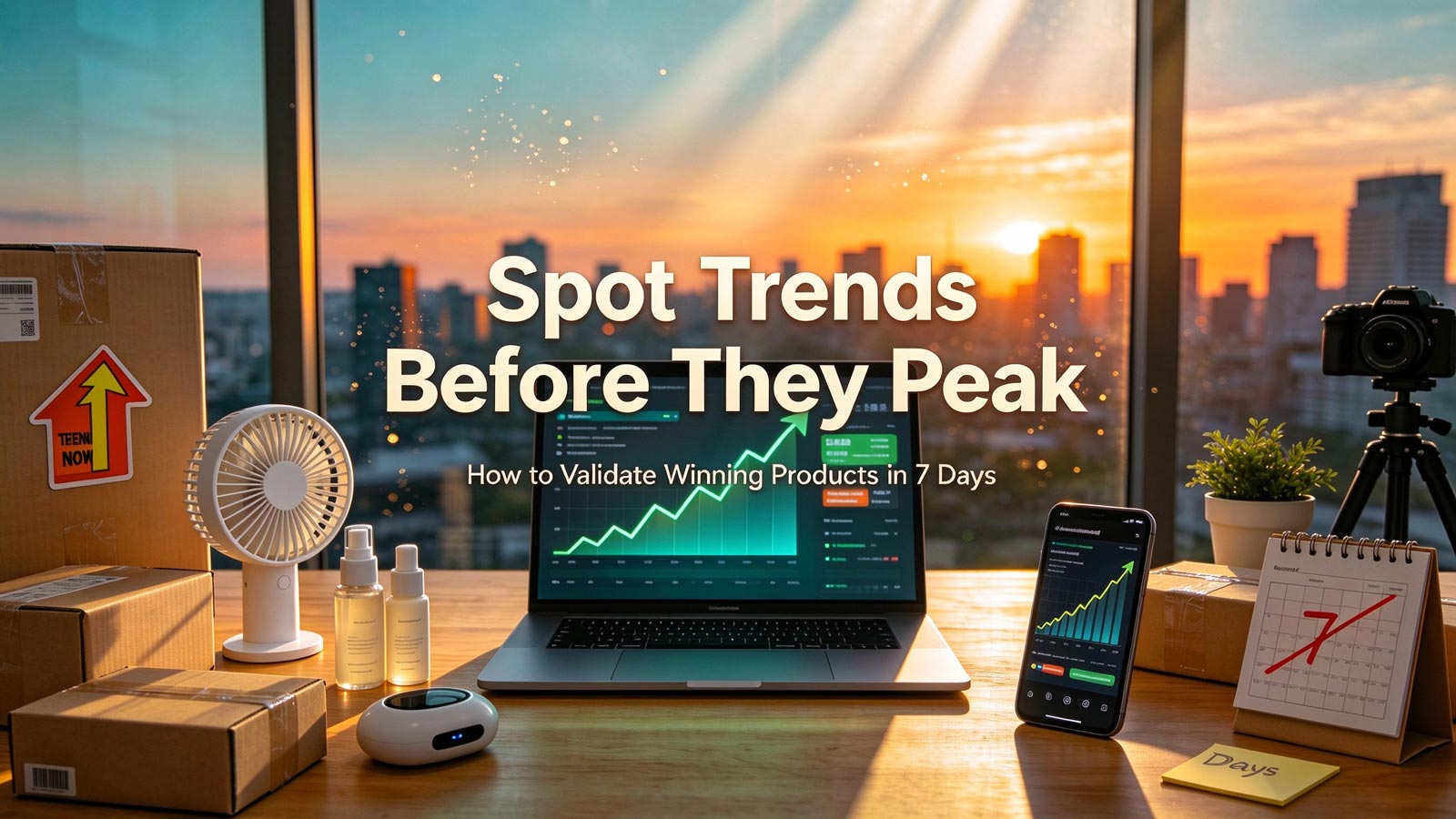
Most trending products have a 6–8 week window before saturation. Miss the first two weeks, and you're competing on price against hundreds of sellers who got there first. Catch it early, and the same product can carry your store for a quarter. This guide gives you a proven 7-day framework for validating any product idea before it peaks.
Understanding Market Trends and Product Validation
Product validation means testing a product's real-world potential before committing resources to it. Three signal categories tell you whether a trend is still worth entering:
Social Media Buzz. TikTok, Instagram, and Pinterest are the earliest indicators — but look past raw volume. A hashtag with 200K posts growing 40% week-over-week matters far more than one with 2 million posts growing 5%. Rising acceleration is what you're after.
Search Engine Data. Google Trends reveals whether interest is climbing or cooling. In the 90-day view, a trend worth entering shows a steady upward slope, not a vertical spike followed by a plateau — a spike usually means you missed the wave.
Competitor Analysis. Use a tool like ShopFindBiz to see how many stores already stock the product, their real sales velocity, and how recently they launched. Rising demand with only a handful of sellers is the sweet spot; rising demand with 300 entrenched competitors is a trap.
If all three signals point up, run the framework. If two point flat or down, don't spend a dollar yet.
The 7-Day Product Validation Framework
Day 1–2: Market Research and Trend Analysis
Shortlist 3–5 candidates, then filter:
-
Margin math first. You generally need a 3x markup minimum to survive ad costs. Landed cost $8 and comparable retail $24.99 works; retail $14 doesn't. Kill failures on Day 1 — no exceptions.
-
Problem or impulse? Products that solve a specific, named problem convert more reliably than pure impulse buys.
-
Saturation check. Inspect the top 10 sellers: review counts, launch dates, and whether prices are holding or collapsing. Prices sliding under $15 signal a late-cycle trend.
Pick one winner and write down your cost, target price, and break-even ROAS on Day 1 — before emotional attachment sets in.
Day 3–4: Create a Minimal Viable Test
Build one simple landing page — single product, clear price, benefit-led headline, buy or pre-order button. Run a targeted ad campaign with a $50–100 budget across 2–3 creatives. Judge by clear benchmarks:
-
CTR: Above 2.5% is a green light; below 1% after $30 spend means the hook isn't working.
-
Add-to-cart rate: Above 6% shows purchase intent; below 2% means people are browsing, not buying.
-
Cost per initiated checkout: Below one-third of your product price is healthy. If it costs more than the product itself, the math will never close.
Pre-orders are the strongest signal that exists: a click means interest, a pre-order means intent. Even 10–15 pre-orders beat 10,000 impressions.
Kill criteria matter more than success criteria. If you spend $30 and see zero add-to-carts, stop. That $30 is the price of the answer.
Day 5–6: Gather and Analyze Data
Read the data like a skeptic:
-
One creative outperforming 3x the others? That's your angle — the hook, not the product, was the variable.
-
High CTR but low add-to-cart? The offer is leaking. A price test is cheaper than a product test — try dropping price 15% before killing the product.
-
Comments and messages. Repeated questions reveal positioning gaps; repeated objections reveal fit problems no metric will surface.
Recalculate unit economics with actual CPC and conversion data: can you close the gap to break-even, or is the product dead?
Day 7: Make a Data-Driven Decision
Two outcomes only. Scale: benchmarks green, margins intact, pre-orders in hand — order inventory and put 70% of budget behind the winning creative. Pivot: benchmarks missed — kill it without sentiment. You lost a week and under $150, and your shortlist still holds 2–4 candidates. Most sellers need 3–5 cycles to land a winner; that's why the framework is built cheap and fast.
Practical Applications and Case Studies
Here's the framework end to end — a realistic scenario based on typical results. A seller spots "portable neck fans" climbing on TikTok with 35% weekly hashtag growth and a steady 60-day slope on Google Trends. A ShopFindBiz scan shows only 6 of 40 niche stores carrying it; the top seller moves ~900 orders a month at $27.99 with just 3 months of reviews. Landed cost $6.20 against $26.99 retail: a 4.3x markup. Pass.
Day 3: landing page, $80 in ads, three creatives. By Day 4: 2.9% CTR, 7.1% add-to-cart, 11 pre-orders. Day 5–6: one creative outperforms 4x; a shipping-fee test lifts checkout initiation 22%. Day 7: scale. Total risk: $80 — for a validated revenue pipeline before a single unit shipped.
Best Practices for Product Validation
-
Decide kill criteria on Day 1, in writing. The framework only protects you if every candidate is treated identically.
-
Weight intent over clicks. Add-to-carts, checkouts, and pre-orders matter more than traffic volume.
-
Confirm supplier lead time before Day 7. A 25-day shipping window turns validation into refund losses.
Conclusion
Spotting trends before they peak isn't about instincts — it's about having a faster feedback loop than everyone else. Each framework cycle costs under $150 and a week of part-time effort: a small price for certainty in a market where most sellers are still guessing. Start today, and catch the next wave while everyone else watches it break.