Introduction
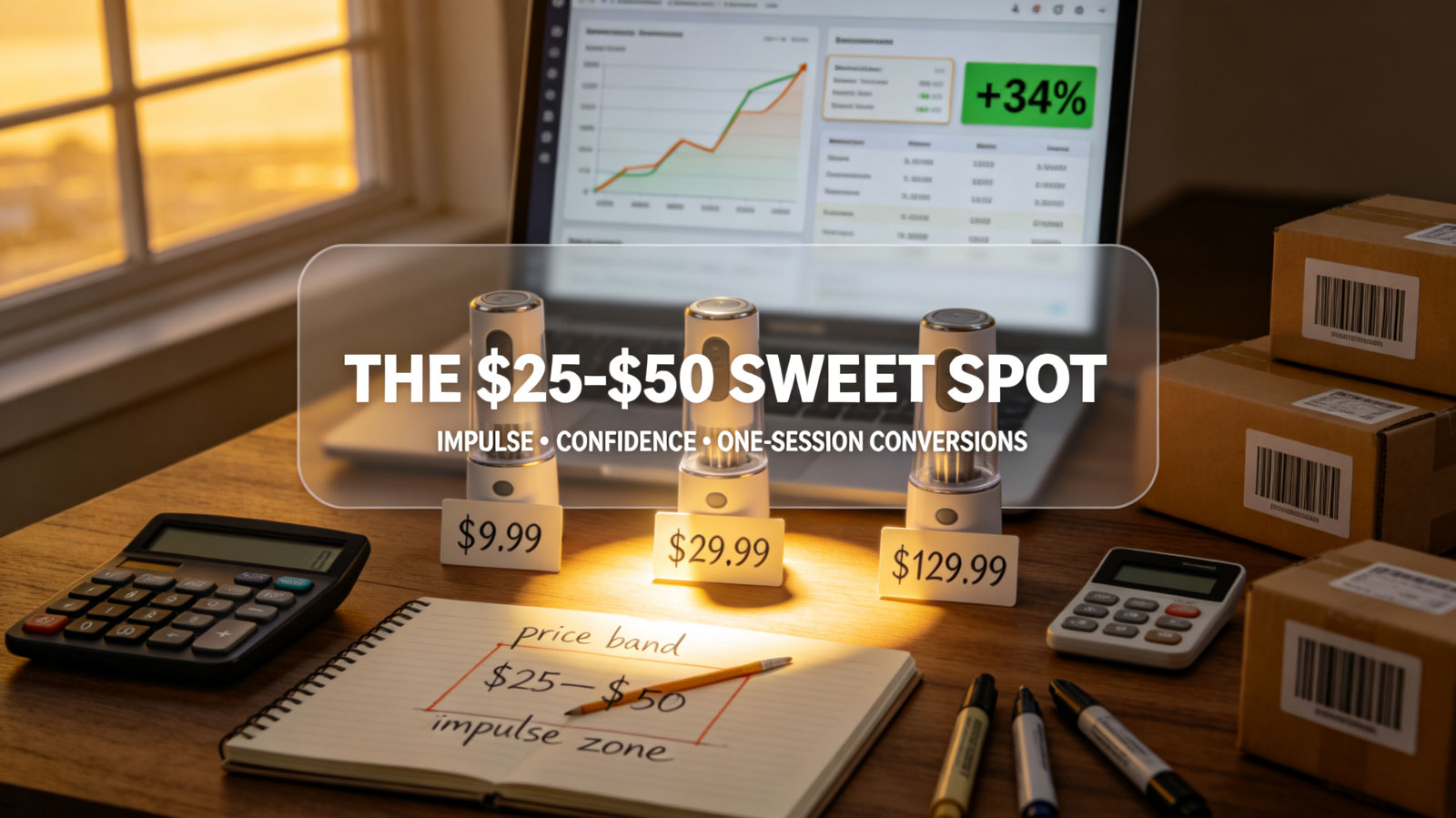
Open any best-seller list and count the prices. The products dominating conversions rarely sit at the extremes — not the $8 gadget fighting for attention in a sea of identical listings, and not the $200 premium item that demands a week of deliberation. They cluster in the middle: the $20–$50 band where a purchase feels substantial enough to matter but small enough to forgive. This guide breaks down why the mid-priced zone converts better than both cheap and premium alternatives, where the advantage actually comes from, and how to find, price, and position products inside it — using real store data, not guesswork.
Why the Middle of the Price Ladder Is Quietly Winning
Both ends of the pricing spectrum carry a hidden conversion tax, and most sellers only notice one of them:
-
Cheap prices signal risk, not value. Below a certain threshold — roughly $15 in most categories — buyers stop asking "what a deal" and start asking "what's wrong with it." Low price reads as low quality, shipping suspicion, or a scam, and the hesitation shows up as abandoned carts and support messages before purchase.
-
Premium prices demand justification. Above roughly $80–$100, the purchase stops being impulsive and starts being a decision. Buyers comparison-shop, read reviews hunting for flaws, and delay. Every additional day between first view and checkout leaks conversions, and premium pricing buys that delay in bulk.
-
The middle band is where impulse and confidence overlap. A $30 product sits under most buyers' "think about it" threshold while still feeling like a real purchase. The decision completes in one session — often one scroll — which is exactly the behavior paid traffic is built to capture.
The band isn't a compromise between cheap and premium. It's a different category of buying behavior entirely.
Where the Conversion Advantage Actually Comes From
The mid-priced zone compounds across four lines:
-
Impulse economics. One-session purchases mean full price, no coupon-hunting, no cart abandonment driven by deliberation. The conversion happens inside the attention window your ad already paid for.
-
AOV-friendly upsells. A customer who just spent $28 without hesitating will accept a $9–$15 add-on far more readily than a customer agonizing over a $120 decision. Mid-priced anchors make attach offers feel trivial, which lifts order value without discounting.
-
Return-rate stability. Cheap products over-promise and generate disappointment returns; premium products generate expectation returns. Mid-priced products set expectations that the product can actually meet, keeping refund rates near category floor.
-
Ad-friendly unit economics. A $25–$40 product with healthy margin supports customer acquisition costs that cheap products can't sustain and premium products can't convert fast enough to justify. The mid band is where paid traffic math stops being a gamble.
Two sellers can run identical creatives to identical audiences, and the one priced at $34 will often out-convert both the $12 and the $129 version — same product, different band, different behavior.
What Mid-Priced Positioning Looks Like in Practice
A realistic scenario based on typical patterns: a seller sourcing in the home-kitchen niche identifies a compact electric frother. The factory quotes $4.80 per unit at volume — a landed cost that supports a $29.99 retail price at comfortable margin. Comparable listings at $9.99 are drowning in identical competitors and suspicion; the $79 premium models are converting slowly and eating ad spend on long decision cycles.
The seller lists at $29.99 with a bundle offer: the frother plus a stainless whisk upgrade for $38.99. Within the first quarter: conversion holds near the category's top quartile because the price reads as "quality but safe," the bundle attach rate pushes average order value above $34, returns stay under 4%, and ad costs stay viable because the product converts inside the first session. Net margin per order lands well above what the same listing at $12.99 could ever sustain. The product didn't change. The price band did, and that alone restructured the P&L.
The Pricing Discipline
Mid-priced positioning rewards precision and punishes improvisation. Four rules keep you inside the band profitably:
-
Price from landed cost, not from competitors. Target a retail multiple that supports your acquisition costs first, then check the competitive band. A $29.99 price with a $5 landed cost beats a $24.99 price with a $9 landed cost every time.
-
Anchor with a premium decoy. List a genuinely superior version or bundle at $49–$59. It legitimizes your $30 hero product and pulls undecided buyers toward it — most will never buy the decoy, and it isn't meant for them.
-
Protect the band with bundle logic, not discounts. When pressure comes, add perceived value instead of cutting price. A $9 add-on at full margin preserves the band; a 20% coupon trains buyers to wait for the next one.
-
Verify the band against real sales data. Use a store intelligence tool like ShopFindBiz to scan what price points actually convert in your niche — the band shifts by category, and assumptions cost quarters.
Reading Your Niche
Run the audit before committing inventory. Scan the leaders in your target category and look at their price structures:
-
The niche is clustered under $15. The upgrade opportunity is open: a well-positioned $25–$35 offer can claim the buyers who are quietly suspicious of the bargain bin but have no mid-priced option.
-
The niche is split between cheap and premium with a hollow middle. The most common pattern — and the most exploitable. The hollow middle is unserved demand waiting for a credible occupant.
-
The niche is already crowded at $25–$40. Entering means competing on offer structure — bundles, variants, warranty — rather than on price alone. Don't start a race to the bottom inside the band.
Conclusion
The $25 sweet spot is not a pricing trick; it's a behavior window. Cheap prices trigger suspicion, premium prices trigger deliberation, and the middle band is where buyers act while the ad's attention is still warm. The sellers capturing this aren't the ones with the cheapest sourcing or the fanciest product — they're the ones disciplined enough to price for the decision they want: fast, confident, and complete in one session. In a market where every click is paid for and every hesitation is a leak, the mid-priced product isn't the compromise option. It's the conversion-optimized one.