Introduction
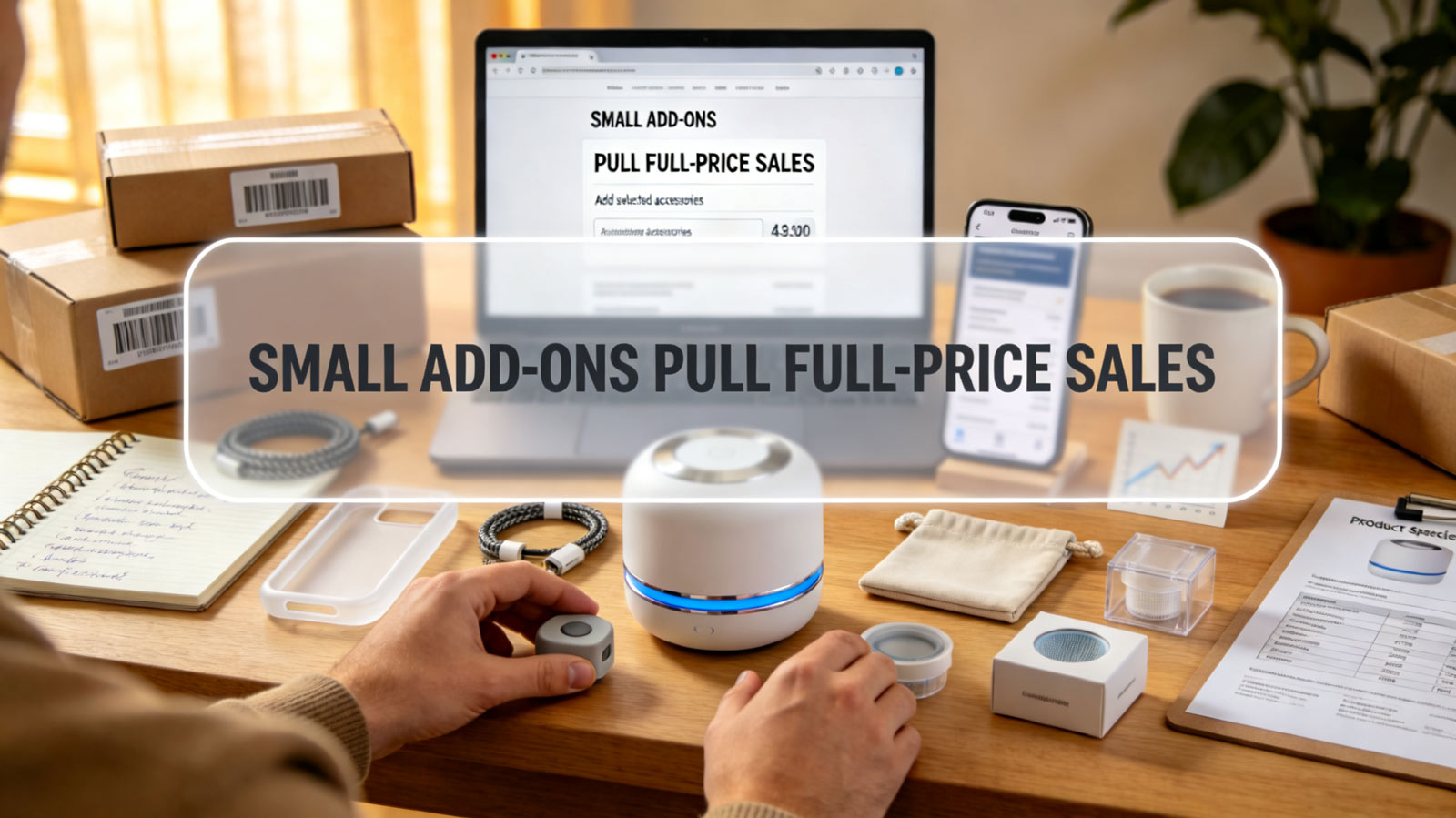
Every online store eventually learns the same uncomfortable lesson: customers do not buy the best product. They buy the product whose total decision feels safest, clearest, and most complete. That is where the accessory gravity well begins. A shopper hesitating over a full-margin product often converts only after a low-priced add-on makes the purchase feel more useful, more protected, or more ready to use. The add-on does not replace the main product—it reduces the psychological distance between interest and checkout. In practical terms, the $9 cable, case, refill, adapter, or mounting kit becomes the small purchase that pulls the $79 core product through the funnel. This article examines why accessory-first selling now outperforms product-only merchandising, how low-priced add-ons raise full-margin sales without discounting the core offer, and how to build accessory gravity without turning the catalog into clutter.
Three Forces That Pull Full-Margin Sales Toward Add-Ons
-
They lower the cost of deciding. A premium product asks the customer to make several decisions at once: Is this the right version? Will it work with what I already own? What else will I need after it arrives? Each unanswered question adds friction. A well-chosen add-on resolves one of those questions immediately. The buyer is no longer evaluating a product; they are evaluating a ready-to-use setup. That shift matters because confusion delays purchase while completeness accelerates it.
-
They raise perceived value without lowering price. Discounts make the core product cheaper. Accessories make the core product more useful. Those are not the same commercial act. A bundle containing a full-margin product and a small accessory can outperform the same product at 10% off because the customer sees more total utility rather than weaker pricing. Stores preserve the integrity of the main product while using the add-on to justify the purchase emotionally.
-
They create natural upsell moments without pressure. Aggressive upsells interrupt the customer. Relevant accessories extend the customer’s original intent. “Customers also bought this adapter” feels helpful when the adapter solves a compatibility issue. “Add this protective case before checkout” feels relevant when the case is clearly designed for the selected model. Accessory selling works best when it feels like completion, not extraction.
What the Accessory Economics Look Like
The economics of accessory gravity depend on one trade: smaller individual revenue in exchange for stronger conversion on the larger core product.
-
Average order value: Stores with relevant accessory placement often see 10-25% AOV lifts, depending on category and attach rate. The add-on may contribute only a few dollars in isolation, but its larger effect is making the full-margin main product easier to purchase.
-
Attach rates: Strong accessory programs commonly achieve 15-35% attach rates when the product is genuinely complementary and the compatibility is obvious. Weak programs treat accessories as generic recommendations and often fall below 5%.
-
Margin structure: A low-priced accessory can carry a higher percentage margin than the core product, especially when it is lightweight and sourced in bulk. Even when the item itself contributes modest revenue, its presence can protect the margin of the main product by reducing dependence on discounts.
-
Return resistance: A customer who buys the complete setup is less likely to return the core product for missing parts or compatibility problems. “Arrived but doesn’t connect” and “I still need another component” are preventable refund triggers. Accessories reduce these failures by solving the issue before it becomes a support ticket.
-
The break-even discipline: Accessory gravity fails when stores add too many irrelevant extras. Ten unrelated recommendations create noise; two highly relevant ones create confidence. The goal is not to maximize add-on count. It is to remove the next most likely objection after the customer chooses the product.
Five Signals an Add-On Is Ready to Become a Sales Puller
-
The core product is useful but incomplete without context. Products with setup requirements, replacement cycles, or model-specific parts naturally attract accessory demand. The customer is already wondering what else they need. The store that answers first wins the sale.
-
Compatibility confusion appears in reviews and questions. Repeated questions such as “Does this fit my model?” or “Which cable do I need?” reveal a gap between product interest and product readiness. Accessories become commercially powerful when they resolve that gap directly.
-
The add-on is cheap to ship and easy to understand. Bulky or complicated accessories create new doubts. The best gravity products are small, durable, visually clear, and easy to explain in one sentence. The buyer should understand the value before reading a full description.
-
It improves the main product immediately. A useful accessory changes the experience on the first day. Chargers make devices usable. Filters improve performance. Protective cases prevent regret. Storage accessories create order. If the benefit starts later or feels optional, attach rates usually fall.
-
It opens repeat purchasing without cannibalizing the core product. Consumables, refills, replacement parts, and wear items can turn a single product sale into a recurring relationship. The ideal add-on does not compete with the main offer; it extends the main offer’s useful life.
The New Operational Bar
Accessory selling looks simple from the outside and breaks quickly in practice. Four capabilities separate a high-conversion accessory strategy from random upselling:
-
Compatibility mapping: Every core product should have a clear accessory tree based on model, use case, and customer need. Shoppers should never have to guess whether an item fits their purchase. The more certainty the store supplies, the more accessory gravity it creates.
-
Bundle architecture: Bundles should be built around jobs, not inventory. “Starter setup,” “travel kit,” “replacement pack,” and “complete protection bundle” are more persuasive than “buy more and save.” The bundle earns its place by reducing assembly effort.
-
Checkout sequencing: The accessory should appear after the customer has chosen the core product but before payment uncertainty peaks. Product-page add-ons work best for obvious companions; cart-level prompts work best for protection, shipping convenience, or last-minute compatibility items.
-
Post-purchase extension: The accessory relationship should not end at checkout. Replenishment reminders, replacement intervals, and “finish your setup” follow-ups can convert one attachment into recurring revenue. Done respectfully, these messages feel like service. Done aggressively, they feel like clutter.
Conclusion
The accessory gravity well is not a trick to make customers buy more. It is a merchandising response to how online buyers actually make decisions. They hesitate when the product feels incomplete, uncertain, or harder to use than expected. They move forward when the store removes those doubts before checkout. Low-priced add-ons accomplish that job better than discounts because they increase usefulness without weakening the price of the main product. In that sense, the cheapest item in the cart can be the one that makes the highest-margin sale possible. Stores that map compatibility carefully, bundle around real customer jobs, and present accessories as completion rather than pressure will keep pulling full-price products through the funnel—one small, useful add-on at a time.