Introduction
Paid reach used to be the default answer to every growth question. In 2026, the arithmetic has changed. Auction prices keep climbing, ad fatigue keeps shortening, and thin margins can no longer absorb a campaign that converts at yesterday's rate. The products that keep winning are increasingly the ones that carry their own distribution inside the box—items that turn every buyer into a walking advertisement the moment a stranger asks, "where did you get that?"
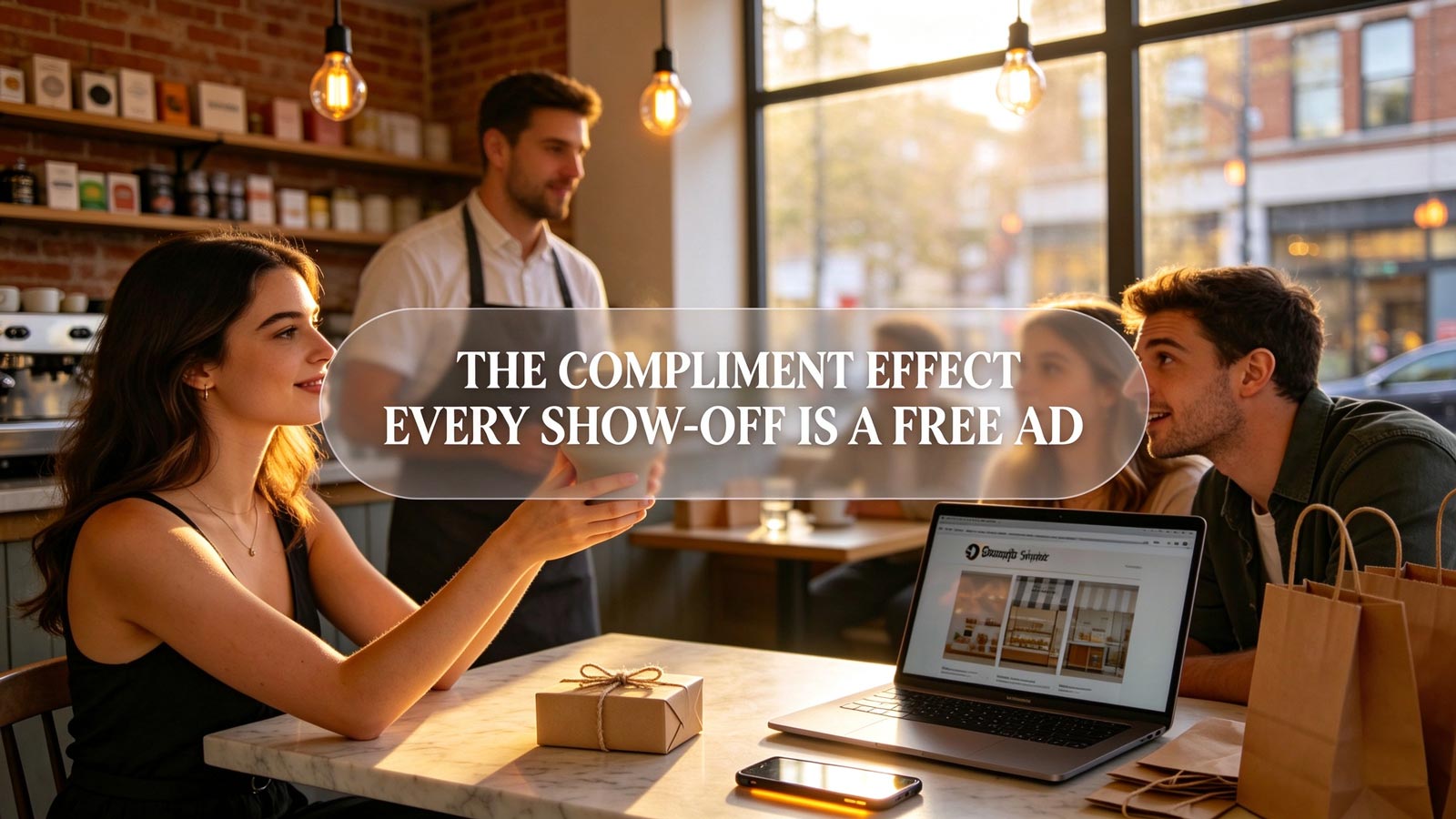
This is the compliment effect, and it is easy to miss because it never appears in the ad dashboard. No metric records the coffee-shop question, the office kitchen comment, the guest picking up an object from the shelf. But the effect compounds: one visible product seeds one conversation, one conversation seeds one pre-sold visitor, and the loop repeats at zero media cost. The result is a new selection hierarchy. Conversion still opens the door. Shareability decides whether the traffic ever stops costing money.
The Physics of the Show-Off Moment
A product earns organic sharing only when three conditions hold at the same time. Miss one, and the compliment never happens.
-
Visibility in Use: The product must appear in public or shared spaces—on a body, on a desk, in a kitchen, in a video-call background. A cabinet product generates zero impressions; a carried product generates them every weekday.
-
Legibility at a Glance: A stranger must understand why the item is clever or beautiful within one second. Nobody narrates a product to a passerby. If the hook needs explanation, the hook does not travel.
-
Answerability: When "where from?" arrives, the buyer needs a brand name or link that survives being spoken once. Products that fail this step send their traffic to generic search results and gift the sale to whoever ranks first.
This is why a water bottle with a distinctive silhouette became a status object while technically superior insulated bottles stayed anonymous, and why a phone case with a visible mechanism outsells a better-protective plain one. The compliment effect is not about quality. It is about whether the product functions as a conversation opener.
Four Product Shapes That Generate Their Own Traffic
Not every category can be shown off, but four shapes reliably produce the effect.
-
The Visible Identity Signal: Items worn or carried in public—jewelry with an unusual clasp, sneakers with a recognizable sole, a watch with an unconventional face. The buyer is purchasing a reason for people to start a conversation, and the product repays the ad spend in compliments.
-
The Table-Piece Object: Products designed to sit in shared spaces—a gesture-controlled lamp guests must try, a desk object that invites touching, a serving board shaped like something unexpected. Every visitor repeats the show-off moment, and every video call broadcasts it by default.
-
The Gift With an Origin Story: A recipient asking "where is this from?" is the warmest lead in e-commerce—pre-sold, urgent, deadline-driven. But the effect requires the giver to know and volunteer the source. Generic giftability is not enough; the product must survive the unboxing as a story worth retelling.
-
The Public-Nuisance Fix: Products that solve a problem everyone witnesses—a fog-free lens wipe, a discreet cable organizer, a compact stain remover used in real time. The recommendation carries urgency the recipient cannot ignore, because the problem is standing in front of them.
None of these shapes requires a viral budget. They require one design detail strong enough to survive a blurry photo and a three-second glance.
Why This Changes Your Sourcing Math
Traditional selection scores sourcing cost, margin, logistics, and ad-test conversion. The compliment effect adds a fifth variable most spreadsheets ignore.
-
Impressions per Ownership Week: Estimate how often the product is seen by non-buyers. A $12 item carried daily out-produces a $40 item stored in a drawer, because attention compounds while the price does not.
-
Share Rate: Typically 1–3% of visible uses produce a "where from?" question. Conservative math still beats most paid channels at current CPMs for thin-margin goods.
-
Conversion on Warm Leads: Compliment-driven visitors arrive with intent and social proof already installed, converting at multiples of cold traffic.
-
Refresh Cadence: Shareable products are also copyable products. The winning SKU needs a design-evolution strategy, or the show-off moment dies the quarter everyone in the feed already owns one.
The practical consequence: a low-margin item with high visibility can outperform a high-margin item with zero shareability on total profit per unit of attention.
The Risks: Copycats, Saturation, and Unbranded Traffic
The compliment effect cuts both ways, and the failure modes are specific.
-
Copycat Speed: A highly showable detail is highly cloneable. Nothing stops a competitor from replicating the one feature that starts conversations.
-
Unbranded Traffic: If the answer to "where from?" is "I don't remember, just search it," the seller trained the market to buy from whoever ranks first. Compliment traffic donated to the category leader is margin lost twice.
-
Saturation Cliff: Once everyone in a buyer's circle owns the item, the show-off moment dies abruptly. Compliment-driven revenue looks stable right up until the moment it is not.
-
Quality Backfire: A product shared widely and disappointing at scale generates anti-compliments—public warnings that travel the same channels. Shareability amplifies whatever is true, including the flaws.
The defense is consistent: own the answer to "where from?" through distinctive packaging, an insert card with a short URL, and a brand name that survives being heard once and typed correctly.
ShopFindBiz Perspective
Through a store-analysis lens, shareability is visible before a single ad runs. Review language tells the story first: phrases like "everyone asks about it," "got this as a gift and ordered two more," "strangers stop me," and "bought one for my sister too" are compliment-effect signals indexed in public. Stores winning this shift make the brand answer easy—clear logo placement, memorable naming, packaging worth photographing. Stores losing it have viral traffic arriving with no destination.
Benchmark the category. If leaders show identifiable design signatures and the review filters surface "compliments," "where from," and "ordered more as gifts," vague product pages will begin to look like a silent conversion tax. If nobody in the niche owns the shareable position, the opening is larger: the first store to make its products visibly attributable can own the compliment loop before it owns share.
From Shelf Signal to Operating Change
The response is not to decorate products with trend language. It is to engineer the show-off moment and capture its traffic.
-
Select for the Glance Test: Replace "does it convert?" with "does a stranger understand it in one second?" If the answer needs a demo video, keep sourcing.
-
Design One Signature Detail: Give the product a single feature that survives a blurry photo—an unusual shape, mechanism, material, or color behavior. One detail travels; five details blur.
-
Make the Answer Easy: Put the brand name where cameras land, ship an insert card with a short URL, and choose naming that can be spelled after hearing it once.
-
Feed the Loop Deliberately: Encourage buyers to share with packaging prompts and post-purchase flows timed to the moment of maximum delight, not the moment of delivery confirmation.
-
Track the Language: Audit reviews monthly for "compliment," "asked," "gift," and "where from." These are distribution keywords, not vanity phrases.
The test is simple: put the product in a buyer's hands in public. Within a week, does a stranger ask about it, and can the buyer answer with your brand name? If yes, the product sells itself—one compliment at a time. If no, the traffic will keep costing money it never had to.
Conclusion
Ads rent attention; compliments compound it. As auction prices rise and creative fatigue accelerates, the durable advantage belongs to products engineered to be shown, asked about, and traced back to a brand. The compliment effect is not a soft marketing idea. It is a measurable distribution channel hiding inside the product itself, and it favors sellers who select for visibility, legibility, and answerability from the very first sourcing conversation. In e-commerce, the cheapest impression is the one a happy customer generates for free. Build products worth showing, and the market will carry your message for you.