Introduction
Every year, brands kill thousands of products. Almost none of them kill the demand. A skincare line gets reformulated, a gadget gets "succeeded" by something worse, a snack vanishes from shelves — and the people who loved it don't disappear. They keep searching, overpaying for leftovers, and asking strangers on the internet where to find it. That lingering demand is one of the only genuinely zero-competition niches left in e-commerce, because the original owner has already left the field. This guide shows you how to find it, verify it, and claim it.
Why Dead Products Leave Live Demand
When a product dies, the reasons are almost never about demand. Lines get cut for margin reasons, portfolio simplification, ingredient costs, or a rebrand. The customers, meanwhile, keep their habits. Three forces keep that demand alive — and they rank differently than most people assume:
Functional gaps come first. Some discontinued products did a job that newer alternatives still don't do as well: a specific cable format, a keyboard layout, a tool mechanism. These buyers aren't nostalgic — they're stuck, because the replacement genuinely isn't equivalent. This demand is the most durable and the least trend-sensitive.
Scarcity premiums come second — especially for parts and consumables. When a device outlives its accessories, the owners of millions of working units become captive buyers: blades for a discontinued shaver, batteries for a legacy camera, filters for a phased-out air purifier. Consumables mean repeat purchases, which makes this the most commercially attractive category of all.
Nostalgia comes third. It's real and it spikes hard — but it spikes. Revival demand driven by sentiment tends to burn bright for a quarter and fade. Worth a short-burst launch, rarely worth building a catalog around.
Brands have exploited this for years, of course — Nintendo's NES Classic sold out in minutes, Crystal Pepsi returns every few summers. But those were the original owners monetizing their own back catalog. The opportunity for independent sellers is everything they left behind.
The Orphan Demand Detection Kit
You're looking for products where demand visibly outlived supply. Three checks, in order:
1. Google Trends residual. Look up the discontinued product and check the curve two to three years after its death. If search volume still holds 30–50% of its peak, the demand is alive. A flatline at zero means it died with the product — move on. Don't trust one spike; you're looking for a sustained plateau.
2. Resale premium. Search eBay's sold listings. If remaining units consistently close at two to three times the original retail price, you've found verified willingness to pay. A premium also tells you what your ceiling is: price below the resale market and you still have margin.
3. The cries. Search Reddit and Facebook groups for "where can I still buy X," "X alternative," and "bring back X." Multiple unanswered threads in the last six months are a direct reading on unmet demand — and a ready-made audience for your launch.
Any two of the three passing is enough to move to sourcing.
Three Ways to Source a Revival
-
Path 1 — The OEM still makes it. Many discontinued products were cut from Western shelves, not from existence. The original factory in China is often still producing the identical item for other markets. Search 1688 or Alibaba by specs and photos rather than brand name, and you may find the unbranded original at a fraction of its old retail.
-
Path 2 — The upgrade already exists. Search the product category plus the common complaints (the same ones you'd mine from reviews). Factories iterate constantly, and a "2026 version" fixing the original's flaws often already sits in a supplier catalog — it just has no one telling the revival story to the orphaned audience.
-
Path 3 — Sell the ecosystem instead. Can't source the product? Sell what its owners need: parts, consumables, cases, accessories. Competition here is thinner, margins are better, and the buyers are captive for years.
Before committing, scan the field with a store intelligence tool like ShopFindBiz: search your niche for stores already serving this demand and check their traffic. No one home means a green light. Two or three entrenched sellers means you need a differentiation angle before entering.
The Red Lines
Three categories are traps. Recalled or safety-failed products are dead for legal reasons — reviving them revives the liability. Trademarked heroes can't be marketed under the old brand name; "compatible with X" claims carry their own legal risk and platform enforcement risk. And food and cosmetics revivals drag you into formulation compliance, shelf-life logistics, and certification costs that erase the small-seller advantage. Stick to hardware, accessories, and consumables where the regulatory surface is manageable.
A Walkthrough: Reviving a Dead Product in Thirty Days
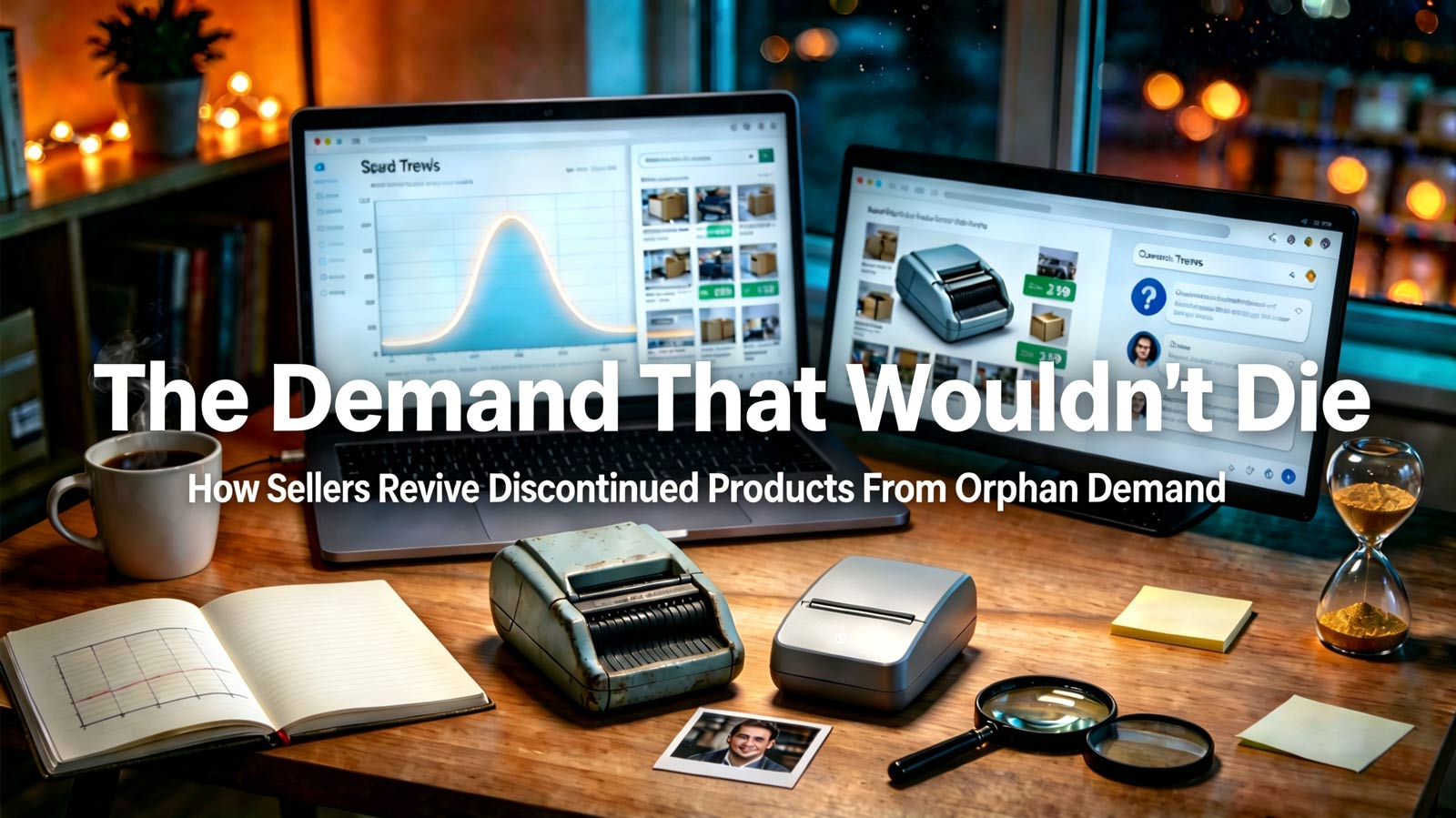
A realistic scenario based on typical patterns: a seller notices persistent Reddit threads asking for a specific discontinued mini label printer — the manufacturer killed the line in 2024 and its app-based replacement frustrates the old user base.
Trends check: search volume holds at 40% of the 2023 peak, twenty-eight months after discontinuation. Premium check: used units on eBay close at $85–110 against a $45 original retail. Cries check: four unanswered "alternative?" threads in the last quarter. Two and a half signals — pass.
Sourcing: a 1688 search by spec surfaces the OEM still manufacturing the identical unit for the domestic market, unbranded, at $11 landed. A ShopFindBiz scan shows no store dominating the keyword — remnant inventory sellers exist but aren't marketing to the orphaned audience. The seller launches a single-product store branded around the workflow the dead product served, runs comparison ads against the frustrating replacement ("the printer they stopped making, still works"), and prices at $39 — under the used market, triple the landed cost. Before scaling, the candidate goes through the standard 7-day validation: landing page, small ad test, pre-orders. Thirty days from first search to first shipment.
Conclusion
Every discontinued product is a small ghost market: verified buyers, no owner, no defender. The brands walking away from these products have already done your market research and abandoned the field — your job is simply to read the signals they left behind. Check the Trends residual, price the resale premium, listen for the cries, source at the lowest rung you can, and stay clear of the red lines. The demand that wouldn't die is waiting for someone to show up and serve it. It might as well be you.