Introduction
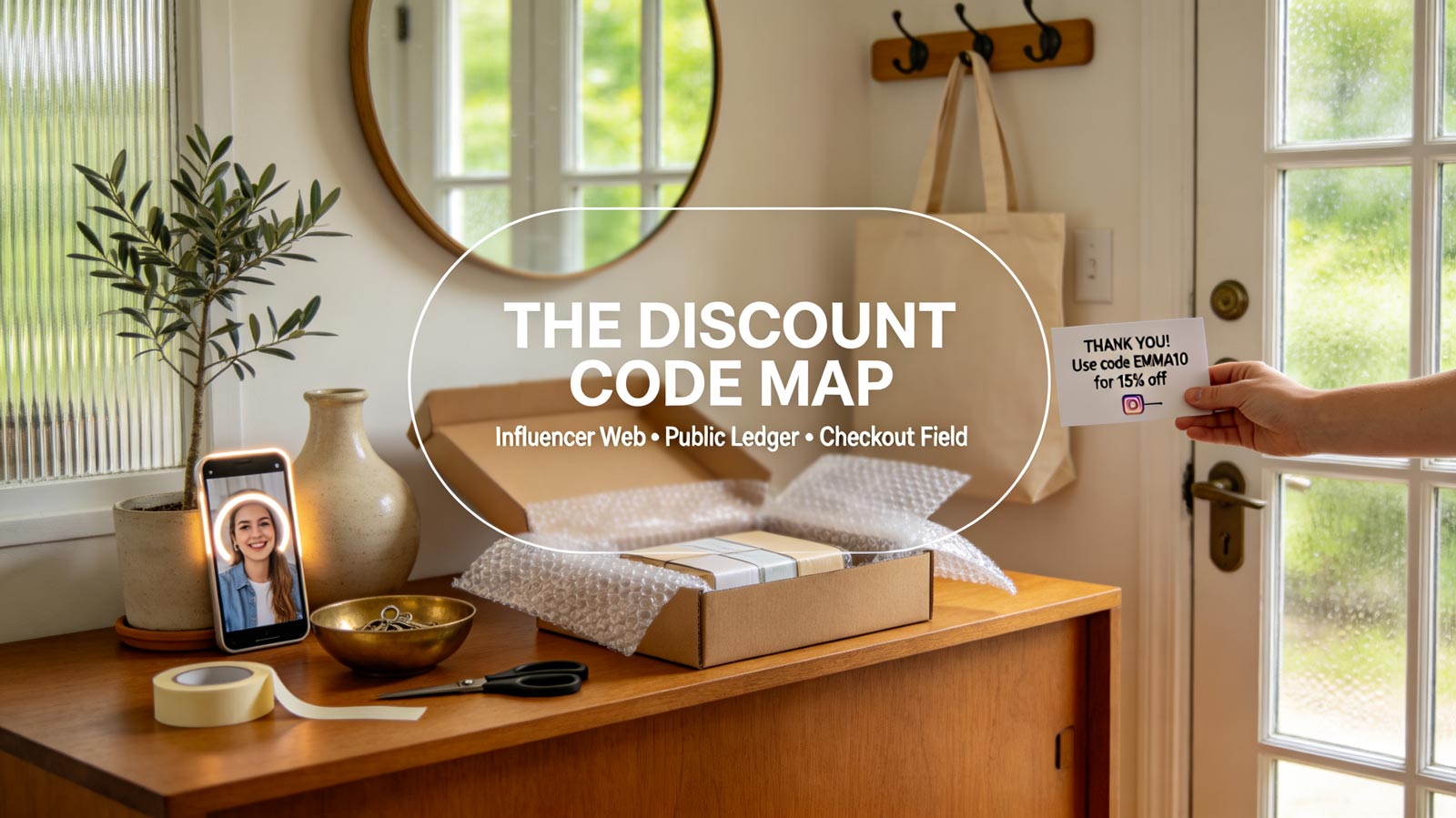
Every discount code is a signature. EMMA10 names a partner; fresh codes announce new deals; quietly killed ones mark failed bets. The checkout field is a public ledger of a competitor's influencer web—who they pay and which partnerships actually convert. Sellers hide their ad strategies behind dashboards and NDAs, then publish their entire creator network in the most visible place on the store: the promo code box. Names, timing, discount depth, and expiration patterns combine into a live map of a competitor's influence operation. Almost nobody reads it. The few who do get a free look at an entire paid acquisition strategy.
The Code Is a Signature
A three-second glance at a checkout page identifies who's carrying a store's products.
Start with the naming convention. Codes built as first-name-plus-number—EMMA10, JAKE20, SOFIA15—are dedicated influencer codes, each one a contract in miniature. Generic words like WELCOME15 or SAVE20 belong to automated marketing flows and reveal nothing about partnerships. The convention alone separates creator deals from blast promotions.
Many codes skip subtlety entirely and simply repeat the creator's handle or its abbreviation. Typing that handle into a search bar surfaces the influencer within seconds: follower count, content niche, audience demographics, even typical sponsorship rates. An instant dossier on the competitor's chosen channel, free with every order.
Depth completes the picture. A modest 10% code usually marks a standard affiliate arrangement with performance-based payout. Codes offering 20–25% off tend to accompany exclusive partnerships with revenue guarantees—the store paying a premium for loyalty and volume. The discount is the visible tip of the commission iceberg. Read the code correctly, and the face behind the traffic appears.
Fresh Codes, Dead Codes
Codes have lifecycles, and each stage of the lifecycle mirrors the deal behind it. Tracking them in sequence turns a static checkout page into a dated campaign log:
-
The Sudden Debut. A cluster of new codes appearing in the same week announces a fresh creator push—usually tied to a product launch or a seasonal moment. Stores publish this signal weeks before any marketing write-up notices the campaign.
-
The Quiet Kill. A code that stops working while the influencer still posts about the brand tells its own story: the partnership ended or the return didn't justify the spend. Dead codes are confessionals of failed bets, and they accumulate over time into a record of what didn't work.
-
The Cluster Effect. When several new codes appear simultaneously with similar naming styles, the competitor likely signed an agency or MCN rather than individuals. The web has a new landlord—and that landlord handles other brands too, whose checkout pages can be read the same way.
The rise and fall of codes reads like a campaign calendar written in public. The only skill required is checking back regularly enough to catch the transitions.
What the Map Reveals About Budget
Individual codes are trivia. The full collection, dated and cross-referenced, sketches the marketing department's budget in surprising resolution. Three aggregations do most of the work.
The Volume Dial. Counting active dedicated codes, multiplied by typical deal cadence, produces a rough headcount of the creator roster. Sudden growth signals budget expansion; steady shrinkage signals retrenchment. Watching the direction month over month beats any industry report at predicting where a competitor's marketing is heading.
The Standing Contracts. Codes named after media formats—PODCAST, NEWSLETTER, YOUTUBE—staying valid for months indicate standing contracts: fixed budget lines rather than one-off sponsorships. These are the competitor's permanent acquisition infrastructure, and their names reveal which channels the store trusts enough to keep paying.
The Launch Spike Pattern. When a burst of fresh codes coincides with a new product drop, the release playbook becomes visible: concentrated creator pushes at launch, maintenance phases between. Because the pattern repeats, future launches can be anticipated from code behavior alone—sometimes weeks before the product exists publicly.
Using the Map Against Them
Intelligence earns its keep only when it changes behavior. Four moves convert the map into position:
-
Recruit their castaways. Every dead code is a creator whose last deal ended and who is likely negotiating their next one. Approaching them with a competitive offer costs an email, not an agency fee.
-
Set the benchmark. A competitor's code depth calibrates negotiations. Knowing rivals offer 20% plus commission prevents overpaying talent—and exposes influencers who quote fantasy rates.
-
Map the whitespace. The creator types a competitor never codes—niches, platforms, audience sizes they ignore—form a low-competition pool. Their blind spots are the cheapest territory to claim.
-
Watch your own checkout. The map runs both directions. A store's own codes broadcast its network to every competitor who looks. Name and manage codes with the awareness that the ledger is public.
The intelligence was never hidden. It was typed into a box on the internet, waiting to be read.
Conclusion
Discount codes are among the most underused open-source intelligence in e-commerce. Naming conventions identify partners, debuts and deaths date campaigns, and the collective pattern budgets an entire influencer operation. Monitoring a competitor's checkout field takes minutes and costs nothing. The influencer web every store works so hard to build is, in the end, publicly posted at the point of sale. The sellers who learn to read the ledger stop guessing at rival strategies—they simply look them up.