Introduction
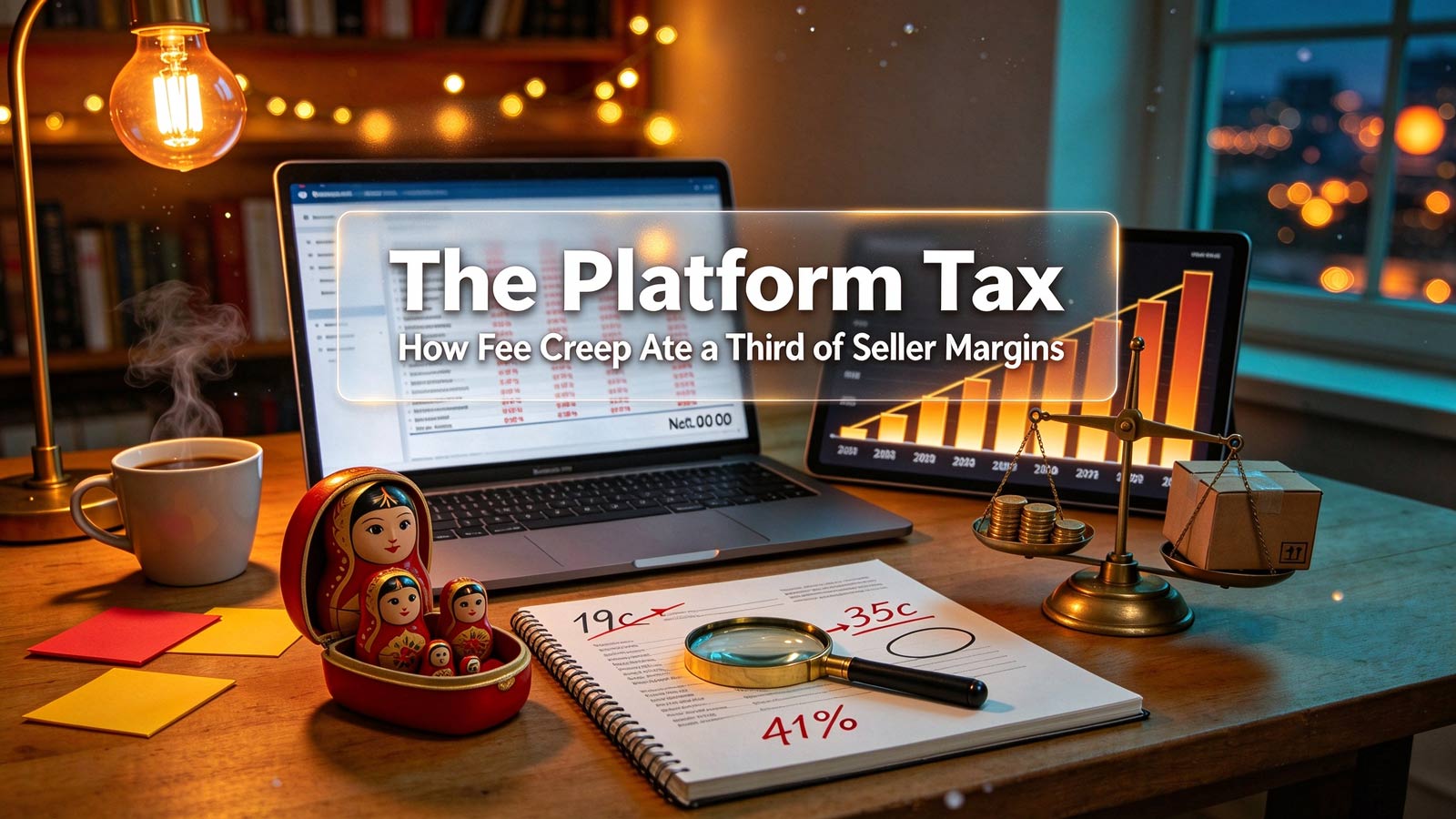
In 2014, selling on Amazon cost you roughly 19 cents of every revenue dollar. By 2022, that same dollar cost about 35 cents. Nothing changed about your product — the platform simply kept adding layers between the sale and your payout, each one reasonable on its own, collectively transformative. Sellers call it the fee creep, and it's the quietest margin crisis in e-commerce: not a single dramatic hike, but a decade of small additions that now consume a third of gross revenue on the average marketplace. This guide breaks down where the money actually leaks, how the major platforms' tax models differ, and how to calculate — and reduce — your real take rate before you realize you've been working for your platform's shareholders.
How a 15% Commission Becomes a 35% Take
The listing page says 15%. Your payout says otherwise. Modern marketplace fees work like nesting dolls — every layer looks complete until you open it:
- Base commission: 8–15%, varying wildly by category. Jewelry and electronics sit at the low end; apparel and accessories, where most dropshippers live, often run 15–17%.
- Payment processing: 2–3%, folded into the payout statement where few sellers look.
- Fulfillment: 10–15% once storage, pick-pack, and returns processing are in. Optional in theory — in practice, refusing it usually means invisible search ranking.
- Advertising: the layer nobody prices in. Category visibility on mature platforms is pay-to-play; ad spend as a share of revenue commonly runs 5–15%.
- Returns and promotions: the silent layer. High-return categories effectively pay the fee on orders that never final.
Each layer arrives with a plausible justification. The damage is the compounding — and the fact that platforms present everything as small percentages rather than one consolidated number, precisely because the consolidated number would change behavior.
The Evolution in One Paragraph
The arc is three moves. Growth era (roughly pre-2015): simple, sub-15% structures designed to attract sellers. Maturation: category tiers, payment fees, premium services. The pandemic acceleration: platforms monetized infrastructure that sellers now couldn't leave. The independent tracker most often cited on this — ILSR's seller survey series — put Amazon's effective take near 19% in 2014 and about 35% by 2022, and the direction since has not reversed. Whatever platform you sell on, assume it's running the same playbook, just at an earlier chapter.
Three Tax Models, Three Strategies
Not all fee regimes are equal, and the newest platforms are cheaper for a reason — they're subsidizing your migration:
- Amazon: the mature tax. Full-stack and brutal: commission, FBA, and a de facto advertising requirement. Expect an all-in take in the 30–40% band for an ad-dependent seller. What you buy: demand that already exists.
- TikTok Shop: the growth-era discount. Subsidized rates and traffic support while it builds seller depth. The window is real but temporary — expect the Amazon arc on a compressed timeline.
- Shein/Temu-style models: the lowest visible rates, because the platform often takes its margin from the supply side instead. You trade pricing power and brand ownership for volume.
The strategic read: marketplaces are cheapest early and most expensive once you're dependent. Fee schedules should be treated like introductory mortgage rates — attractive precisely until switching costs peak.
Calculate Your Real Take Rate
Before optimizing anything, run your own numbers:
Add up every cost the platform touches — commission, payment processing, fulfillment, ad spend, returns, promo discounts — then divide that total by your revenue. The result is your true take rate.
Then the diagnosis:
- Under 20%: healthy. You have room to buy growth or absorb shocks.
- 20–30%: the squeeze zone. Every ad dollar is already partly the platform's money. Start building your exit option.
- Over 35%: you're an outsourced fulfillment department. Growth makes it worse, not better — scaling a 35% tax structure just pays more tax.
A realistic scenario: a home-goods seller ran the formula on his top SKU and found a 41% true take — he'd been reading the 15% commission line for two years. The SKU's margin lived in repeat purchases anyway, so he moved it to his Shopify store at 2.9% processing, kept the marketplace listing for cold traffic, and recovered eight points of margin in one quarter. The first step wasn't strategy. It was arithmetic.
What To Do at Your Scale
- Marketplace-only sellers: audit by SKU. Anything with natural repeat-purchase behavior belongs on a channel you own; marketplaces should be your acquisition funnel, not your business. One compliance note — moving customers off-platform (insert cards, email capture) must respect marketplace terms of service, which vary and are enforced. Read the policy before the playbook.
- Hybrid sellers: your platform store is now your profit pool and your marketplace store is your top-of-funnel. Budget accordingly — most hybrid sellers still over-invest in the taxed channel out of habit.
- Scaling sellers: negotiate. Top-seller programs and annual agreements move rates more than any blog advice. Multi-platform presence is your leverage — the cheapest commission you'll ever get is the one a platform offers to stop you from leaving.
Reading a Competitor's Dependency
The fee creep also reads outward. A store intelligence tool like ShopFindBiz shows whether a rival is living on platform traffic or has already built direct channels — its traffic mix is the tell. A "marketplace top seller" whose direct and organic traffic is quietly growing has seen this math too and is de-platforming; study its sequence. One whose entire presence rents platform visibility is running your future playbook at a discount — and when its fees cross the threshold, its customers will be looking for alternatives. Be the alternative they find.
Conclusion
Fee creep doesn't announce itself. It arrives as five separate small line items, each defensible, compounding into a third of your revenue. The sellers who survive it are the ones who run the full arithmetic before the platform does it for them — and who remember that this is only one of four cost curves repricing the industry. Channels are concentrating, budgets are migrating, and creative now decides who can afford to compete. Add the tax on every transaction, and the real question of 2026 isn't which platform to sell on. It's how much of your business you still own.