Introduction
A store's shipping setup is the most underread page in competitive analysis. The threshold number, the way it's displayed, the delivery promise underneath it — together they expose the store's average order value, its margin structure, and how desperate it is for baskets. All of it is public. It takes one open cart, two minutes, and a calculator to reverse-engineer.
The reading method is simple: a threshold is never a random number. It is a target order value, printed in public. This piece reads free shipping the way an analyst reads a pricing page — first the psychology that makes thresholds work, then the margin math underneath, then the implementation tells, then what to do with the numbers on your own store.
The Psychology of Free Shipping Thresholds
Buyers feel shipping fees more sharply than product prices — a $6 shipping charge stings more than a $6 price increase, even when the total is identical. Thresholds exploit exactly that asymmetry: the cart total feels controllable, the fee feels like a loss. That is why the threshold works as a weapon rather than a discount.
But the psychology only converts when three conditions hold:
-
The gap is small: a customer $12 below the threshold adds an item; a customer $40 below abandons.
-
The reminder is constant: stores that depend on threshold lift keep the progress bar visible from first cart open.
-
The add-on is easy: the store surfaces sub-threshold items — bundles, minis, accessories — because a threshold without a cheap bridge item loses baskets instead of growing them.
Read those conditions in a competitor's store and you know whether its threshold is engineered or inherited. A bare number buried in the FAQ is a policy. A progress bar plus "You need $9 more" plus a row of $12 add-ons is a system.
Financial Impact on Retail Operations
The margin math behind a threshold is a contribution problem, and every store's setup leaks its answer.
Start with the reverse read. Divide the threshold by the store's typical item price. A $60 threshold on a $35 product store implies a two-item target basket; a $75 threshold on a $28 store implies the same store knows its AOV sits near $50 and wants a 50% lift. Thresholds set 15–30% above the likely AOV are engineered. Thresholds set 50% or more above it are either aspirational, or the store plans to get there through bundles rather than items.
Then read the subsidy. Free shipping is never free — it is paid from margin, marked-up base prices, or volume-negotiated carrier rates. Three signals separate the profitable setup from the bleeding one:
-
Low prices plus low threshold plus free returns: either very thick margins, or a store buying growth. Do not copy it.
-
Threshold slightly below the most popular bundle price: the store engineered the bundle first and set the threshold to ratify it.
-
Flat-rate shipping under the threshold: the store knows its real cost per parcel and is charging honestly below the line — a sign of tight operations, not weakness.
The core arithmetic for your own store: a customer adding a $15 item to clear the line must generate more contribution than the shipping cost you absorb. If your absorbed cost is $8 and the add-on carries 40% margin, you gain $6 — that threshold loses money on those baskets. If the add-on is a $22 bundle at 45% margin, you gain $9.90, and the threshold works. The formula is that boring, and that reliable.
Implementation Strategies and Best Practices
Implementation is where stores reveal whether they understand their own thresholds. Reading the tells:
-
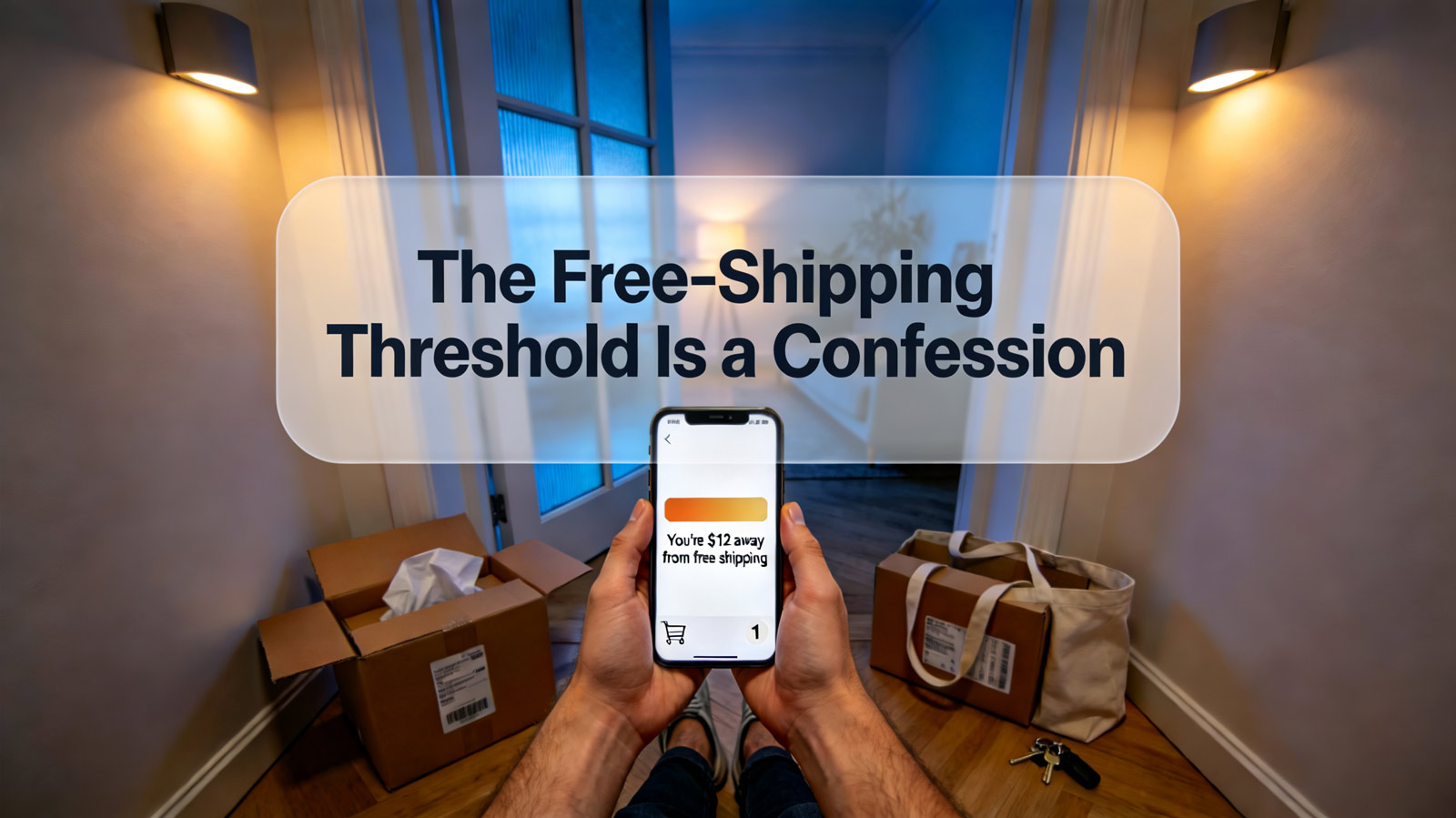
The cart drawer leads with the threshold. Stores that show "You're $11 from free shipping" before checkout even opens have tested this and it pays. It also tells you their single biggest friction is order size, not trust.
-
The delivery promise is specific. "Ships in 24h, arrives in 3–5 days" signals owned or stable logistics. "7–15 business days" signals dropship or thin control — whatever their threshold, fulfillment is their weak point, and competing on speed beats competing on price.
-
Thresholds move seasonally. A store that drops its threshold for November and restores it in January is protecting conversion at peak, not abandoning discipline. A store that never moves it either has huge margin headroom or stopped managing it.
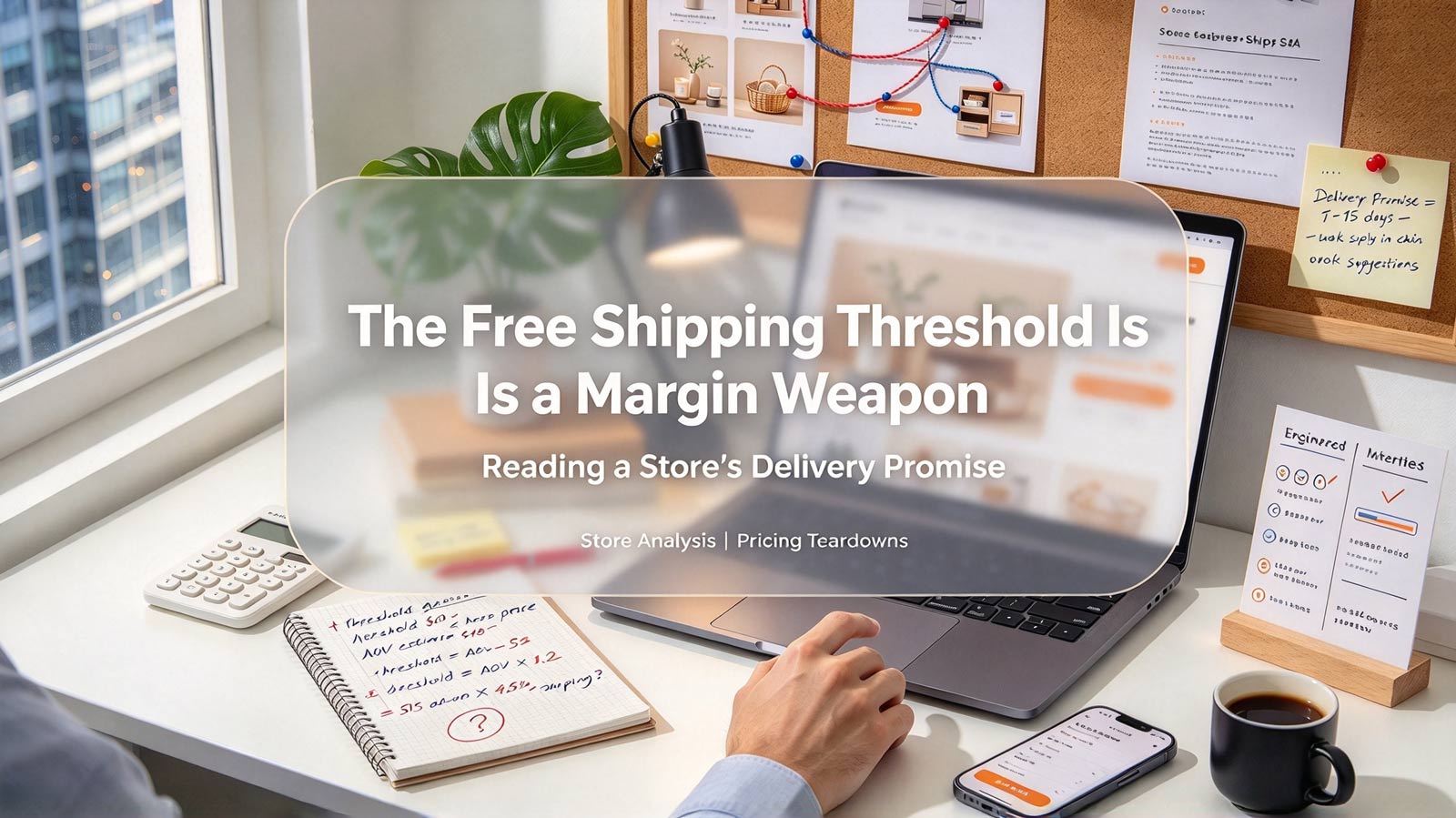
For your own store, the working sequence: set the threshold at current AOV times 1.2 as a starting point, stock at least one bridge item within $10–15 below the gap, verify the contribution math on the most common basket-plus-bridge combination, and only then promote the bar site-wide.
Case Studies and Industry Examples
The landmark public move remains Amazon's 2013 shift from a $25 to a $35 non-Prime threshold — widely covered at the time, quietly revealing in what came after: the company left the number alone for years. The internal data was never published, but the standing decision says the higher line did not damage the business enough to reverse. That is the honest version of the case: the move is confirmed, the effect is inferred from persistence, not from leaked metrics.
The more instructive reads are smaller. Premium apparel stores frequently set thresholds around two-item baskets — $120–160 on $70 price points — because the second item is the entire business model, and the threshold is there to stop the one-item order. Home goods stores run the opposite logic: thresholds low enough to let a customer add a decor item to a furniture order, because the add-on carries the margin the big item doesn't.
The pattern across both: the threshold always maps to the unit economics of the most common basket, never to a competitor's number. Stores copying a famous threshold without that mapping are the ones whose cart abandonment quietly doubles.
Conclusion
A free shipping threshold is a confession printed in public — it states what a store believes its basket should be, and the pages around it reveal whether that belief is funded by margin or by hope. Read the number against the price band, the bar against the add-ons, the promise against the operation, and a competitor's shipping strategy stops being a policy and becomes a spreadsheet. Set your own line the same way: from your AOV, your bridge items, and your contribution math — in that order, and never from someone else's headline number.