Introduction
Every checkout has two kinds of momentum. There is the momentum the store can see—the add-to-cart, the shipping form, the payment field—and the momentum only the customer feels: the mental calculation of whether this purchase is worth creating another account, remembering another password, and surrendering another inbox. Forced account creation sits directly on top of that second momentum and quietly taxes it. The store reads the fallout as “cart abandonment,” a vague metric with a hundred possible causes. The sharper read is simpler: the store built a wall at the exact moment the buyer had already decided to pay, then blamed the buyer for walking around it.
The guest checkout wall is one of the most reliable conversion diagnostics available, precisely because it is a choice. Stores do not accidentally demand accounts; they choose certainty over convenience. That choice leaks information about how the store sees its customers, its email list, its repeat purchase assumptions, and its confidence in the product. A store that blocks guests is rarely optimizing for the person holding the card. It is optimizing for the asset it hopes that person becomes.
The Wall Is a Strategy Decision, Not a UX Accident
Checkout friction is usually described as a design flaw. Forced registration is different: it is an intentional trade, made visibly.
-
The Email List Comes First: The store has decided that owning the customer matters more than serving the customer in this session. It wants the address for abandoned-cart emails, lifecycle flows, and lookalike audiences—even if the immediate cost is the order itself.
-
The Product Is Expected to Do the Saving: This setup only makes sense when management assumes the offer is strong enough to survive interruption. That confidence is sometimes earned. More often, it is inherited from a template, an agency default, or a boardroom belief that “loyalty starts at registration.”
-
Retention Is Being Confused With Capture: A guest who buys twice is more valuable than a registered account that churns at the password screen. The wall conflates identification with retention and ends up capturing neither.
The checkout flow is where a store’s theory of the customer becomes operational. Forced accounts reveal that the theory values future access over present payment.
What the Lost Orders Actually Look Like
The damage does not announce itself as “forced login.” It appears under ordinary labels that keep the real cause invisible.
-
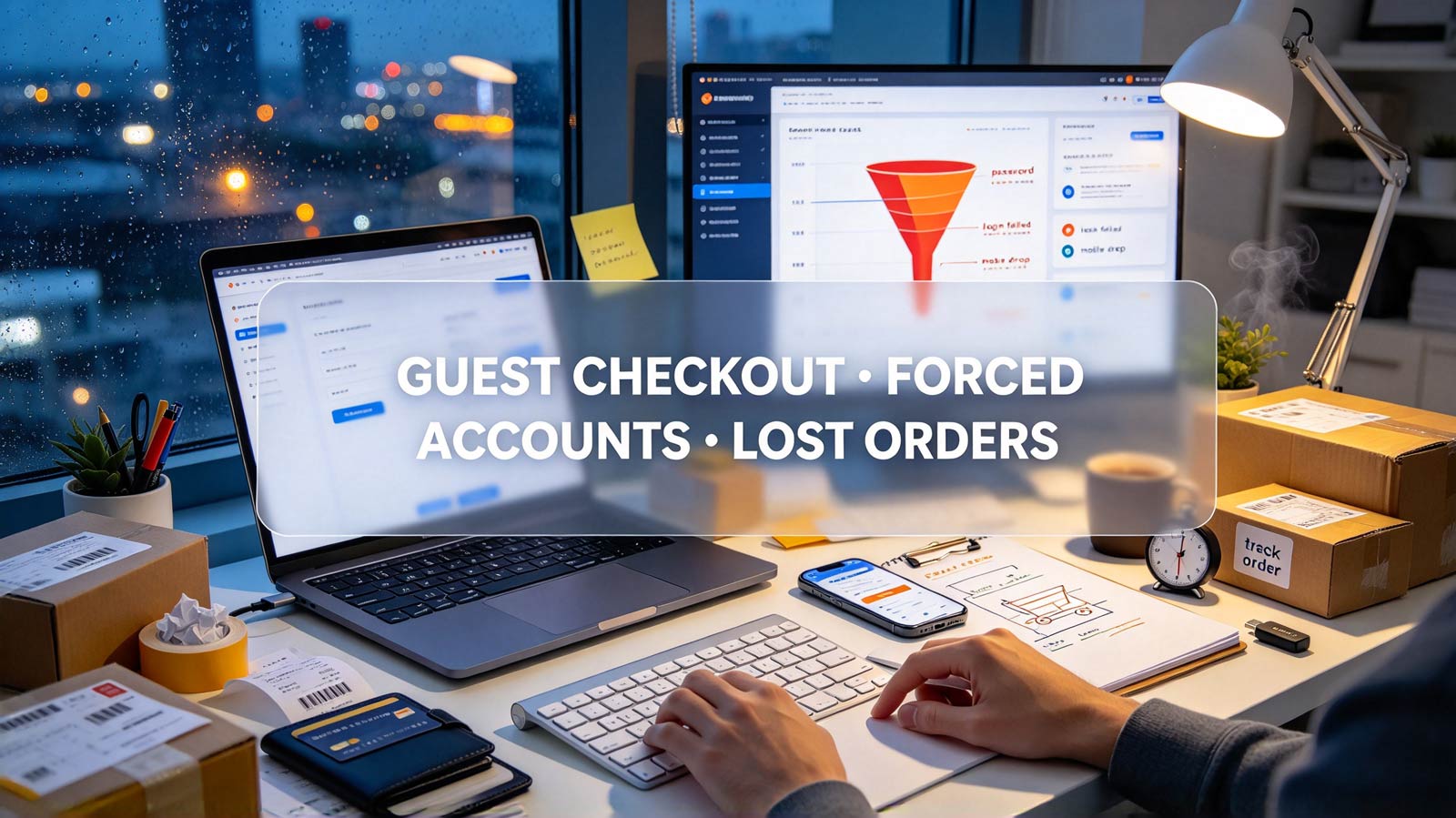
The Password Reset Spike: Login failures cluster around checkout because returning buyers do not remember which combination they used, and new buyers abandon rather than verify. The store sees failed logins; the customer experienced an unplanned exit interview.
-
The Mobile Collapse: Account creation is tolerable on a desktop with a password manager. On a phone, with autofill failing and one thumb available, the same wall becomes a cancellation button. Mobile checkout share rises while conversion falls, and the device report blames “mobile intent.”
-
The Recovery Email Mirage: Some forced-account stores point to recovered carts as proof the wall works. But recovery revenue is the visible fraction; it never shows the orders that were never started, the buyers who reordered from a competitor with guest checkout, or the customers trained to expect a discount after abandonment.
-
The Support Ticket Echo: “Do I need an account to order?” and “I can’t log in” tickets are not service noise. They are pre-abandonment confessions arriving one step too late.
The cleanest signal is the sequence: high product-page engagement, strong add-to-cart rate, then a stall at account creation. When intent dies after commitment, the wall—not the offer—is the suspect.
Why Smart Stores Still Build the Wall
The wall survives because it produces something measurable, and measurable things defend themselves in meetings.
-
Attribution Is Easier: Registered users are easier to track across devices and sessions. In a privacy-changed web, identity feels like control, and control feels like strategy—even when it taxes the top of the funnel.
-
Repeat Purchase Math Needs an Address: Stores with thin margins and strong replenishment logic want the email before the first order because they have planned the second order already. The flaw is sequencing: they collect the identifier before proving the value that would make the identifier welcome.
-
Discount Culture Rewards Capture: Popups trained the store to ask first and serve later. Forced checkout is the same instinct moved one step closer to payment, where the cost of refusal is highest.
None of these reasons are irrational. They are simply mispriced. The list asset is booked immediately; the lost order is recorded as anonymous abandonment and never assigned to the policy that caused it.
Reading a Store Through Its Checkout Gate
As a store-analysis signal, the guest checkout decision is unusually dense. It compresses positioning, unit economics, and operational maturity into one screen.
-
Confidence: Guest checkout says the product is strong enough to be bought without leverage. Forced accounts say the store expects to need the relationship, the inbox, or the discount to bring the buyer back.
-
Margin Structure: Stores with aggressive introductory pricing often demand registration because the first order is a customer-acquisition cost wearing a product’s clothing. Full-margin brands can afford to let strangers buy like strangers.
-
Operational Sophistication: A mature store separates identification from purchase. It lets guests pay instantly, then offers account creation after confirmation using order details, receipts, loyalty, and warranty value. The immature store makes the account the tollbooth.
-
Channel Mix: Marketplaces train customers to expect speed and minimal commitment. A store competing against Amazon while demanding registration is offering less convenience than the default and asking for more data in return.
The wall also forecasts service load. Forced accounts create password resets, duplicate profiles, merge requests, and “which email did I use?” chats—small frictions that scale into a support tax.
ShopFindBiz Perspective
Through a competitor-analysis lens, the checkout gate is one of the fastest trust and health checks available. Open a rival store, add a mid-priced SKU to cart, and walk the payment path as a guest. The moment a store demands an account, note what happens next: Is email verification required before payment? Is social login offered as relief? Is the password rule punitive? Does the page remember the cart after login fails? Does the post-purchase screen try to convert the order into an account with a reason—tracking, warranty, returns—or with nothing but a form?
Then triangulate. Stores with forced accounts often show adjacent symptoms: heavy exit-intent discounting, aggressive newsletter capture, weak post-purchase retention offers, and ads leaning on price rather than product. The pattern suggests a business buying identification because loyalty has not been built. In store analysis, that is an opening. A competitor demanding registration at checkout is telling you which customers to target with ads that say less setup, faster checkout, no account required. You are not merely attacking friction. You are exploiting a disclosed belief about how replaceable the customer feels.
From Diagnosis to Action
The finding only matters if it changes the storefront.
-
If forced accounts are active: Run the numbers by segment. Compare conversion for new versus returning visitors, mobile versus desktop, high-margin versus entry SKUs. If the wall hurts most where first orders are won, move account creation after purchase and sell it with utility.
-
If the email list is the reason: Replace pre-purchase capture with post-purchase value. Offer order tracking, returns initiation, warranty registration, replenishment reminders, and saved addresses after the receipt. The same identifier arrives with consent instead of resentment.
-
If login failures are high: Treat them as checkout defects. Add one-tap passwordless login, keep carts persistent across devices, and never make verification a precondition to payment.
-
If a competitor has the wall: Build comparison creative around checkout freedom. Keep the claim specific and honest: no account needed, order in under a minute, receipt and tracking without a subscription to being marketed at.
Then audit the language. A store that says “create an account to continue” is issuing a command. A store that says “continue as guest—track, return, and reorder from your receipt” is removing a reason to leave.
Conclusion
The guest checkout wall looks small because it is measured one abandonment at a time. In aggregate, it is a policy about who the store believes the customer is: a person trying to buy something, or a lead resisting capture. Stores that force registration are usually protecting an email list, a retention model, or an analytics habit. Stores that remove the wall are making a harder claim—that the product, the price, and the experience are strong enough to earn the second visit after surviving the first one frictionlessly. In store analysis, the checkout gate is where strategy becomes visible. Lost orders rarely leave a note. They leave a wall.