Introduction
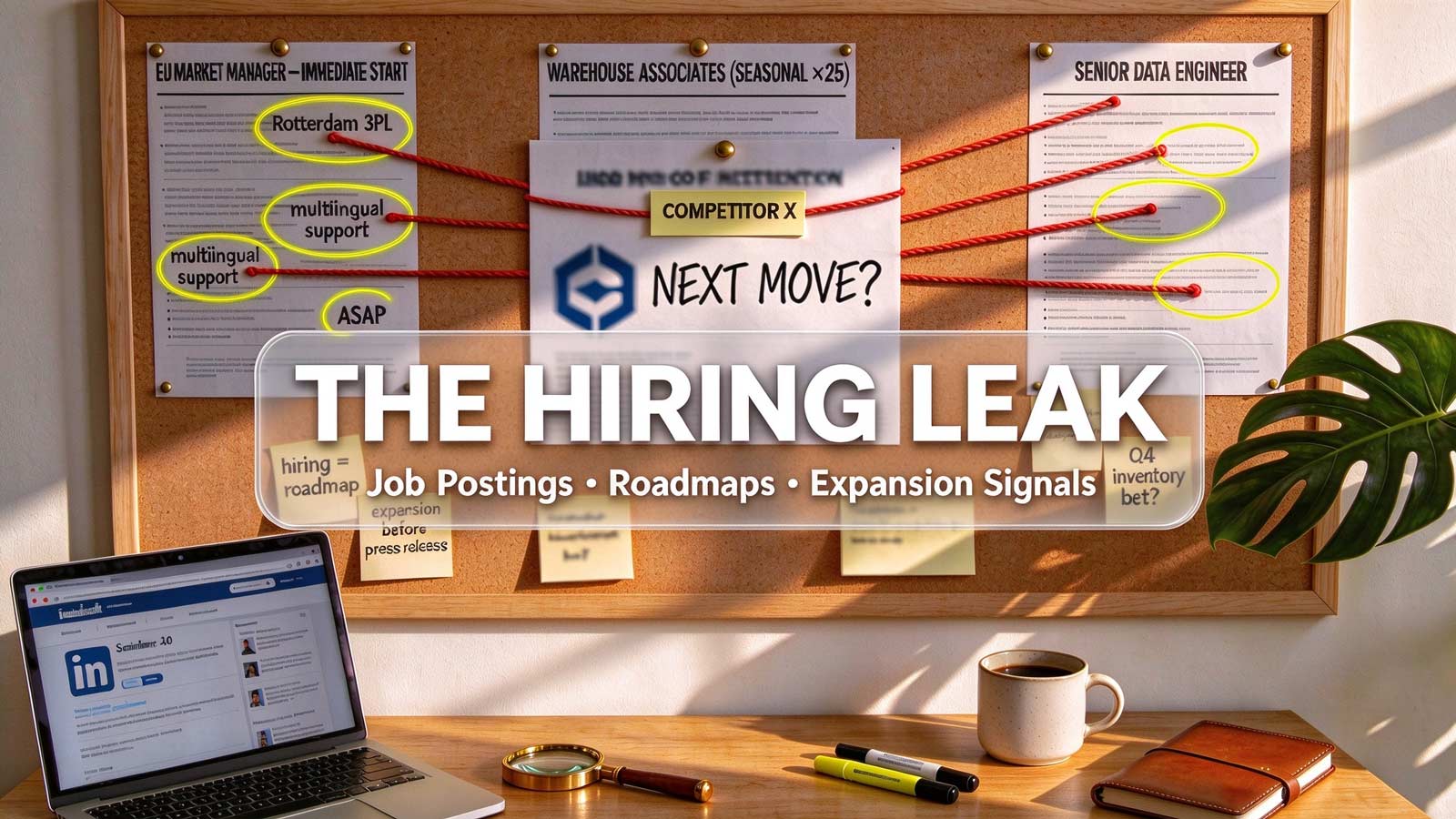
Job postings are strategy documents in plain sight. An EU market manager listing announces expansion before any press release; a warehouse hiring spree signals inventory bets; a data-engineering opening betrays a tech rebuild. Roles reposted for months reveal stalls. Roadmaps hide on careers pages. Companies can't execute strategy without people, and they can't hire people without publishing what they're planning. Budgets move before announcements, and job descriptions are the trail. A competitor's careers page is the closest thing to a free seat at their board meeting—and almost no seller thinks to check it.
The Job Board Runs Ahead of the Press Release
Press releases describe finished decisions; job postings describe decisions in motion. The sequence is always the same—hire first, announce later:
-
Budgets Move Before Announcements: A company can only enter a new market, launch a product line, or rebuild a platform after the people who'll do it are hired. The listing is the opening move, weeks or months before anything public confirms it.
-
Roles Are Roadmaps: A single job description contains a quarter-by-quarter to-do list: "launch localized storefront," "stand up 3PL in Rotterdam," "migrate to headless commerce." Whoever wrote it already wrote the strategy memo.
-
Timing Is the Tell: Phrases like "immediate start" and "ASAP" expose time pressure—usually a window the competitor is racing to hit. Slow, evergreen postings reveal comfortable timelines and optional projects.
Read three months of listings and the competitor's calendar for the next year assembles itself.
Reading the Org Chart Between the Lines
Job titles map to strategic direction with surprising precision:
-
Market Expansion Markers: A regional manager, a localization specialist, or multilingual support roles almost always precede geographic expansion. By the time the localized storefront launches, the team has been assembling for half a year.
-
Capability Builds: Data engineering hires signal a metrics-driven rebuild. Content and video editor clusters signal paid social acceleration. Supply chain and demand-planning roles expose how big an inventory bet the store is making for peak season.
-
The First-Hire Pattern: When a company creates a brand-new function, the very first role they post reveals what the founder actually prioritizes. A "head of retention" before a "head of growth" says the churn problem now outranks acquisition.
An org chart drawn from job ads is a more honest statement of intent than any pitch deck.
The Posting Details Most Sellers Skip
The headline role is only half the signal. The metadata tells the rest:
-
The Forever Listing: A role reposted for ninety-plus days usually means one of three things: impossible requirements (a management problem), high turnover (a culture problem), or a frozen budget (an expansion stall). Each reading is actionable.
-
Salary Transparency: Posting pay bands is often a fix for weak applicant flow—and the width of the band reveals maturity. Wide ranges suggest an early-stage operation still calibrating; tight ranges suggest established, budgeted roles with a plan behind them.
-
The Sudden Vanish: A batch of listings disappearing overnight means either hiring completed (expansion is now underway) or a hiring freeze (something broke). Distinguishing the two takes one more data point—check whether the careers page went quiet everywhere, or just in one department.
Individually these are trivia. Combined, they texture the financial picture no press release will show.
Turning the Leak into Positioning
Intelligence only pays when it changes behavior:
-
Beat Them to the Market: A competitor hiring an EU manager is three to six months from a European push. That window is long enough to localize a bestseller, secure regional suppliers, or lock down the ad keywords they'll need.
-
Poach the Playbook, Not Just the People: A job description's skill requirements—"experience with subscription analytics," "fluent in marketplace operations"—are a table of contents for their internal playbook. Build the capability before they finish hiring for it.
-
Mirror Audit: The leak runs both ways. A store's own careers page broadcasts its plans to every competitor who thinks to look. Post roles with the same care as press releases—or expect the roadmap to be read.
The best competitive intelligence was never stolen. It was posted, indexed, and ignored.
Conclusion
The careers page is the most honest document a company publishes. Press releases get polished, financials get framed, but every skill requirement and urgent-start label is a cash commitment the company can't walk back. Sellers who scan competitor job boards quarterly hear about expansions, pivots, and stalls months before the market does. The roadmap was never hidden. It was hanging on the careers page the whole time.