Introduction
Every loyalty program launches with the same promise: points today, devotion tomorrow. The math once worked. A customer who earned rewards returned more often, spent more per order, and tolerated the occasional misstep. That contract has quietly inverted. Redemption thresholds keep rising, points quietly devalue, and tiers multiply until "progress" becomes a second job. The result is a paradox hiding in plain sight across thousands of stores: the program designed to lock customers in is now the mechanism pushing them out. Churn rarely announces itself with a rage-quit email. It looks like a points balance that never quite matures, a reward email that gets ignored, a member who drifts to a competitor with no program at all.
The Broken Contract
The loyalty deal is simple psychology: effort in, value out. Break either side and the program stops being an asset and starts being a liability with a monthly cost.
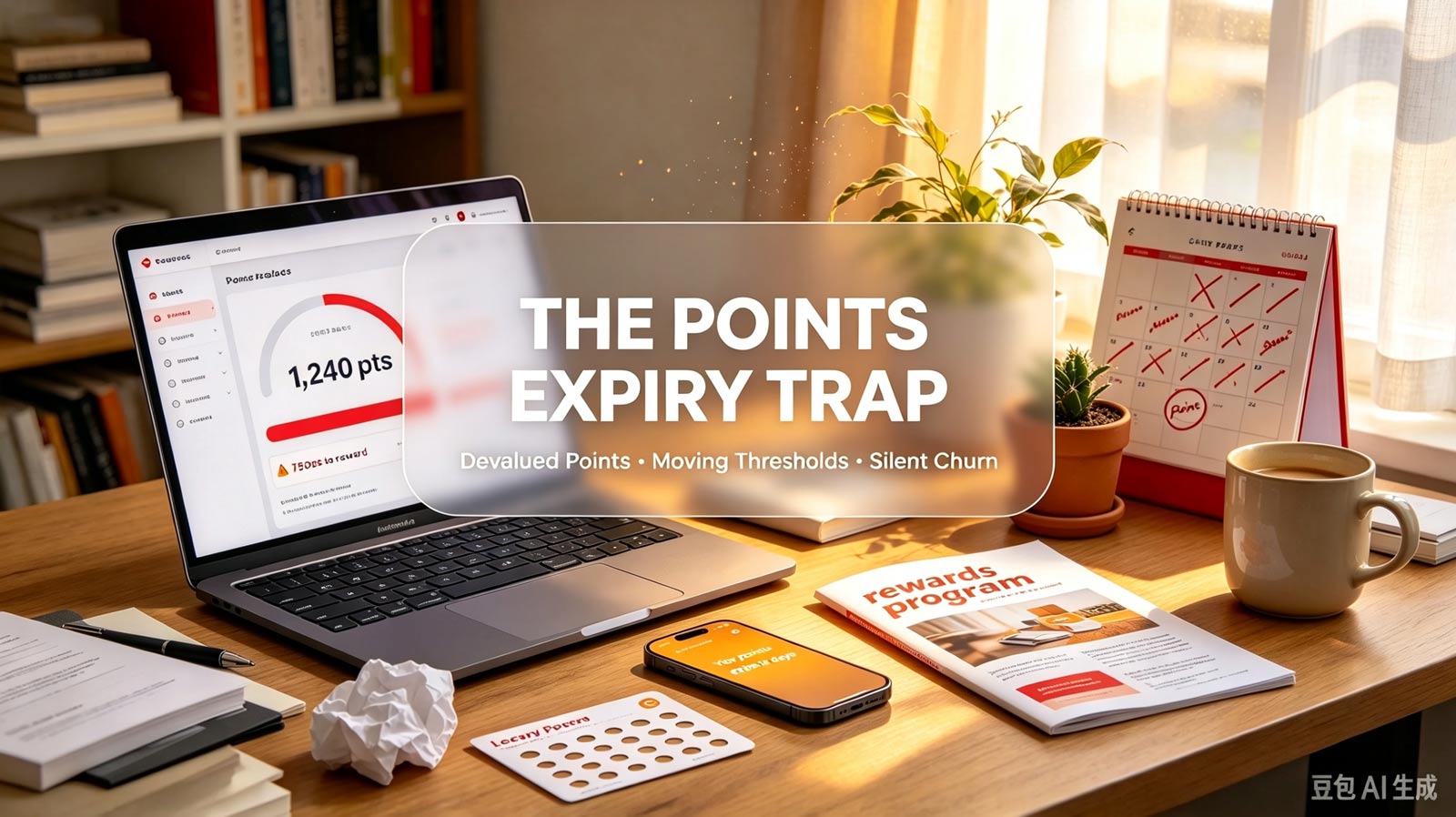
Start with the denominator. Points are a currency the issuer controls, and most programs dilute it constantly. A reward that required 500 points in 2023 quietly costs 750 in 2025—same effort, less payout. Members notice. Not through announcements, but through the gut feeling that the balance moves slower than it used to. Devaluation doesn't trigger complaints; it triggers disengagement, which is worse because it's silent.
Threshold design completes the sabotage. Behavioral research on goal-gradient effects shows effort accelerates near a reward—but only when the reward feels reachable. Programs engineered with expiry dates, tiny earn rates on low-margin items, and "just 200 points away!" nudges exploit that psychology until the member realizes the finish line keeps moving. At that moment the goal-gradient effect inverts: the closer the customer is forced to look, the more obvious the scam. The program hasn't just failed to motivate. It has trained the customer to distrust the brand.
The Membership That Feels Like a Debt
There is a second, quieter failure mode: program fatigue. The average online shopper now belongs to more loyalty programs than they can name, and each one demands attention—emails, tiers, expiring points, "you've unlocked Bronze" milestones. Attention is the scarcest currency in e-commerce, and every program competes for it.
The fatigue compounds when programs add friction instead of removing it. Points that require a calculator to understand. Rewards gated behind app downloads. Checkout flows that ask members to log in before applying benefits they already earned. Each step converts a perk into a chore. Chores get abandoned.
Worse, a bloated program changes how customers evaluate the brand itself. A shopper who feels manipulated by points arithmetic doesn't separate the program from the store. The suspicion bleeds: if the reward currency is rigged, what else is? Program distrust becomes brand distrust, and brand distrust is the strongest known predictor of churn. The program built to buy loyalty ends up buying doubt.
The Data Hiding in the Earnings
Points balances are also an open book—and for operators, the read is uncomfortable. Three patterns in a store's own loyalty data typically predict the churn before it shows up in revenue.
The Frozen Balance. A large cohort of members whose points stopped growing months ago hasn't forgotten the program. They've abandoned the effort. Frozen balances are the loyalty program's equivalent of a dead code: a record of broken promises. The longer the freeze, the colder the reactivation.
The Redemption Cliff. When members redeem once and never again, the program succeeded exactly once—at the moment of highest engagement—and failed every day after. Either the reward underwhelmed, or the path to the next one looked too steep. Single-redemption members are trial users who already delivered their verdict.
The Tier Drop-Off. If a meaningful share of members stalls one tier below the top, the program's ladder is mispriced. The gap between "almost VIP" and actual VIP is where churn concentrates, because the customer did the math and walked. Tier gaps are retention wounds that never appear in aggregate metrics.
Reading these three signals converts the loyalty dashboard from a trophy case into an early-warning system.
Fixing the Program Before It Fixes Your Churn
Intelligence earns its keep only when it changes behavior. Four moves convert the diagnosis into retention:
-
Cut the thresholds, not the rewards. A reward that arrives twice as fast at half the value retains better than one that arrives slowly at full value. Frequency of winning beats size of winning; the brain files repeated small payouts under "this brand treats me well."
-
Kill expiry on earned points. Expiry is the single most trust-destroying mechanic in loyalty. Points are wages, not coupons. Letting them expire converts the program from a relationship into a trap—and members treat traps accordingly.
-
Make balances legible in seconds. If a customer can't tell at checkout exactly what their points buy, the program is a black box. Black boxes get ignored. One clear line—"You have $12.40 in rewards"—outperforms any points arithmetic.
-
Reactivate the frozen cohort first. The cheapest retention in e-commerce is a member who already earned value and stopped collecting. A no-strings reward lands differently on someone with a dormant balance than on a stranger: it reads as the brand making things right.
Conclusion
Loyalty programs were built on a simple exchange: value for allegiance. When thresholds rise, currencies devalue, and attention gets taxed, the exchange collapses—and the collapse is silent. Customers don't cancel their membership; they cancel their engagement, and the store reads it as market noise. The programs that retain in this environment share one trait: they pay out faster, expire nothing, and ask for less. Loyalty was never bought with points. It was bought with the feeling that the brand keeps its side of the deal.