Introduction
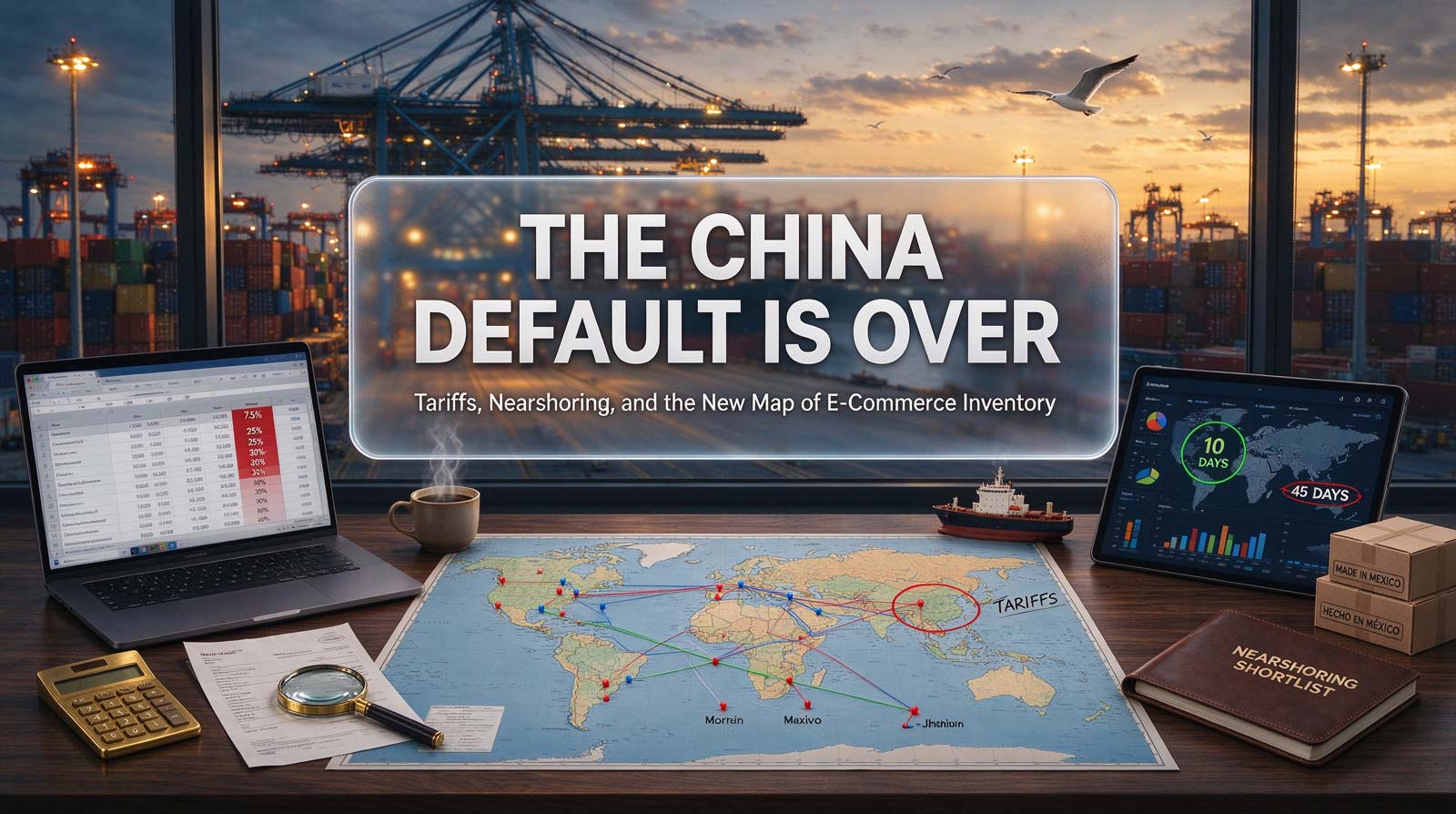
For twenty years, "where do I manufacture this?" had one answer: China. That answer just got expensive. The 2018 Section 301 tariffs put 7.5% to 25% on $370 billion of Chinese goods — and instead of disappearing, the tariff stack only grew: additional duties layered through 2025 pushed effective rates on many Chinese imports well past 30%, while Vietnam, the most obvious escape route, settled around 20% after its own trade deal — and drew aggressive transshipment enforcement for its trouble. The question sellers now face isn't whether to leave China, but how far. This article breaks down the tariff math, the nearshoring options that actually hold up in 2026, and a four-factor test for deciding if moving production is worth it for your catalog.
The Tariff Math That Broke the China Default
The U.S. International Trade Commission found that Section 301 tariffs drove a roughly 25% decline in imports of affected Chinese products between 2018 and 2021, with much of that production shifting to Southeast Asia and the Western Hemisphere. That was the warm-up. The 2025-2026 tariff regime layered new duties on top of the old ones, and the cost structure of China sourcing changed from "cheapest option with paperwork" to "cheapest option plus a margin-crushing toll."
The damage isn't just the tariff line on the invoice. It's the cash flow strain of paying duties upfront, before a single unit sells. It's the compliance overhead of customs classification. And it's the competitive asymmetry: your domestic rival doesn't pay any of it. When a 25% duty lands on a product with a 30% gross margin, you don't absorb it — you either raise prices and lose the buy box, or eat it and lose the business.
Nearshoring vs. Reshoring: Know the Difference
These terms get used interchangeably. They shouldn't be.
-
Nearshoring means moving production closer to your market without bringing it home — a U.S. brand shifting from China to Mexico, Vietnam, or the Dominican Republic. The prize is speed: 2-5 day shipping instead of 30-plus, plus tariff relief under trade agreements.
-
Reshoring means producing domestically. You get "Made in USA" premium pricing and zero tariff exposure, but you pay U.S. labor rates and inherit U.S. factory minimums.
The trade agreement detail matters enormously and is where most articles get sloppy. Mexico sits under USMCA, whose textile rules differ sharply from the "yarn-forward" standard of CAFTA-DR, which covers Central America and the Dominican Republic only — Mexico is not in it. The apparel industry's hybrid model is instructive: cut and sew in a CAFTA-DR country using U.S.-made fabric, and the garment enters the U.S. duty-free. Assume the agreement, get the rule wrong, and your "tariff-free" shipment gets reclassified at the border with penalties attached.
What the Transition Actually Looks Like
Here's the process end to end — a realistic scenario based on typical patterns. A seller in the home goods niche, 60% tariff exposure on landed cost, decides to move.
Months 1-3: supplier vetting. The Mexico shortlist is shorter than the Alibaba page suggests — fewer factories, higher minimums, and most won't take your purchase order seriously below quantities Chinese suppliers accepted. Budget three months and at least one factory visit. Video audits catch what emails hide.
Months 4-6: tooling and quality control. The furniture seller in this scenario cut delivery time from eight weeks to ten days and reduced landed cost 18% — but only after rebuilding its QC checklist from scratch, because "the same product" from a new factory is never the same product on the first run.
Months 6-12: the cash flow flip. Lead times collapse from 60 days to 10, which means inventory arrives weeks before you pay for it in full — and reorder cycles shrink from quarterly to monthly. All three transitions in this scenario reported the same surprising benefit: not tariff savings, but inventory velocity. Faster replenishment meant fewer stockouts, less dead stock, and working capital freed up everywhere at once.
Total transition cost: 6-12 months and real money. Typical ROI on that investment: 12-24 months for mid-priced goods, faster if your demand is volatile.
The Four-Factor Test
Not every catalog should move. Run yours through this:
-
Tariff exposure. Below roughly 7.5% of landed cost, moving rarely pencils out. Above 15%, it almost always does.
-
Shipping economics. Ocean freight plus duties versus higher unit costs plus near-zero freight. Do the math per SKU, not per brand — the answer flips across your catalog.
-
Inventory velocity. Unpredictable demand is nearshoring's best friend. If you reorder monthly anyway, a 10-day supply chain is transformative. If you sell steady evergreen volume on 90-day cycles, China still wins.
-
Production complexity. Simple products with few components transition cleanly. Multi-part assemblies with deep Chinese supplier ecosystems (electronics, anything with custom tooling) carry hidden switching costs that blow up timelines.
The sweet spot: retail prices between $20 and $200, simple bills of materials, and demand that moves around.
ShopFindBiz Perspective
Through a competitor analysis lens, the nearshoring wave is visible long before anyone announces it — and it's researchable tonight. Scan your category's leaders with ShopFindBiz and watch the leading indicators of a production move: delivery-time promises quietly dropping from "2-3 weeks" to "3-5 days," product descriptions swapping origin language, price points drifting up as tariff savings get reinvested in faster shipping, and new SKUs launching with nearshore-friendly simple construction. A competitor that moves first gets 6-12 months of fulfillment advantage before you see it in their revenue; you can see it in their storefront in a week. Track the freight signals too — when a niche's bill-of-lading patterns shift from Yiwu and Shenzhen to Monterrey and Ho Chi Minh City, the pricing war in that category is about to reset.
From Diagnosis to Action
The wave only matters if it changes what you do:
-
High tariff exposure, simple product: start the Mexico or CAFTA-DR shortlist now. Every quarter of delay is a quarter of margin you're donating to customs.
-
China-dependent complex assembly: don't move — negotiate. Use the tariff era to restructure supplier terms, and nearshore only your highest-velocity SKUs as a hedge.
-
Watching a competitor move: their transition window is your opening. Their costs spike and quality wobbles for two quarters — time your campaigns and your poaching accordingly.
-
Everyone in your niche is stuck: that's the opportunity. First mover on delivery speed in a slow-shipping category inherits the customers who were tolerating the wait.
Then point the lens inward: calculate your own tariff exposure per SKU tonight. Whatever percentage you find is the number your competitors' sourcing teams are already using against you.
Conclusion
Nearshoring isn't a supply chain tweak — it's the end of a twenty-year default. Tariffs didn't just raise costs; they made geography a strategic variable again, and the sellers treating it that way are already compounding advantages in cash flow, delivery speed, and stockout rates. The moves that work share a pattern: honest tariff math, SKU-level analysis, and supplier relationships built before the purchase order, not after. The manufacturing map is being redrawn one category at a time. The only question is whether your products are on it — or waiting for someone else to move first.