Introduction
Every Shopify store with a free-shipping bar is publishing a number it thinks you will not read closely. That threshold — $35, $50, $75 — is not a random perk. It is a calculated anchor, set against real order data, shipping contracts, and margin targets. Competitors rarely disclose their average order value, but their free-shipping minimum discloses it for them. This article shows how to read that number, what it reveals about a store's cost structure and growth stage, and how to use the same logic to set your own threshold with evidence instead of guesswork.
Why the Threshold Is a Confession
A free-shipping minimum exists to do one job: pull the average order value upward. Stores set it slightly above their current AOV, so that a meaningful share of carts must add one more item to cross the line. That means the threshold is almost always a proxy for the AOV itself — usually 10–30% above it.
The math is straightforward. If a store prices most items at $20–28 and sets the free-shipping bar at $50, it is telling you its typical order is one item, and its real ambition is the two-item basket. If the same catalog sets the bar at $75, the store either has heavier shipping costs, thinner margins, or a customer base already willing to buy in bundles. Either way, the number is a deliberate signal, and it is consistent with the rest of the storefront if you know where to cross-check it.
-
Threshold vs. pricing: Compare the minimum against the store's core price points. The gap between them is the upsell distance — and the size of that gap reveals how aggressive the store is about order building.
-
Threshold vs. catalog weight: Light products with high shipping thresholds signal strong margins and a branding play; heavy products with low thresholds signal a logistics cost problem being absorbed to protect conversion.
-
Threshold vs. discounts: A store pairing a high threshold with frequent sitewide sales is managing AOV in both directions — it wants bigger carts but will trade margin to get them.
What the Threshold Reveals About Cost Structure
Shipping is the one cost every store must price in, and the threshold shows how each store chooses to distribute it. There are three common strategies, and each reads differently.
Stores with a low threshold or free shipping everywhere are either absorbing the cost into product margin, negotiating carrier rates at real volume, or using fulfillment centers close to their customers. Stores with a high threshold are pushing logistics costs onto the customer until the order is large enough to dilute them. Stores with no threshold at all but inflated base prices have simply hidden shipping inside the product — which tells you their conversion funnel is sensitive to sticker shock at checkout, not at the product page.
The threshold also exposes growth stage. A new store often sets an arbitrary number — $50 because it sounds standard. A mature store sets a number tied to its data, and it changes that number as shipping contracts improve. Watching a competitor quietly lower their threshold over a quarter is often the first public sign that their volume has unlocked better carrier pricing — intelligence you can act on before they announce anything.
How to Read a Competitor's Threshold in Five Minutes
You do not need inside data to test what a store's minimum is telling you. The storefront will confirm or correct it quickly.
-
Build a sample cart: Add the store's best-selling item and note the gap to the threshold. That gap is the store's intended upsell unit — usually a specific accessory or bundle the store expects you to add.
-
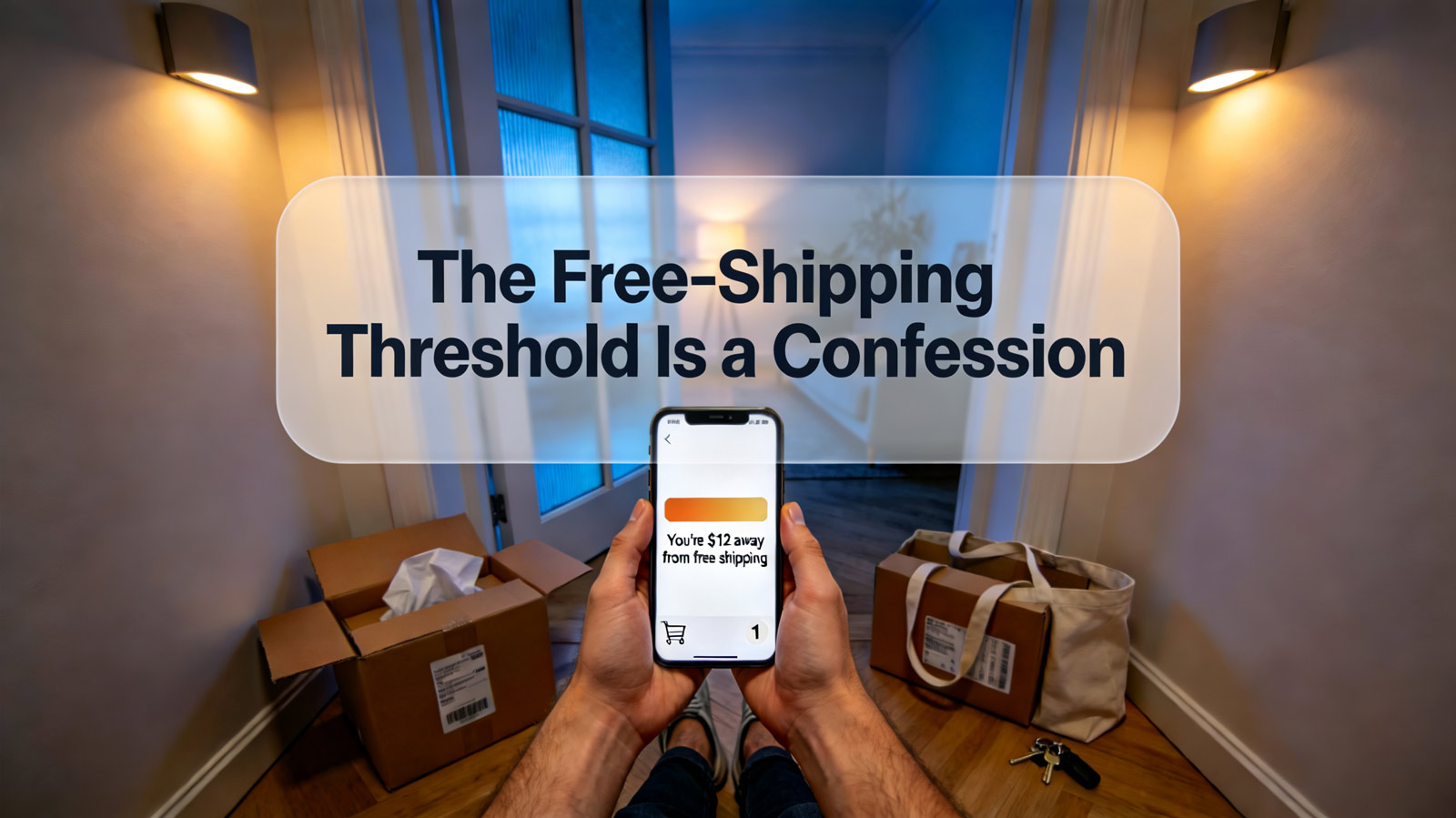
Check the announcement bar: Stores actively managing AOV rotate threshold messaging ("You're $12 away from free shipping") and A/B test the number itself. A changing bar signals active threshold experiments.
-
Watch the bundles: If the store sells pre-built bundles priced just above the threshold, the threshold was almost certainly set around the bundle price — not the other way around.
-
Compare across markets: A store showing different thresholds by country is disclosing its per-market shipping costs and AOV. The differences map its logistics network better than any shipping policy page.
Setting Your Own Threshold From Evidence
The same forensic logic works inward. Start with your actual AOV, not your aspirational one. Set the threshold 15–25% above it, then validate the gap: can a typical customer close it with one logical add-on, or does it require two? One add-on converts; two create abandonment.
Then pressure-test the number against shipping reality. If your most common order costs you $6.80 to ship and your threshold triggers at $50, know exactly what margin remains on the average qualifying order. A threshold that protects AOV but quietly destroys margin on every order over the line is a trap — many stores discover their "free shipping" orders are their least profitable.
Finally, treat the threshold as a living variable. Review it quarterly against AOV movement, carrier rate changes, and competitor shifts. The stores that treat free shipping as a fixed feature leave money on the table; the stores that treat it as a tuned instrument — adjusted against data, tested against the market — turn a logistics cost into one of their most reliable levers.
Conclusion
A free-shipping minimum looks like a customer perk. It is actually a published statistic — a store's honest estimate of what its customers spend, what its shipping costs, and how hard it is willing to push for a bigger basket. Competitors publish this number on every storefront, usually in the announcement bar, and rarely expect anyone to interrogate it. Read the threshold, test it against pricing and catalog weight, and you can reverse-engineer the economics behind it. Then apply the same discipline at home: set your minimum from your data, tune it against your costs, and revisit it as both change. The bar on your storefront is not decoration. It is a strategy statement — make sure it says what you actually mean.