Introduction
Every e-commerce store dreams of the same product: the hero SKU that scales hard, dominates the ad account, and carries the quarter on its back. That dream has a predictable ending. The hero product peaks in six weeks, attracts forty copycats, gets bid into unprofitability, and spends the rest of its life on discount. Meanwhile, a quieter category of product keeps compounding in the background: the filter that needs replacing every ninety days, the pod that runs out monthly, the blade that dulls, the refill that empties. These consumables rarely win awards and almost never trend. They simply sell again, on schedule, without new ads, to customers who already trust the brand. In 2026, with acquisition costs structurally elevated and privacy rules degrading targeting every quarter, the product that resells itself is worth more than the product that sells loudly. This article examines why consumables now generate more lifetime revenue than one-time bestsellers, what the repeat purchase economics actually look like, and how to identify consumable winners before the market prices them correctly.
Three Forces That Make Consumables the Real Winners
-
They convert acquisition cost into an annuity. A one-time bestseller must pay back its full acquisition cost in a single order, or the store loses money. A consumable pays it back across four, six, or twelve orders. The same $30 acquisition cost is a bet on one transaction for the bestseller and a bet on a revenue stream for the consumable. As CPMs keep climbing, only the second bet stays rational.
-
They are insulated from the copycat cycle. A viral hero product is reverse-engineered and listed on a marketplace within weeks, often at half the price. A consumable's moat is not secrecy; it is habit. Once a customer's coffee machine, pet feeder, or skincare routine is stocked with a specific refill, switching costs are real even when the product itself is simple. Competitors can copy the pod. They cannot copy the sixty refills already purchased.
-
They make revenue forecastable. One-time products produce spiky, promotion-dependent revenue that is hard to plan around. Consumables produce rhythm. A store with 5,000 active refill customers and a 70% reorder rate can project next quarter's baseline revenue with unusual confidence, and that confidence changes everything from inventory orders to ad budgets to hiring.
What the Consumable Economics Look Like
The economics of a repeat purchase engine rest on one trade: a slower, quieter first sale in exchange for a revenue curve that compounds instead of decaying.
-
First-order margin: Consumables often win the first order at modest or even negative margin, because the product is priced to enter the routine. The profit arrives on orders two through ten, not order one. Stores that judge consumables by first-order ROAS systematically abandon their best products.
-
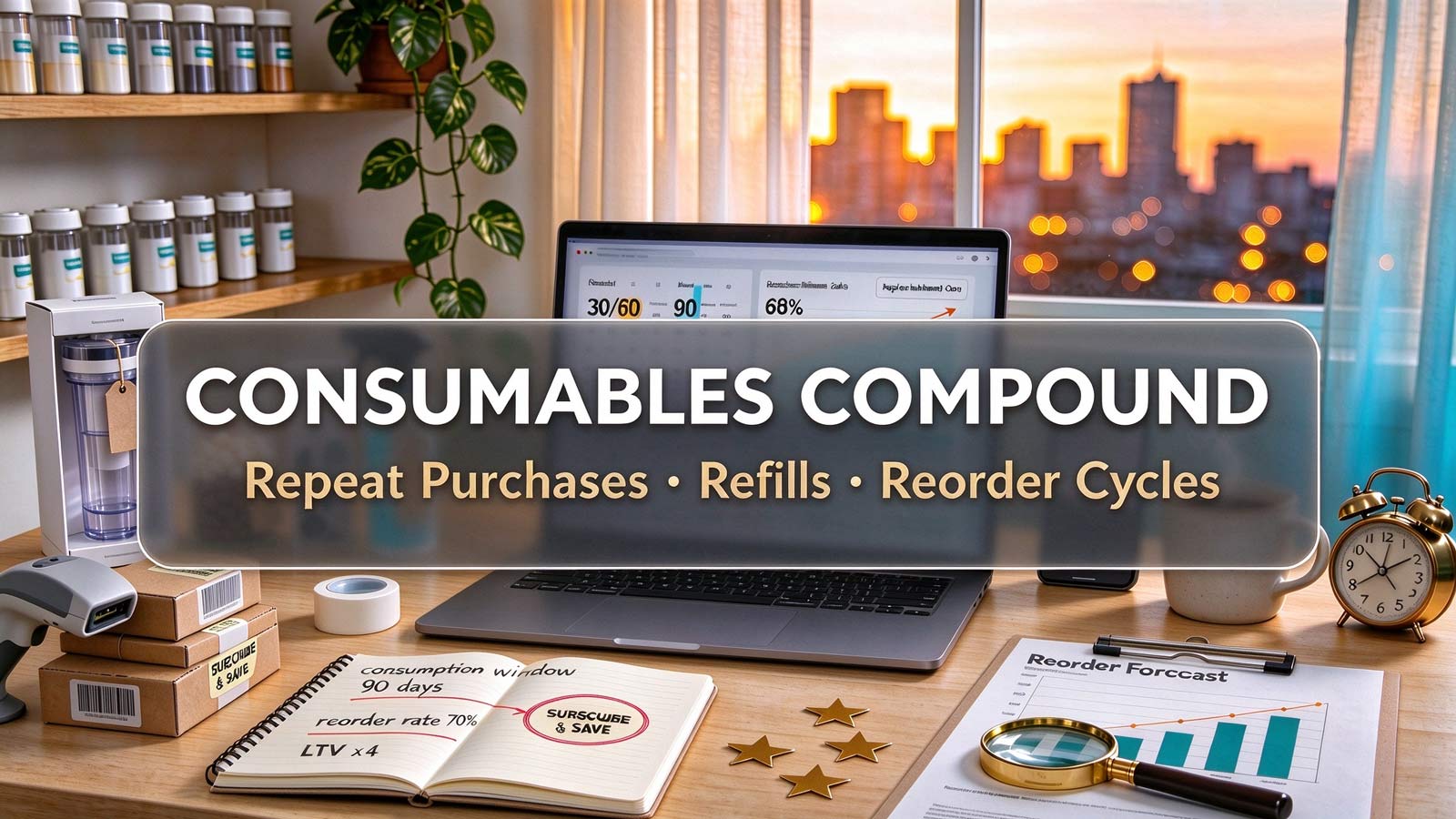
Repeat purchase rate: Strong consumable programs see 50-70% of customers reorder within the expected consumption window, provided the window is short (under 60 days) and the replenishment reminder arrives on time. Weak programs treat the refill as an afterthought and fall below 20%.
-
Time between orders: The ideal consumption cycle is 30-90 days. Shorter than 30 days and logistics costs eat the margin; longer than 90 days and the customer forgets the brand exists. The 90-day window is where most consumable economics quietly die or quietly compound.
-
Customer lifetime value: A consumable customer acquired at $30 can return 3-6x the first-order revenue over 18 months, with marketing cost approaching zero after the third order. A bestseller customer returns exactly one order, forever, unless reacquired.
-
Discount dependence: Repeat buyers of consumables rarely need incentives. Reminder timing, not percentage off, drives the reorder. Stores routinely find that a well-timed "your filter is due" email outperforms a 20% coupon by a wide margin.
Five Signals a Product Is Built to Become a Repeat Purchase Engine
-
It empties, wears out, or expires on a predictable schedule. Refills, filters, blades, pods, serums, supplements, and cleaning agents all announce their own replacement date. That predictability is the entire business model. If the customer cannot tell you when they will need the next one, the product cannot build a rhythm.
-
It lives inside a routine, not a whim. The morning coffee pod, the monthly pet supply, the quarterly water filter, the weekly face mask. Products attached to existing habits reorder themselves because the habit, not the marketing, triggers the purchase. Products attached to novelty must re-earn attention every single time.
-
It locks compatibility without locking trust. The best consumables fit a specific device or system (a particular machine, bottle, or tool) while remaining excellent enough that customers would choose them anyway. Compatibility creates the reorder; quality prevents the workaround.
-
It ships small and light at full price. Consumables succeed or fail on shipping economics. A $14 refill with free shipping only works if the product is light, durable, and cheap to mail. Bulky consumables surrender their margin to the carrier and their category to whoever localizes first.
-
It invites subscription without requiring one. The strongest consumables convert to subscriptions at 20-40% attach rates when the subscribe option is positioned as convenience rather than discount. Heavy-handed subscription pressure on a first order backfires; gentle "never run out" framing after the second order converts.
The New Operational Bar
Selling consumables is an operations discipline disguised as a marketing play. Four capabilities separate a compounding refill business from a pile of unsold stock:
-
Consumption-window analytics: Track not when customers can reorder but when they should. Model the expected depletion date per SKU and trigger replenishment outreach a few days before the product runs out, not weeks after. Most stores email too late and blame the product.
-
Subscription architecture: Offer subscriptions after the second order, not the first, and frame them around continuity rather than savings. A "skip, pause, swap" control panel converts fence-sitters, because the dominant objection to subscribing is loss of control, not price.
-
Bundle and replenish design: The first order should be a starter setup (device plus first consumable), and the consumable should be impossible to miss in the post-purchase flow. Stores that sell the durable and bury the refill are building their competitor's annuity.
-
Loyalty loop closure: Reward reorder behavior, not just spend. Points for on-time refills, early access to new consumable variants, and tier benefits tied to continuity all reinforce the rhythm. The goal is a customer who feels the brand owns their replenishment calendar — because it earned it.
Conclusion
The bestseller gets the headline; the consumable gets the business. One-time heroes convert loudly, decay quickly, and leave the store buying the same customer again next quarter. Consumables do the opposite: they accept a quieter first sale, enter the customer's routine, and return on schedule with minimal marketing spend and near-zero discount pressure. In a market where acquiring a stranger keeps getting more expensive, the product that turns one acquisition into twelve orders is not a niche strategy — it is the only arithmetic that still closes. The stores that win the next five years will not be the ones that find the next viral product. They will be the ones that stock the products which empty, wear out, and come back — and that build the operations to be waiting when they do.