Introduction
Review counts get all the attention. Timestamps get none — and timestamps are where the truth lives. A store can curate its star ratings, seed its testimonials, and scrub its worst complaints. But it cannot fake the rhythm of when reviews arrived, because that rhythm is generated by real orders shipped to real addresses on real dates. Read the timeline instead of the average, and a competitor's review section stops being a marketing asset and becomes a diagnostic instrument: one that tells you whether the store is scaling, stalling, seasonal, or quietly buying its own credibility.
Why the Timeline Beats the Rating
The average rating answers one question: how do happy customers feel? The timeline answers better ones: how many customers exist, whether their numbers are growing, and whether the store's operation can keep pace with its own demand. Two stores can both sit at 4.8 stars with two thousand reviews and be opposite businesses — one adding forty verified reviews a week on a steady cadence, the other that added fifteen hundred reviews in its first six months and barely fifty since.
Aggregates flatten that difference into invisibility. Timestamps restore it. Every review carries a date, and every date is a data point in a public time series — free, unguarded, and impossible to retroactively edit without leaving scars. Scars like bulk uploads of reviews on consecutive days, long silent gaps after a launch surge, or a suspicious cluster of five-star praise the week a new product dropped. The timeline is the one place a store's actual momentum is on permanent public record.
The Four Velocity Patterns
Pull the last ninety days of review dates from any store and one of four patterns emerges:
-
Steady cadence. Reviews arriving at a consistent weekly rate, spread across products, mixing four- and five-star with the occasional complaint. This is a healthy engine: predictable order volume, fulfilled on time, with real customers volunteering feedback. This store is scaling sustainably — and its review base is a moat you can't argue with.
-
Launch spikes. A burst of reviews around new product drops, then near-silence between launches. The store lives campaign to campaign; between drops, cash flow is thin and customers aren't reordering. Its vulnerability is the gap — that's when its audience is unengaged and reachable.
-
The flatline with a history. A dense block of old reviews, then a trailing silence that has lasted months. Traffic may still look fine — legacy SEO doesn't die fast — but the store stopped converting somewhere along the way. Dead or dying operations keep their storefronts lit long after the engine quits; the review timeline is the first place it shows.
-
The manufactured pulse. Reviews arriving in machine-like clusters — ten on a Tuesday, twelve the next, all five-star, similar phrasing, reviewer accounts with single reviews. Timestamps expose planted reviews better than any text analysis, because real customers don't order on a schedule. Where authenticity is being faked, everything else is worth doubting too.
Reading Velocity Like a Vital Sign
Velocity doesn't just separate real from fake — it measures operational health. A store whose review inflow is accelerating is a store whose fulfillment is keeping up with its marketing; a store whose inflow is decelerating while its ad presence grows has hit a wall somewhere between the click and the doorstep, and its customers are silently churning.
Seasonality matters too. A supplement store that goes quiet every February isn't failing — it's cycling. But a store in a non-seasonal category showing seasonal silence has a demand problem, not a calendar problem. Cross-reference velocity against the store's own promotional calendar: if reviews spike only during sitewide sales, its base price doesn't move product, which means its margins are built on discounts and its full-price days are borrowed time.
And watch the complaint velocity most carefully of all. The rate of negative reviews matters more than the count. One angry review a month is noise; the same one-star ratio doubling quarter over quarter is a fulfillment or quality system breaking in public — often months before the store's revenue chart admits it.
Cross-Check the Timeline Against the Data
Review velocity is evidence, but it's incomplete evidence — it shows orders, not traffic. Reconcile the two with a store intelligence tool like ShopFindBiz.
If a store's review inflow is flat while its estimated traffic is climbing, something between visit and purchase is leaking: pricing, shipping costs, or trust. If reviews are decelerating while traffic holds steady, the leak is on the fulfillment side — and either way, customers are arriving unsatisfied, which is the cheapest kind of customer for you to win. If review volume is high but product count is thin and static, the store is a one-hit operation riding a single hero SKU; flank the product, don't chase it. Timestamps tell you the heartbeat; traffic data tells you whether the patient is running a marathon or standing still.
A Walkthrough: Reading a Store in Fifteen Minutes
Here's the process end to end — a realistic scenario based on typical patterns. A seller is evaluating a competitor in the home organization niche.
First pass: 1,900 reviews, 4.7 average. Surface looks solid. Second pass: sort by date. The last thirty days produced four reviews. The thirty days before that: three. But scroll back eight months and the store was adding twenty-five a week. The timeline shows a cliff — and the most recent reviews mention slower shipping and a changed product material. Third check: ShopFindBiz shows traffic roughly stable, catalog unchanged, prices unchanged.
The diagnosis writes itself: demand is still arriving, but the operation degraded — likely a supplier switch or a fulfillment downgrade — and repeat customers stopped reordering. The store is living on acquired traffic and legacy SEO while its review engine starves. The attacking seller builds its pitch on the exact complaints now appearing in the timeline — faster shipping, original materials, a visible quality guarantee — and courts the customers the competitor's own reviews just orphaned. Fifteen minutes of timestamp reading turned a 4.7-star "strong competitor" into a store bleeding out in public.
From Diagnosis to Action
Reading velocity only matters if it changes what you do:
-
Steady cadence store: don't attack its reviews. Attack its gaps instead — the products its customers praise but wish existed, the complaints it answers slowly. Its momentum is real; your opening is qualitative.
-
Launch-spike store: time your campaigns for the gaps between its drops, when its audience has nothing new to buy and its ads go quiet.
-
Flatline store: its SEO position is an unguarded asset. Move on its keywords and catalog now — the rankings will outlive the operation, and you can inherit them.
-
Manufactured-pulse store: document it, then don't compete on trust at all — compete on verifiable proof. Real reviews with real photos beat a wall of five stars the moment anyone looks twice.
Then point the same lens inward. Pull your own last ninety days of review timestamps. The pattern your competitors see when they read yours is the same pattern you'll be judged by — and it's the cheapest competitive audit you'll ever run.
Conclusion
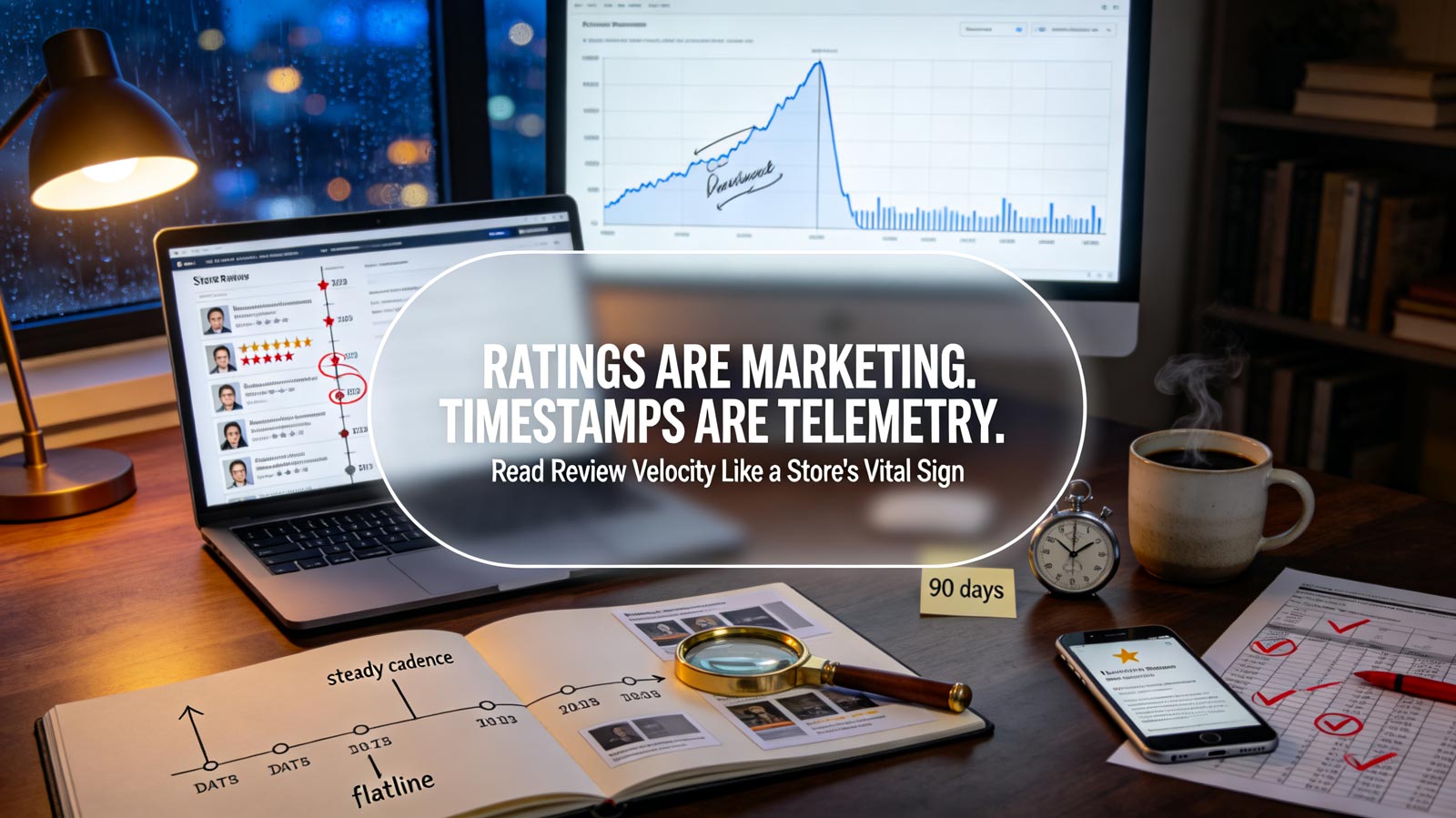
Star ratings are marketing. Timestamps are telemetry. Sort any store's reviews by date and its real condition surfaces within minutes — growth, stall, seasonality, or fabrication, all logged publicly by the only people whose opinions the store can't script: customers with order numbers. Review counts tell you what a store wants you to believe. Review velocity tells you what's actually happening. Read the timeline before you read the testimonials — the truth was published the whole time, one date stamp at a time.