Introduction
Every store answers one message honestly. You just have to know how to ask. A single support inquiry — timed right, asked right — exposes whether you're looking at a staffed operation with documented systems or a founder juggling inboxes between supplier calls. This guide gives you a five-minute protocol for running the test on any competitor, a scoring sheet for reading the results, and the one cross-check that tells you whether its polite reply is confidence or camouflage.
The Protocol: Three Questions, Three Channels, Three Time Slots
Consistency is what makes the test diagnostic. Send the same three scripted questions to every store you analyze:
-
The knowledge question — a specific product detail buried in the listing ("does the XL size have the reinforced strap shown in the third photo?"). This tests whether answers live in a knowledge base or in someone's head.
-
The policy question — returns, warranty, or a "what if it arrives damaged" scenario. This tests whether policies are documented or improvised.
-
The complexity question — bulk pricing, customization, or a use case slightly outside the product's obvious lane. This tests escalation: can frontline support hand you to someone with authority?
Send all three through every channel the store offers — email, live chat, Instagram DM. A store that answers chat in seconds but leaves email unanswered for days has decorated its storefront, not built a support system. Then repeat the test in two more windows: a weekday morning and a weekend evening. Weekday-only responses mean the founder is still the support team; weekend coverage means dedicated staff, which at market rates implies at least a few thousand dollars a month in committed payroll.
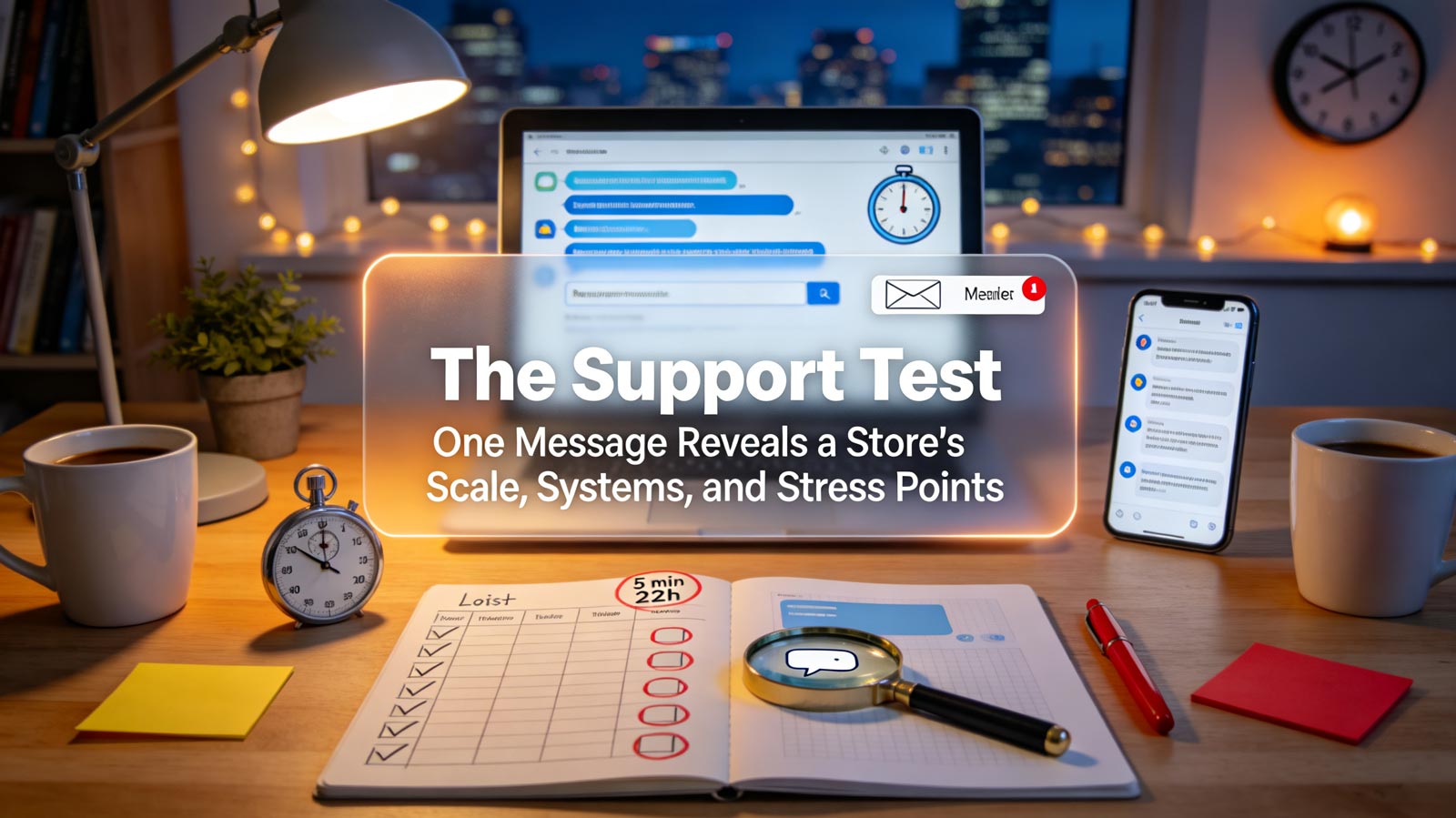
Log five data points per test: response time, accuracy, whether the answer actually addressed the question, whether a human or template replied, and whether anyone followed up. That sheet is your diagnosis.
Reading the Results: What the Patterns Reveal
Scale. Chat answered by a human in under five minutes signals a staffed team, not a side hustle. Email inside two hours signals a systematized operation; beyond 24 hours usually means the owner is answering between other jobs — small, and possibly fragile. References to "our logistics team will get back to you" reveal departmental structure; a single voice handling everything reveals its absence.
Systems. Instant but rigid replies that can't deviate from a script suggest a helpdesk stack running on templates — organized, but shallow. A store that answers the knowledge question perfectly but stumbles on the policy question has invested in product training but not documentation. Bots with no human escape hatch are a facade: efficient-looking, brittle under anything unusual.
Stress points. Conflicting answers across channels mean poor internal communication. Heavy deflection to FAQ pages under a simple policy question often means the team is underwater. And the most exploitable signal of all: consistent quality on weekdays that degrades sharply on weekends — that's capacity strain, visible from the outside, exactly when customers are shopping.
Cross-Check the Story Against the Data
A polite reply is a claim; traffic is evidence. Before you act on the diagnosis, reconcile the two with a store intelligence tool like ShopFindBiz.
If support insists they're "swamped with orders" while estimated traffic has been flat or falling for three months, the pressure is financial, not operational — a bluff, and a store defending its image more than its customers. If response quality is degrading while traffic is spiking, you've found a growth-pain window: demand exceeding infrastructure is precisely when customers are most willing to try an alternative. And if support is razor-sharp but traffic is modest, you've found a store that executes well and markets poorly — its catalog is worth studying, because its products clearly satisfy the people who find them.
A Walkthrough: Two Stores, Two Different Prey
A realistic scenario based on typical patterns: a seller tests two competitors in the home fitness niche. Store A: chat connects in three minutes, but the agent can't answer the returns question and deflects to a FAQ that doesn't address it. Store B: no chat at all; the email answer arrives in twenty-two hours — but it's a four-hundred-word reply from the founder, precise on every question including bulk pricing.
Two completely different vulnerabilities. Store A has payroll but no knowledge base — attack with policy transparency, comparison ads built on its own FAQ's gaps. Store B is founder-dependent and high-touch — its customers are loyal, so don't fight for them head-on; instead target the segments it can't serve quickly, where its twenty-two-hour delay loses the sale. One protocol, two opponents, two opposite playbooks.
Fortify Your Own Front Door
One caveat before you go testing everyone: this works in both directions. Your rivals can run the same protocol on you tonight. So run it on yourself first — same three questions, same channels, same weekend window. Whatever the sheet exposes is what every competitor can already see. Close the worst gap first: usually that's the policy question, because it's the cheapest to fix with a documented page and a saved reply. An unanswered test costs you nothing to find. An unanswered customer never tells you they left.
Conclusion
Analytics dashboards show you what a store did. A support thread shows you what a store is — staffed or solo, systemized or improvised, confident or strained. Send the three questions, log the five data points, cross-check the story against the traffic, and you'll know more about a competitor's real condition than a month of ad spying. The message takes a minute to write. The answer is worth a teardown.