Introduction
Every store advertises confidence on its homepage. The warranty page is where it has to prove it. A guarantee is a promise with a price tag attached, and the terms a store sets — how long coverage runs, what it excludes, how claims are handled — are calculated from the store's real margins, supplier leverage and product quality, not from its marketing copy. Read the warranty page the way an analyst reads a balance sheet, and a competitor's supposed secrets become visible: which products it profits from, which suppliers it controls, and where its catalog is fragile.
Why Warranty Terms Are a Margin Signal
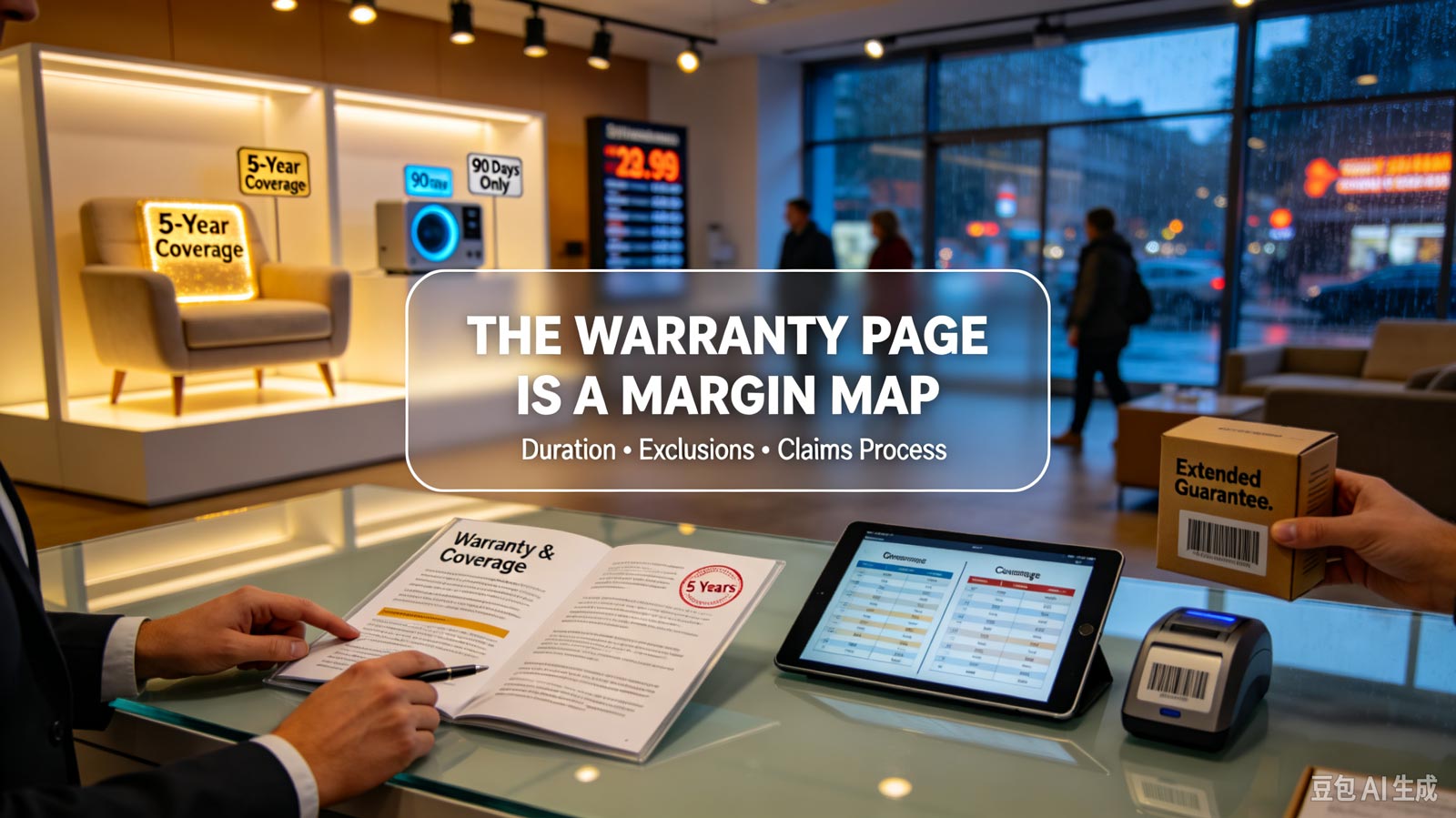
A warranty is an insurance policy the store writes on itself. Every month of added coverage increases the expected number of claims, and the store only extends that exposure when the profit on the product comfortably absorbs it. This is why warranty length functions as a rough margin map. A store offering five years on its house-brand furniture and ninety days on third-party electronics is telling you exactly which lines carry real markup and which lines are thin pass-throughs.
The structure matters as much as the length. Coverage that excludes the most common failure modes is coverage priced for products that fail predictably. Scratch-resistant claims on items reviewers say scratch easily, water-resistance exclusions on products marketed for outdoor use — these mismatches between the marketing story and the warranty fine print mark the gap between what the store sells and what it delivers.
The warranty page also exposes supplier relationships. Store-brand products with generous coverage signal direct factory relationships strong enough to push defect costs back up the supply chain. Products carrying only the manufacturer's default warranty, by contrast, are catalog filler the store cannot or will not stand behind — and that passivity reveals weak leverage with its own suppliers.
What the Fine Print Actually Reveals
Three fields on a warranty page do most of the analytical work. The coverage duration and what triggers it tell you how long the store expects the product to last without complaints. The exclusions list tells you where failures are most likely and most expensive. The claims process — whether it is a self-service portal, an email to a generic address or a third-party administrator — tells you whether warranty cost is a managed line item or an afterthought.
-
Duration by product line: compare coverage across a store's own catalog; the spread between its longest and shortest guarantees maps its internal margin ranking.
-
Exclusion density: a paragraph of exclusions on a simple product signals known defect modes the store would rather not pay for.
-
Claim friction: stores that make claiming deliberately difficult expect claims, which means they expect failures — a quality signal no review average will show you.
-
Coverage on accessories and consumables: generous coverage on low-ticket items is a confidence flex; tight coverage there is ordinary caution and says little.
Practical Applications for Retailers
Turning warranty pages into competitive intelligence takes one systematic pass. First, collect warranty terms from five to ten competitors in your niche, recording duration, exclusions and claims process for their flagship and entry-level products. Second, normalize by product category, since coverage norms differ across electronics, furniture and apparel; only deviations from the category baseline are informative. Third, cross-reference the findings with pricing: stores pairing long warranties with rising prices over the past quarter are monetizing their confidence, while stores quietly shortening warranty terms are usually absorbing margin pressure.
-
Benchmark before you build: match or beat the category's coverage baseline only on products where your margins genuinely allow it; overpromising coverage you cannot fund converts warranty cost into churn.
-
Attack the exclusion gaps: if competitors exclude the failure mode their reviews complain about most, a product built to survive that mode — with coverage that says so — wins the comparison table instantly.
-
Read the shortening window: when a competitor reduces warranty length or tightens terms, expect price hikes or cost cutting to follow; that is your cue to capture its price-sensitive buyers.
-
Use coverage as listing copy: warranty terms are among the last things shoppers read before checkout, so state yours in plain, confident language where the comparison happens.
Best Practices for Reading — and Setting — Warranty Terms
Treat warranty analysis as a recurring audit, not a one-time look. Terms change quietly, and a mid-year revision to exclusions or claims processes is often the earliest public sign of a quality problem or a margin squeeze. Recheck your top competitors twice a year and log every change with its date; the timeline itself becomes a strategic record of how their economics are shifting.
Keep the signal honest by reading warranties against reviews, not alone. A store offering generous coverage on a product whose reviews are full of failure reports is not confident — it is managing a claims backlog, and the cost of that will eventually surface in price or terms. Conversely, short coverage on a flawless product line is an untapped opening: a competitor with strong quality and weak coverage language has left conversion on the table that better-presented terms can capture.
Finally, set your own terms with the same discipline you use to read others'. Warranty cost is a knowable percentage of revenue once claim rates are tracked, and a store that knows its numbers can confidently offer coverage competitors dare not match — turning the warranty page from a legal obligation into a positioning weapon.
Conclusion
The warranty page is the rare part of a store that is legally required to be honest. Duration, exclusions and claims process add up to a disclosure of margins, supplier leverage and product confidence that the homepage never makes. Read competitors' warranties systematically, set your own terms from measured claim data, and a compliance page becomes one of the most revealing instruments in store analysis.