Introduction
In 2026, global trade is experiencing a period of "slow growth".
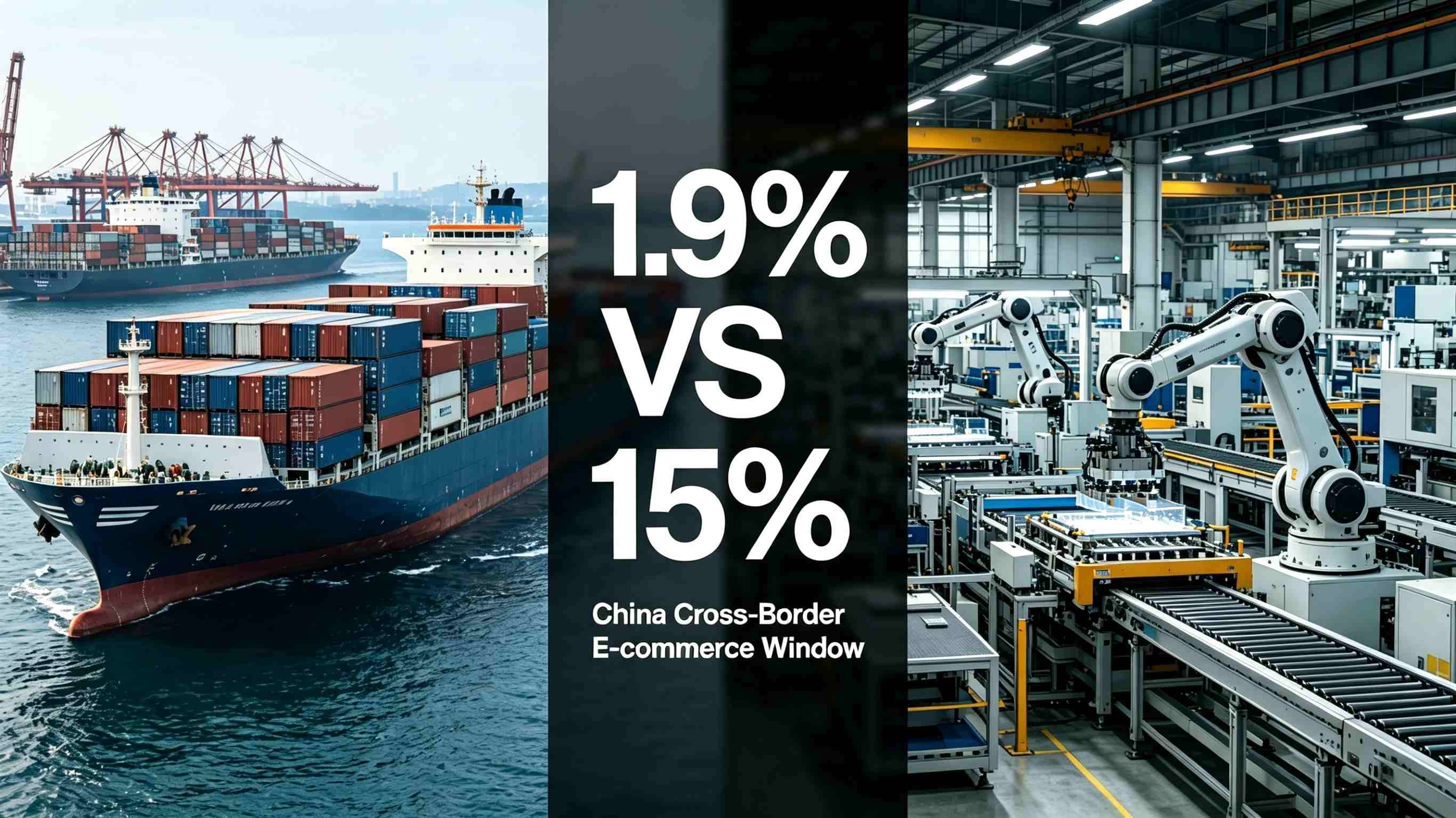
In its latest Global Trade Outlook and Statistics report, the WTO (World Trade Organization) lowered its baseline forecast for global merchandise trade growth in 2026 to 1.9% . This is one of the lowest growth rates since the 2009 financial crisis, excluding pandemic years.
But at the same time, China also released its first-quarter foreign trade data : the total value of imports and exports of goods reached 11.84 trillion yuan, a year-on-year increase of 15% . Not only did this mark the first time in history that the first quarter's value had exceeded 11 trillion yuan, but the growth rate was also nearly eight times the global average .
On one hand, global trade is frozen; on the other, Chinese exports are booming. How did this "window of opportunity" open? How long can it remain open? What does it mean for Chinese cross-border e-commerce sellers?
I. 1.9% vs. 15%: The Truth Behind These Two Numbers
WTO 2026 Global Trade Forecast:The WTO's baseline forecast for global trade in 2026 shows that global merchandise trade growth will be only 1.9%, one of the lowest levels in the past 15 years; global services trade growth will be slightly better at 3.5%. The main downside risks come from geopolitical conflicts, rising protectionism, and ample supply chains, resulting in high overall uncertainty.
China's foreign trade data for Q1 2026:In comparison, China's total import and export value of goods trade in Q1 2026 reached 11.84 trillion yuan, a year-on-year increase of 15%. Among them, exports were approximately 6.8 trillion yuan, an increase of approximately 12% (estimated value), and imports were approximately 5.0 trillion yuan, an increase of approximately 19% (estimated value). At the same time, cross-border e-commerce exports continued to grow, and the growth rate was higher than that of traditional foreign trade.
Key question : Why did China's exports still grow by 15% when global trade was almost at a standstill?
II. China's "Triple Engines" of Exports
Engine 1: Supply Chain Resilience
The COVID-19 pandemic and supply chain crisis of 2020-2022 actually became a "stress test" for China's manufacturing industry. While factories in Vietnam, India, and Mexico were shut down due to the pandemic, Chinese factories restored 90% of their production capacity within two months.
What is the result? Global buyers have developed a "path dependence"—even though they know they need to "diversify their supply chains," when it comes to actually placing orders, they still look for Chinese suppliers because their reliability and delivery speed are irreplaceable .
Data support : In Q1 2026, China's exports to ASEAN increased by 18%, exports to the EU by 10%, and exports to the US by 8%. Even against the backdrop of trade frictions, the US remains one of China's largest single export markets.
Engine 2: Industrial Upgrading
China's exports are shifting from "low-end manufacturing" to "mid-to-high-end manufacturing".
New energy vehicle data for the first half of 2026 : China's production and sales of new energy vehicles both exceeded 7 million units , and exports continued to lead the world. However, this article focuses on another aspect—the spillover effect of industrial upgrading on cross-border e-commerce.
When Chinese factories are able to produce new energy vehicles, they can also produce: - higher quality smart home products - more sophisticated fitness equipment - more environmentally friendly reusable consumer goods - more complex electronic components.
What this means for Shopify sellers: China's supply chain is "naturally upgrading." You just need to find the right factory to get better and cheaper products than your competitors.
Engine 3: Mature infrastructure for cross-border e-commerce
Logistics: The delivery time for dedicated logistics lines from China to Europe and the United States will be shortened from 15-20 days in 2019 to 5-8 days in 2026 (major cities). Overseas warehouse coverage will expand from first-tier cities to second-tier cities.
Payment: The transaction fees for cross-border payment tools (Payoneer, PingPong, Lianlian Pay) have decreased from 3-5% to 0.5-1%, and the withdrawal speed has been shortened from T+7 to T+1.
Compliance: The professionalism and standardization of services such as VAT registration, trademark registration, and product certification enable small and medium-sized sellers to go global in compliance with low costs.
Platforms: The onboarding process for Chinese sellers on platforms such as Shopify, Amazon, TikTok Shop, and Temu is becoming increasingly simplified.
III. How long can the window of opportunity for counter-trend trading remain open? Three variables.
Variable 1: Geopolitics
The US de minimis policy for goods under $800 is being tightened. In 2026, US Customs increased scrutiny of small packages, causing logistics costs for Temu and Shein to rise by 10-15%.
Impact on independent website sellers:
- If you are using the Dropshipping model (single-item direct shipping), the cost will increase.
- If you are shipping in bulk to an overseas warehouse, the impact will be relatively small.
- In the long run, compliance is the trend, and the space for "gray customs clearance" will become smaller and smaller.
Variable 2: Exchange rate fluctuations
In 2026, the RMB exchange rate against the US dollar is expected to fluctuate between 7.0 and 7.3. For exporters, RMB depreciation is beneficial (they receive more RMB in return), but appreciation will compress profits.
Recommendation: Avoid gambling on exchange rates. Lock in exchange rates for 3-6 months using forward exchange instruments, or directly price and receive payments in USD.
Variable 3: Increased competition
30% in 2025-2026 , but the average store GMV will only increase by 15% . This means that the number of people sharing the pie is growing faster than the pie itself .
Conclusion: The window of opportunity for a turnaround won't stay open forever. Optimistically, there are still 2-3 years . Pessimistically, competition will bring profit margins back to the global average within a year .
IV. How can independent website sellers seize the last window of opportunity?
Strategy 1: Shift from "selling goods" to "selling the brand"
- The advantage of China's supply chain is shifting from "cheap" to "good and cheap".
- However, if something is "good and cheap" but lacks a brand, it will ultimately fall into a price war.
- Build your own brand website with Shopify to accumulate customer data and brand assets.
Strategy 2: From "One Platform" to "Multi-Channel Deployment"
- Don't put all your eggs in one basket.
- Independent website (Shopify) + Platform (Amazon) + Social e-commerce (TikTok Shop) + Wholesale (B2B)
- Each channel plays a different role: independent websites build brand awareness, platforms drive sales, and social media acquire customers.
Strategy 3: Shift from "Popularization" to "Vertical Cultivation"
- By 2026, the survival space for the grocery store model will be shrinking.
- Choose a niche product category and develop it thoroughly.
- Use ShopFindBiz to analyze the top players in this niche and find a differentiated entry point.
Strategy 4: Shift from "shipping from China" to "overseas warehouses + local supply chain"
- Logistics speed is becoming a key variable in conversion rates.
- Even for dropshipping, priority should be given to supply chains with overseas warehouses.
- Once monthly sales stabilize, consider bulk stocking up on inventory for warehouses in the US/Europe.
V. Data Speaks: A True Portrait of China's Cross-Border E-commerce
Estimates based on industry reports from the General Administration of Customs of China:China's total cross-border e-commerce exports have continued to expand over the past few years, growing from 2.3 trillion yuan to 2.8 trillion yuan, and reaching over 0.8 trillion yuan in Q1 2026. In terms of growth rate, it has increased from 18% to 22%, and is estimated to remain above 20% in 2026. The proportion of independent website sellers is also rapidly increasing, from 15% to 20%, and is expected to reach over 25% in 2026. However, although the average annual GMV per store has increased from 800,000 yuan to 950,000 yuan, it was only about 250,000 yuan in Q1 2026 (quarterly data), indicating a slowdown in growth.
Key Trends:
- The growth rate of cross-border e-commerce exports (20%+) is far higher than that of traditional foreign trade (15%).
- The proportion of sellers on independent websites is increasing rapidly, from 15% in 2024 to over 25% in 2026.
- However, the growth rate of average store GMV is slowing down, indicating that competition is intensifying.
In conclusion
The 1.9% growth rate in global trade and the 15% growth rate in China's exports are not separated by luck, but by the resilience of the supply chain, the maturity of infrastructure, and the achievements of industrial upgrading accumulated over 14 years .
But this window of opportunity is narrowing. Geopolitical pressures, currency volatility, and intensified competition are looming.
For Chinese sellers currently using Shopify, the second half of 2026 may be the last period of "easy growth." After that, it will be a real battleground—a battle of brand, operations, and data.
Are you ready?