Introduction
If any shoe has turned ugleness into cultural capital, it is Crocs. Once named by Time magazine as one of the world’s ugliest inventions, the hole- punched clog brand delivered a surprising report card in 2024: full-year revenue of $4.102 billion, roughly 28.7 billion RMB, up 3.5% year over year, breaking the $4 billion mark for the first time. What makes this remarkable is that it is not a smooth growth story. It is the story of a brand that survived two existential crises and was nearly written off by the capital markets, only to rescue itself through an “accessory economy” and an “ugly fashion” cultural label. Crocs’ path holds lessons for every consumer brand stuck in a growth bottleneck today.
Financial Data and Brand Analysis: Two Crises and One Pivotal Acquisition
Crocs’ 2024 financials are the core to understanding its current competitiveness. Full-year revenue reached $4.102 billion, up 3.5% year over year. The core Crocs brand contributed $3.278 billion, up 8.8%, while the secondary brand HEYDUDE contributed approximately $824 million. Fourth- quarter revenue was $990 million, up 3.1%. Full-year gross margin reached58.8%, a clear improvement from 55.8% the prior year. Full-year operating profit was $1.022 billion, with an operating margin of 24.9%. Full-year net income was $950 million, up from $793 million the year before. Diluted earnings per share came in at $15.88, up 24%. On the DTC channel front, sales accounted for 37.2% of the total, a share that has been rising year after year. The China market accelerated in the fourth quarter, becoming an important growth driver.
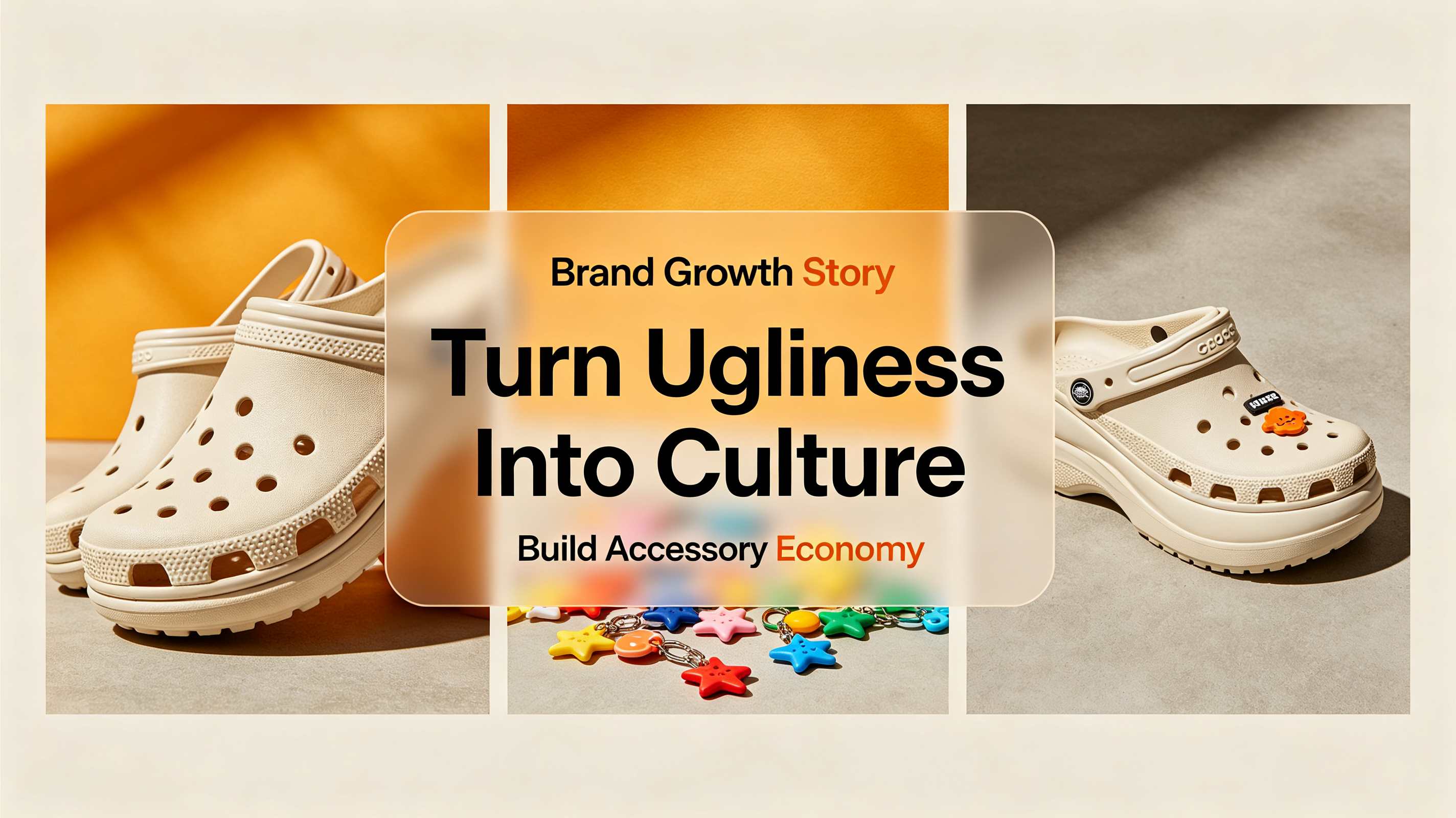
These numbers only reveal their full weight when placed in historical context. Crocs did not glide to this point. In 2008, after expanding too aggressively and losing control of inventory, the brand lost more than $185 million and came close to bankruptcy. Between 2014 and 2017, Crocs fell into a second trough, plagued by a chaotic product line and muddled positioning, with store closures, layoffs, and production line selloffs becoming the norm. What ultimately pulled Crocs out of the mire was a seemingly modest acquisition: in 2006, Crocs bought Jibbitz, the shoe-charm accessory brand. That tiny charm, designed to slot into the holes of a clog, would later become the most elegant design in Crocs’ entire business model, transforming a pair of shoes bought once into an accessory ecosystem bought again and again.
The Jibbitz “Accessory Economy” and Collaboration Strategy
Jibbitz charms are the key to understanding Crocs’ moat. The commercial logic is exquisitely simple. The clog itself is a low-frequency purchase, but the charms are high-frequency, low-barrier personalized consumption. A shopper can spend a few dollars on a single charm and pin their interests, hobbies, and identity onto their shoes. This low-barrier personalization lowers the decision threshold for repeat purchases while building deep brand stickiness. The more charms you buy, the stronger your emotional bond with the shoes, and the less likely you are to switch brands. On Xiaohongshu, Crocs-related posts exceed 520,000, with a large share dedicated to charm styling and unboxing, forming a self-propagating content ecosystem.
The collaboration strategy is the second pillar Crocs uses to generate buzz and social virality. Crocs partners with multiple IPs and celebrities, redefining “ugly” as a cultural label of rebellion against mainstream aesthetics. In 2024, Crocs launched the “Little Whale” platform series with a 6- centimeter heel height, satisfying the demand for elevation while extending the brand’s playful DNA. Every collaboration is a social event. Limited releases manufacture scarcity, celebrity endorsements amplify reach, and UGC content ferments organically. Crocs’ brilliance lies in never trying to whitewash the “ugly” label. Instead, it turned ugliness into “ugly fashion,” letting consumers earn an identity marker by daring to be ugly. This cultural resonance is far harder for competitors to copy than any functional selling point.
DTC Channel Strategy and Omnichannel Upgrade
Crocs drives growth through a DTC model combined with omnichannel upgrades, with DTC channel sales now accounting for 37.2% of the total and rising annually. The significance of this rising share is strategic. The DTC channel means Crocs can directly capture consumer data, control its brand narrative, lift gross margins, and drive repeat purchases through loyalty programs and personalized recommendations. Compared with brands overly dependent on wholesale, Crocs’ sustained DTC investment makes it more resilient to channel volatility. At the same time, Crocs has not abandoned omnichannel. Instead, it uses the high margins and high engagement of DTC to feed its wholesale and retail networks, forming a synergistic structure where DTC is the engine and omnichannel is the amplifier. The acceleration of the China market in the fourth quarter is exactly how this omnichannel layout pays off in emerging markets.
ShopFindBiz Perspective
From ShopFindBiz’s analytical lens, Crocs’ website and e-commerce matrix is a classic two-tier “body plus accessory” product structure. The first tier is the footwear body itself, spanning classic, platform, and collaboration silhouettes across a pricing ladder from entry to premium. The second tier is the Jibbitz charm ecosystem, with low unit prices, an enormous SKU count, and a high release cadence, forming an independent high-frequency repurchase engine. Scrape the Crocs store with ShopFindBiz and you can clearly see the dramatic difference between the two product types in SKU count, price band, and release rhythm: body SKUs are relatively stable, while accessory SKUs continuously expand, a direct data fingerprint of the accessory economy. Third, on pricing strategy, Crocs maintains mid-to-high pricing on the body to protect brand value, while charms drive repeat purchases and lift average order value at low prices, forming a classic “high- price anchor plus low-price repurchase” combination. Fourth, collaboration product pages typically carry strong visual impact and limited-edition markers, launching in sync with social media conversation to create a “content is product” release rhythm. For sellers studying accessory ecosystems and repurchase models, Crocs is a sample worth dissecting. Enter its store URL into ShopFindBiz to quickly compare the SKU share and price distribution of body versus accessory, gauging the depth of its accessory strategy.
Final Thoughts
Crocs’ story proves one thing: a brand’s greatest weakness can sometimes be its greatest opportunity. Mocked as the “ugliest shoe,” Crocs chose not to flee the label but to elevate it into a cultural identity, making consumers love it for daring to be different. Two near-death crises did not break it. Instead, they forced out the elegant design of the Jibbitz accessory economy and the social virality engine of the collaboration strategy. The rising DTC share reflects Crocs’ long-term commitment to consumer relationships and data assets. For consumer brands today, Crocs offers three lessons. First, find your “charm,” the accessory lever that turns a low-frequency purchase into a high-frequency repurchase. Second, embrace rather than evade your label, converting weakness into cultural capital. Third, treat DTC as a growth engine rather than a sales supplement, using data and loyalty systems to build a genuine moat.