Introduction
The phrase "Shopify is finished" has been repeated from 2020 to 2026. But the data tells a completely different story.
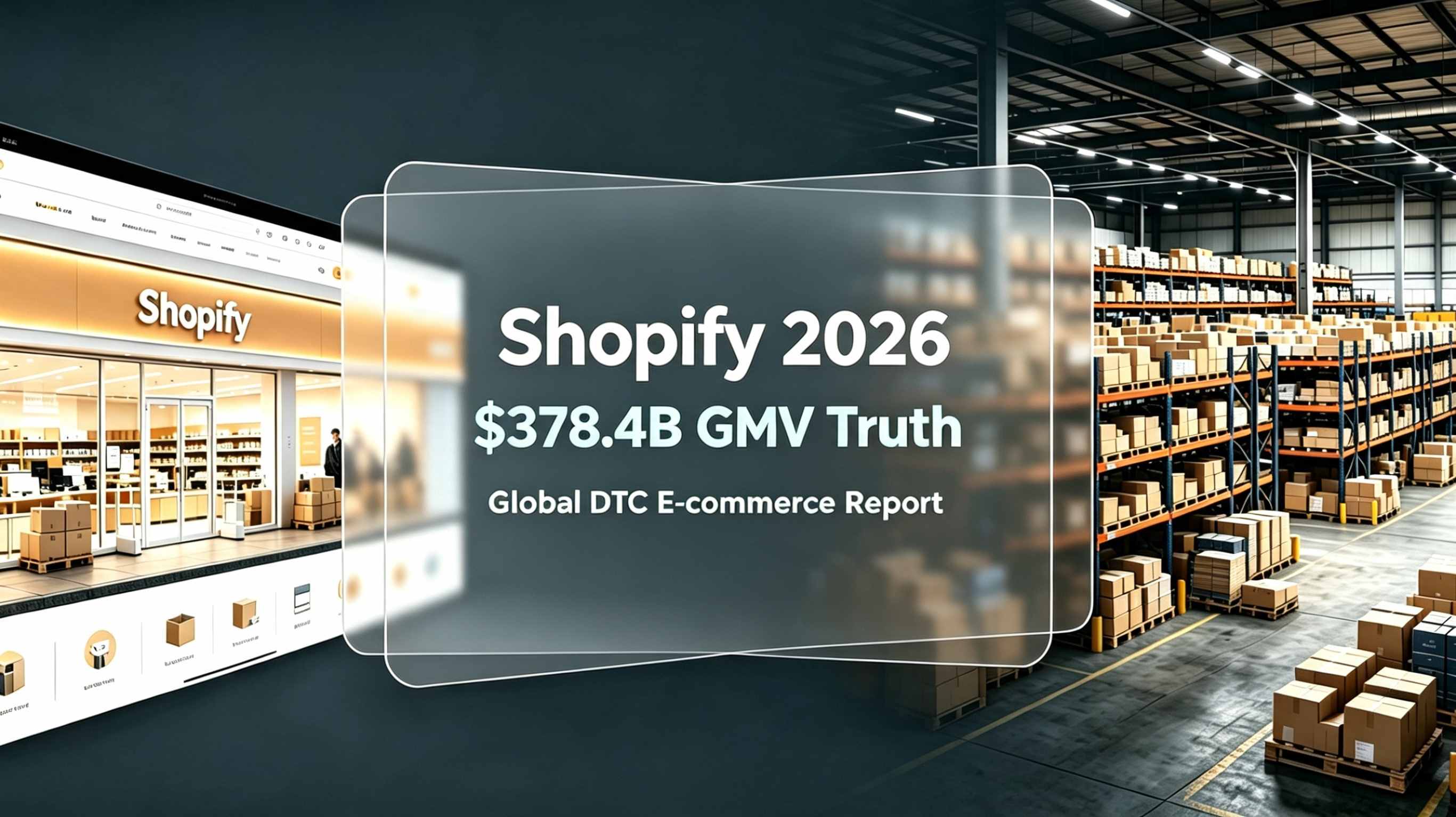
In 2025, Shopify's annual GMV (Gross Merchandise Volume) reached $378.4 billion , with revenue of $11.8 billion , representing a year-over-year increase of 22% . This is not just growth, but 11 consecutive quarters of double-digit growth . The data for Q1 2026 is even more impressive—GMV reached $100.743 billion , a year-over-year increase of 35%; revenue reached $3.17 billion , a year-over-year increase of 34% .
Shopify hasn't died out; in fact, its growth rate is even faster than in previous years. This article, based on Shopify's official financial reports and third-party market data, dissects the true face of the independent website ecosystem and its significance for Chinese sellers.
I. What does $378.4 billion mean?
Shopify's key metrics for the entire year of 2025:In 2025, Shopify's GMV (Gross Merchandise Volume) reached $378.4 billion, a year-on-year increase of 22%, while revenue also grew by 22% to $11.8 billion. Merchant Solutions' revenue was approximately $8.8 billion, representing an increase of over 20%. The number of active merchants on the platform exceeded 5.2 million, a year-on-year increase of 8%, marking the 11th consecutive quarter of double-digit growth.
Entering 2026, the growth momentum accelerated further. Q1 GMV reached US$100.743 billion, a year-on-year increase of 35%; revenue was US$3.17 billion, a year-on-year increase of 34%; among which, Merchant Solutions revenue reached US$2.42 billion, with the growth rate still remaining above 20%.
Key Insight: The 35% GMV growth in Q1 2026 is significantly higher than the 22% growth for the whole of 2025. This means that Shopify's growth is not slowing down, but accelerating.
To put it in perspective: Shopify's GMV of $100.743 billion in Q1 2026 is equivalent to completing approximately 60% of the total transaction volume for the entire year of 2021 in just one quarter. In four years, Shopify has transformed itself from a "website building tool" into a trillion-dollar e-commerce infrastructure.
II. Where does the growth come from? Not from North America, but from the whole world.
Nearly half of Shopify's GMV growth came from outside North America. This is the most noteworthy sentence in the financial report.
Regional growth data (compared to Q4 2025):In terms of regional performance, the North American market grew by approximately 25% year-on-year, the European market grew by 45% in local currency terms, and the Asia-Pacific and other regions recorded growth rates of over 30% and over 35% respectively.
Europe emerged as the biggest bright spot. European Q4 GMV grew by 45% year-on-year, or 35% even at constant exchange rates. This means that the growth in the European market is real and structural, rather than a numbers game driven by exchange rate fluctuations.
Significance for Chinese sellers:For Chinese sellers, the rapid growth of the European market is accompanied by relatively low competition, and the increasingly sophisticated payment infrastructure in the Eurozone (especially Shopify Payments) lowers the barriers to entry. Although GDPR compliance is initially cumbersome, once standardized processes are established, it can actually create a competitive advantage. It's worth noting that the German-speaking regions (Germany and Austria) and the French-speaking regions (France and Belgium) are Shopify's fastest-growing sub-markets in Europe.
III. Shopify is increasingly resembling a payment company.
2026 Q1 Revenue Structure Breakdown:
- Subscription Solutions : $750 million, representing 23.7% of total revenue.
- Merchant Solutions : $2.42 billion, accounting for 76.3% of total revenue.
Merchant Solutions includes: ShopifyPayments (payment fees), Shopify Shipping (logistics), Shopify Capital (loans), and Shopify Audiences (advertising).
Key Insight: Shopify's revenue structure is shifting from "selling software" to "earning transaction fees." This means Shopify's business model is becoming increasingly similar to VISA and MasterCard—the more merchants sell, the more Shopify earns. This also explains why Shopify is continuously lowering the barrier to entry for website creation (free themes, low-priced packages): it wants transaction volume, not subscription fees.
Impact on sellers:
- Shopify will increasingly focus on helping merchants increase sales (because it earns a percentage of GMV).
- While Shopify Payments' fees are not low (2.4%-2.9% + $0.30), it boasts high integration and conversion rates.
- Using Shopify's native payment tools offers a superior checkout experience compared to integrating third-party payment methods (such as PayPal).
IV. Independent websites vs. Amazon: Data doesn't lie
Many people debate whether independent websites can outperform Amazon. Data tells us: they are not competing, but rather merging.
Key signals for 2026:
- Amazon began serving independent website sellers. In early 2026, Amazon announced that its Multi-Channel Fulfillment (MCF) service was officially supported by sellers on Shopify, Walmart, and Shein. This means you can build a website on Shopify and ship using Amazon's fulfillment services.
- Shopify's GMV growth rate (35%) far exceeds that of Amazon's e-commerce business (approximately 10-12%). Although the base figures are different, the direction is clear: independent websites have a steeper growth curve.
- Brand searches for DTC brands are on the rise. On average, brand-conscious Shopify stores account for 35% of their search volume. This means that one-third of their traffic is free, coming from customers' proactive searches.
Conclusion: Independent websites and platforms are not a zero-sum game. The smartest companies are using a dual-track strategy of "platform validation of demand + independent website brand building".
V. Action List for Shopify Sellers in the Second Half of 2026
Based on the data above, here are the things you can do immediately:
1.If you haven't entered the European market yet, now is the time to do so.
- Europe saw a 45% increase in Q4, but the density of independent seller websites is far lower than in the United States.
- Priority access to the UK, Germany, and France
- Prepare for VAT (Value Added Tax) registration and GDPR compliance.
2.If you're still purely AliExpress Dropshipping, consider upgrading your supply chain.
- Shopify's GMV growth primarily comes from established brands and stores with high repurchase rates.
- Logistics speed is becoming a key variable in conversion rates.
- Use ShopFindBiz to track competitors' supply chains and find faster resources.
3.Set Shopify Payments as your default payment method
- Native payment tools have a conversion rate 5-10% higher than third-party payment tools.
- Although the transaction fees are not low, they can reduce shopping cart abandonment rates.
4.Build brand search traffic
- 35% of brand searches are generated by free traffic.
- Make your name memorable to customers through email marketing, social media content, and word-of-mouth marketing.
In conclusion
$378.4 billion is not just a company's achievement, but an indicator of the maturity of an ecosystem. Shopify has proven that independent websites are not a niche option, but one of the mainstream forces in global e-commerce.
For sellers still hesitating about starting an independent website in 2026, the question isn't "Is Shopify still viable?", but rather "Are you ready to secure a place in this trillion-dollar ecosystem?"