Introduction
In the consumer goods world, century-old brands are often dismissed as dated and out of touch. Yet Stanley 1913 tells a story that defies this assumption entirely. Founded in 1913, the thermos brand was generating only about $73 million in annual revenue as recently as 2019. By 2023, that figure had soared to $750 million, and in 2024 Stanley officially surpassed the American brand Yeti to become the top-selling thermos brand in the United States. In just four years, sales grew more than fiftyfold. The architect of this revival was not a veteran of the drinkware industry but a marketing executive borrowed from the “ugly shoe” brand Crocs. Stanley’s story is fundamentally about redefining the customer, mastering color, engineering scarcity, and using a direct-to-consumer model to awaken a dormant asset.
Financial Data and Brand Transformation: From Olive Green Camping Mug to Women’s Trend Item
Stanley was founded in 1913, giving the brand a 111-year history. For most of that history, its identity was the olive green all-steel vacuum bottle clutched by campers, construction workers, and outdoor enthusiasts. It was rugged and durable, but it had nothing to do with fashion. The turning point came in 2020, when Terence Reilly, formerly the Chief Marketing Officer of Crocs, joined Stanley as president. He arrived with a contrarian conviction: Stanley’s future lay not on outdoor retail shelves but in the daily commute and fitness routines of young women.
Reilly’s instinct was validated quickly. In 2019, Stanley’s annual sales were only about $73 million. By 2023, that number had surged to $750 million. Stanley’s revenue grew from $73 million in 2019 to more than $800 million in 2024. The hero product, the Quencher H2.0 series, surpassed 10 million units in cumulative sales, becoming a phenomenon in its category. The parent company PMI (Pacific Market International) rode the wave to even greater heights, with full-year net sales exceeding $4 billion in 2025. On Amazon’s US marketplace in 2024, Stanley captured a 9.33% sales share, securing the category throne.
This transformation was no accident. What Reilly brought from Crocs was an entire playbook for DTC and social media marketing. With the help of The Buy Guide, Stanley introduced a direct-to-consumer business model, shifting away from a distributor-dependent setup toward selling directly to consumers. This gave the brand precise control over its narrative, pricing, and release cadence. Stanley’s official site, stanley1913.com, runs on the Shopify platform, meaning it could iterate product pages, color drops, and loyalty programs at low cost and high speed, without being weighed down by legacy ERP and store systems.
Color, Scarcity, and TikTok Virality
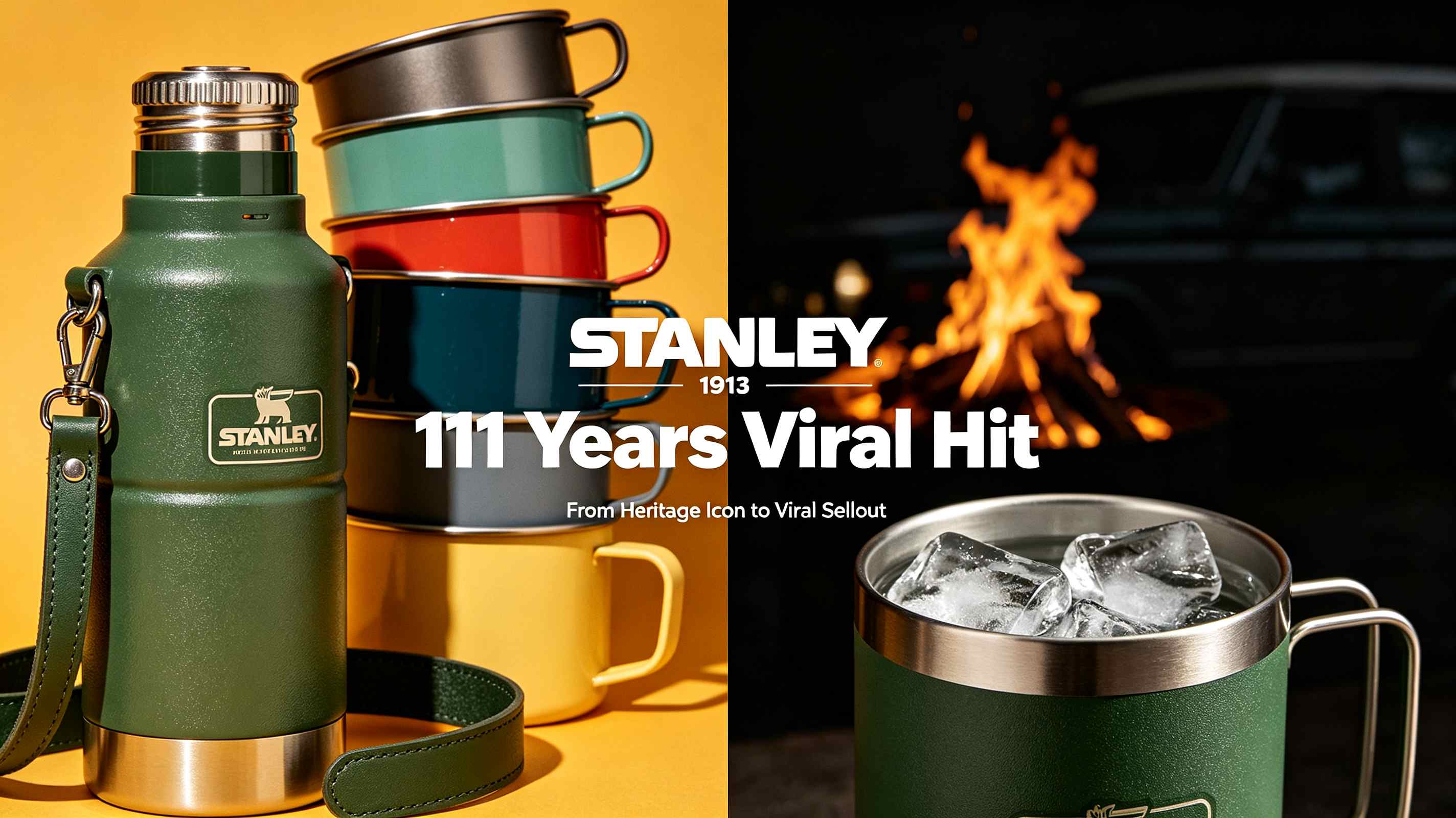
Stanley’s real magic lies in color. The Quencher H2.0 is not a single product but a constantly refreshed color matrix. Stanley manufactures scarcity through limited color drops, transforming a functional tumbler into a collectible fashion item. Every new color release triggers a buying frenzy and organic secondary spread on social media. Consumers began collecting Stanley colors the way sneakerheads collect sneakers, and “Stanley color collection” became an enduring viral genre on TikTok.
The explosive power of social media was amplified by several iconic moments. The most famous was the car fire incident, in which a user’s car burned to the frame but the ice inside a Stanley cup left in the vehicle remained intact. The clip racked up tens of millions of views on TikTok, an advertisement worth an almost incalculable sum, delivered for free. Reilly personally responded and gifted the user a new car. Authentic, accidental, and dramatic content like this resonated far more with young consumers than any polished ad campaign. On TikTok, Stanley hacks, color unboxings, and cup-hoarding challenges formed a self-sustaining content ecosystem.
On the supply chain side, Stanley’s breakout was underpinned by strong Chinese contract manufacturing. Jiayi, Stanley’s core OEM partner, reported 2.472 billion RMB in revenue from PMI in 2024, accounting for 87.2% of its total revenue. This deeply integrated manufacturing relationship allowed Stanley to scale capacity rapidly as demand exploded while keeping costs under control. But the risks are real too. Emerging brands like Owala are rising, and the US drinkware market is cooling. To sustain growth, Stanley must keep investing in color and conversation.
ShopFindBiz Perspective
From ShopFindBiz’s analytical lens, stanley1913.com is a textbook example of a color-driven DTC store. If you use ShopFindBiz to scrape its product structure, several defining traits emerge. First, the SKU matrix radiates outward from the Quencher H2.0 core, with sizes spanning 14oz to 64oz, but what truly drives sales is not size variation but color variation. The same cup shape is split into independent SKUs across colors, creating a visual sense of constant newness. Second, pricing is highly concentrated. The Quencher’s core pricing sits in the $35 to $45 range, expensive enough to feel giftable yet affordable enough to trigger impulse purchases, a precise positioning as an accessible everyday luxury. Third, stanley1913.com leverages Shopify’s limited-release capability to turn color drops into events, and the frequent“sold out” states on product pages themselves manufacture scarcity. Fourth, product pages lean heavily on UGC-style lifestyle imagery and conversational copy, softening the hard-sell feel and reinforcing that the cup is part of your life. For sellers studying color SKU matrices and release cadence, stanley1913.com is a sample worth dissecting repeatedly. Enter the store URL into ShopFindBiz to quickly see its active SKU count, price distribution, and new-release frequency, revealing the rhythm of its color strategy.
Final Thoughts
Stanley 1913 offers a lesson for every legacy brand: you do not need to invent an entirely new product. You need to redefine who uses it and why. Reilly did not change Stanley’s core craftsmanship. He changed Stanley’s persona, from a rugged tool that kept coffee hot for construction workers to a colorful accessory that adds personality to a young woman’s day. Color, scarcity, DTC direct-to-consumer engagement, and TikTok virality were all indispensable. But there is a flip side. When a brand bets its growth on color and conversation, it must forever outrun the trend. The rise of Owala and the slowing market are reminders that Stanley’s next fiftyfold gain will not arrive automatically. For smaller sellers, the takeaway is to find your own “color,” the lever that turns a functional product into an emotional one, and then amplify it with DTC and social media.