Introduction
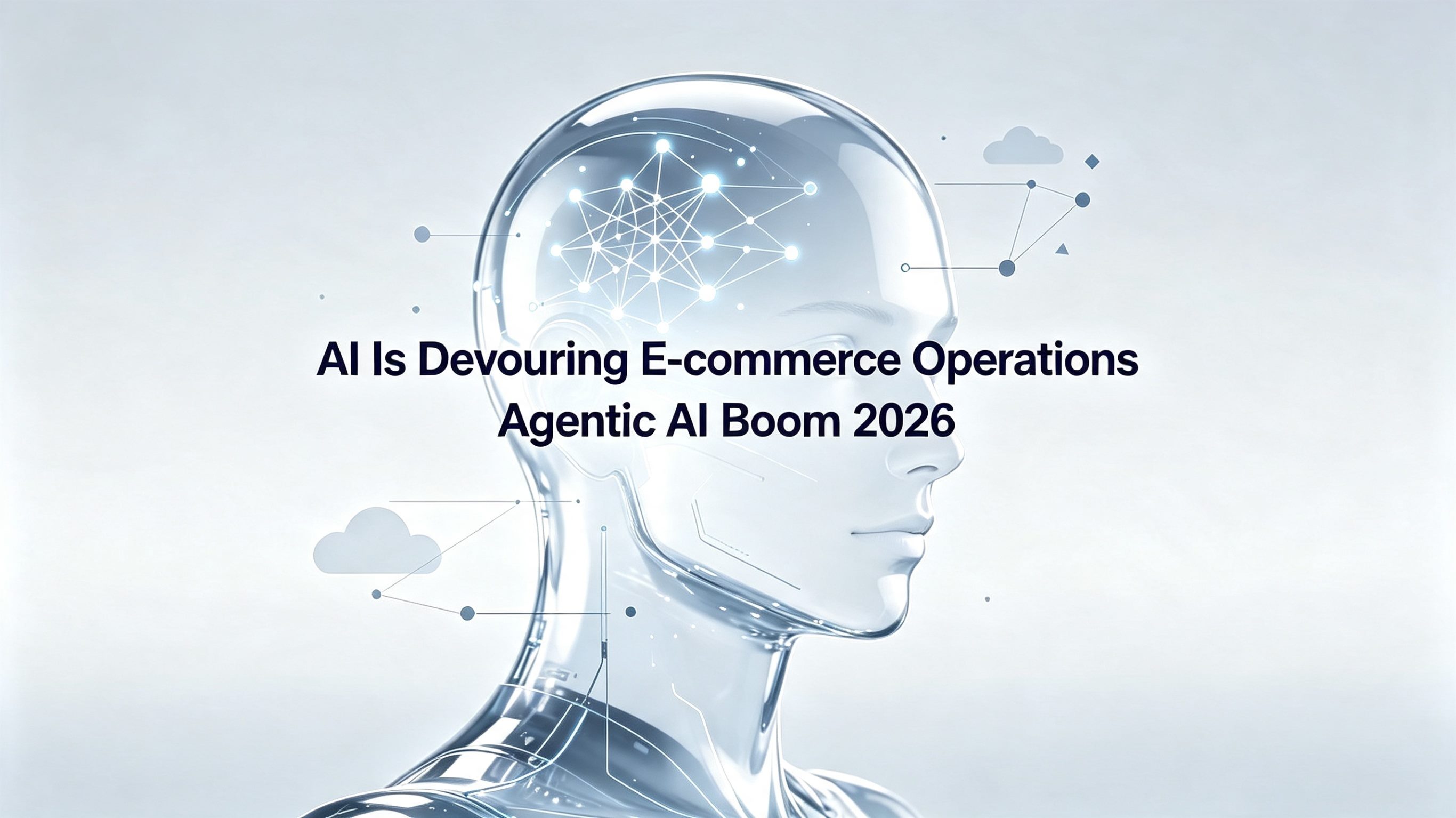
In April 2026, Gartner released a report that shook the e-commerce industry: "The Hype Cycle of Agentic AI." One figure in the report was particularly striking: by the end of 2026, 40% of enterprise applications would embed task-oriented AI agents—compared to less than 5% in 2025.
Within a year, it went from 5% to 40%. This is not a gradual improvement, but an exponential leap .
Meanwhile, the adoption rate of AI in the e-commerce sector has exceeded 80% . From product description generation to customer service chatbots, from advertising optimization to inventory forecasting, AI is taking over every aspect of e-commerce operations.
The question is: Is your team ready?
I. A 40% leap: What does Gartner's data mean?
Gartner's core predictions:Gartner predicts that the proportion of enterprise applications embedding AI agents will jump from less than 5% in 2025 to 40% by the end of 2026, an increase of 35 percentage points. Meanwhile, AI adoption in e-commerce will also rise from approximately 60% to over 80%, an increase of more than 20 percentage points.
What is a "task-oriented AI agent"?
It's not a chatbot, but an AI system capable of autonomously performing tasks. For example:
- Automatically monitor competitor prices and adjust pricing while you sleep.
- Automatically place replenishment orders with suppliers based on sales forecasts.
- Analyze social media trends and automatically publish content at the best time.
- Identify high-value customers and automatically send personalized emails
The key difference is that in the past, AI was "you ask and it answers," while now, AI agents are "you set the goal and it executes it on its own."
II. E-commerce AI Adoption Map: Who is using what?
A panoramic view of e-commerce AI applications in 2026:By 2026, AI applications in e-commerce will exhibit a pattern of multi-level penetration. Product description generation leads with a 68% adoption rate; while it significantly boosts efficiency, human refinement remains necessary. Customer service chatbots have an adoption rate of 45%, capable of cutting customer service costs by 30%. Ad copy optimization sees a 55% adoption rate, driving a roughly 15% increase in click-through rates (CTR), while social media content generation stands at 42%, tripling content output speed. Regarding operational decision-making, product selection recommendations and trend forecasting have an adoption rate of 32% but currently serve only to assist decision-making. Inventory forecasting, adopted by 28% of businesses, can reduce excess stock by 15%–20%. Although dynamic pricing has an adoption rate of just 18%, it boosts profit margins by 5%–10% and delivers an exceptionally high ROI. Finally, AI-driven store layout and design recommendations remain in the early stages, with an adoption rate of 20%.
Key Insights:
- Customer service and content creation are the areas where AI is first penetrating because they have clear inputs and outputs, making it easy to quantify results.
- Product selection and inventory management are the areas where AI is hardest to replace. This is because they require business acumen and a deep understanding of the supply chain, which AI can currently only assist in, not make decisions about.
- Dynamic pricing has a low adoption rate, but its ROI is extremely high. It is an underestimated blue ocean market.
III. Three practical scenarios of AI in e-commerce
Scenario 1: 24/7 competitor monitoring + automatic price adjustment
Traditional approach: Manually check competitor prices weekly and adjust accordingly. This is time-consuming, lagging, and prone to omissions.
AI Approach: - Monitor price changes of 50 competitors using tools (such as ShipFindBiz Pro). - AI identifies price change patterns (are competitors clearing inventory? Or is it a long-term price reduction?). - Automatically adjust prices according to preset rules (competitors reduce prices by 10% - we follow suit with 5%; competitors run out of stock - we raise prices by 15%).
Results: After adopting dynamic pricing, a home furnishing seller saw an 8% increase in profit margin and a 12% increase in sales volume.
Scenario 2: AI generates multilingual product descriptions
Traditional approach: Hire a translator or write it yourself; it takes 2-3 days to produce 5 language versions of a product.
AI approach: - Generate basic descriptions using GPT-4/Claude - Optimize e-commerce scenarios using industry-specific tools (such as Jasper, Copy.ai) - Manual review and polishing (critical steps, cannot be omitted)
Results: A cross-border seller improved the product description production speed from 3 days/product to 2 hours/product, resulting in a 25% increase in conversion rate in multilingual markets (German, French, Spanish).
Scenario 3: AI Customer Service + Sentiment Analysis
Traditional approach: Manually replying to emails and chat messages, processing 50-100 messages per day, which is prone to omissions and emotional outbursts.
AI-powered approach: - Chatbot handles 80% of common questions (logistics tracking, return and exchange policies, size inquiries) - AI identifies customer emotions (anger, anxiety, satisfaction) and automatically escalates to human customer service - Automatically generates after-sales follow-up emails to increase repeat purchase rates
Results: A clothing e-commerce website reduced its customer service costs by 30% and increased its customer satisfaction rating from 3.8 to 4.6.
IV. AI Tools List for Shopify Sellers
Ready-to-use AI tools (free or low-cost): Shopify sellers have a wide range of ready-to-use AI tools at their disposal. ChatGPT and Claude—available for free or at $20/month—can be used for product descriptions, email copy, and brainstorming; Canva AI, free or $13/month, is suitable for creating social media images, infographics, and video thumbnails; ShopFindBiz offers competitor analysis, data monitoring, and trend discovery features, with options ranging from free to $19/month; Tidio and Gorgias provide AI customer service chatbot solutions starting at $29/month; Jasper and Copy.ai focus on e-commerce copywriting, with plans starting at $49/month; and Prisync and Competera offer dynamic pricing monitoring services starting at $99/month.
Recommended starting package: ChatGPT (content) + ShopFindBiz (data) + Canva (design) = less than $50 per month, covering 80% of AI application scenarios.
In conclusion
The penetration rate of AI agents has increased from 5% to 40% faster than anyone predicted. But remember: AI will not replace e-commerce sellers, but sellers who use AI will replace those who don't.
Your action list for the second half of 2026 should include:
- Let AI generate product descriptions (save 50% of the time).
- Delegate common customer service questions to AI (save 30% on costs).
- Entrust competitor monitoring to AI (real-time, comprehensive).
- Invest the time saved in product selection strategy and brand building.
Ultimately, what determines your success or failure is not the capabilities of AI, but your ability to use AI.