Introduction
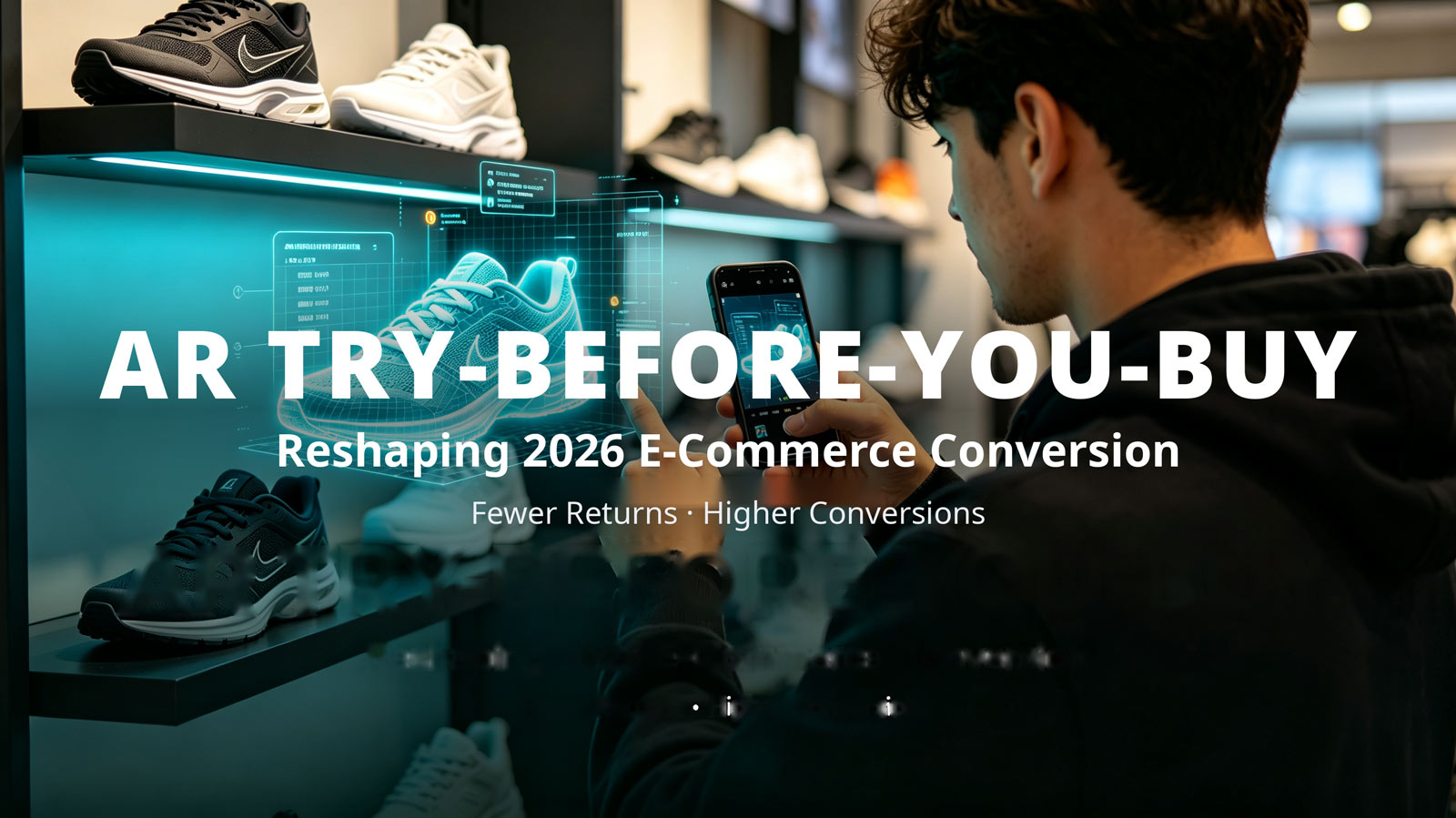
Augmented reality try-before-you-buy tools are quietly reshaping e-commerce in 2026 — and most sellers haven't caught on yet. The concept is simple: shoppers use their smartphone cameras to virtually "try on" products, from clothing to furniture, in their own space before buying. Once a novelty for retail giants like IKEA and Sephora, AR is now a mainstream expectation, with early adopters reporting higher conversions, larger orders, and return-rate reductions of up to 40%. This guide breaks down how immersive shopping solves online retail's oldest problem — and what it means for sellers of every size.
The Psychology Behind AR Shopping Conversion
Augmented reality bridges the sensory gap that has persisted since the first online store launched. When shoppers can visualize a product in their own space or on their own body at true scale, with realistic lighting and shadows, it triggers buying impulses that static product images cannot replicate.
Industry research and neuro-marketing studies suggest that AR visualization creates a form of psychological ownership: users begin to feel that the product is already "theirs" during the trial, long before they reach checkout. This endowment effect, combined with reduced decision friction, shows up in the metrics retailers care about most:
- Emotional connection through personalization — seeing "your" new sofa in your actual living room is qualitatively different from browsing a catalog
- Lower cognitive load — size, scale, and fit guesswork disappear from the decision process
- Reduced post-purchase doubt — buyers who have already "lived with" the product virtually are less likely to regret the purchase
That last point matters more than many sellers realize. Retailers that have measured AR engagement report return-rate reductions of up to 40% among customers who used try-before-you-buy features. With returns quietly eating into margins across e-commerce in 2026, AR is as much a profitability tool as a conversion tool. Retailers also report that average order values tend to rise 15-20% when customers engage with AR features, because visualization naturally showcases complementary items and upgrades.
How AR Is Quietly Rewriting Conversion Benchmarks
The most striking thing about AR commerce in 2026 is how silently it has moved from experiment to baseline expectation.
Consider the behavior shift: just two years ago, AR try-on was a marketing gimmick. Today, shoppers in categories like eyewear, furniture, and beauty increasingly skip listings that don't offer some form of virtual trial. Marketplace data shows that AR-enabled listings hold shopper attention significantly longer, and time-on-page remains one of the strongest predictors of conversion.
The direction of travel is consistent across categories:
- Home goods and furniture: Room-scale AR with surface detection and realistic shadow rendering lets customers walk around virtual furnishings. Furniture retailers were among the earliest AR adopters, and their published case studies show shoppers who engage with AR features convert at many times the rate of those who don't.
- Apparel and footwear: Virtual try-on has matured from novelty to sizing aid. Major brands now use camera-based foot and body scanning to recommend sizes, directly attacking the number one reason apparel gets returned.
- Beauty and cosmetics: Facial-tracking technology has become accurate enough that virtual makeup trials now account for a meaningful share of shade-selection decisions, replacing in-store testers that never fully migrated online.
The pattern is the same everywhere: the closer the digital experience gets to physical inspection, the more hesitation disappears at checkout.
Category-Specific AR Strategies That Drive Conversions
Different product categories require different AR approaches. Here's what works where:
Home Goods & Furniture. The winning formula is room-scale accuracy: lighting-aware rendering, occlusion handling (so the virtual sofa sits behind your real coffee table), and multi-angle inspection. Sellers in this category should prioritize a small set of hero SKUs rather than catalog-wide coverage — AR engagement is concentrated in considered purchases.
Apparel & Accessories. Fit confidence is everything. The most effective implementations pair AR visualization with size recommendation engines that analyze the shopper's camera input. Show the garment in motion on realistic body types rather than static renders.
Beauty & Cosmetics. Precision matters more than spectacle. Shoppers comparing shades need accurate color rendering under different lighting conditions, and they need to see how products look over time, not just at first application.
Jewelry & Watches. Scale accuracy is the make-or-break factor — a virtual ring that renders 10% too large destroys trust instantly. This category benefits most from persistent sessions that let shoppers revisit their virtual try-on across devices before deciding.
AR on a Budget: What Small Shopify Sellers Can Actually Do
Here's the uncomfortable question for independent sellers: AR sounds expensive. Five years ago, it was. In 2026, it no longer has to be.
Shopify now supports 3D models and AR Quick Look natively on product pages, meaning any seller can upload a USDZ or GLB model and give iOS shoppers an instant AR experience — no custom development required. On top of the native stack, a growing ecosystem of apps and services has brought AR within reach of single-store operators:
- 3D/AR product model apps on the Shopify App Marketplace let sellers convert existing product photos into AR-ready models at a fraction of custom-development cost
- WebAR solutions run directly in the browser, eliminating the friction of app downloads that killed early AR adoption
- Virtual try-on plugins for eyewear, jewelry, and cosmetics can be deployed on a per-category basis, so sellers can test AR on their highest-return SKUs first
The smart playbook for a small seller in 2026 is not "AR everything." It's: identify your three highest-traffic, highest-return products, deploy AR on those, measure conversion and return-rate deltas for 60-90 days, and scale from there. AR is no longer a moonshot — it's an A/B test.
What's Next for AR Commerce
As AR hardware, 5G networks, and AI generation tools mature, several developments will push immersive shopping even further:
- Haptic feedback integration, allowing shoppers to "feel" fabric textures through their screens
- AI-generated product visualization, where shoppers render variations of a product in their space before the item even exists in inventory
- Social AR shopping, where friends appear virtually in the same session to shop together
- Persistent digital twins, with blockchain-verified AR representations of physical products that follow an item through its lifecycle
Forward-thinking brands are already designing products with virtual try-on in mind, knowing that digital-first product evaluation is becoming the default consumer behavior across retail.
How to Know If Your Competitors Are Already Doing This
One of the quiet dynamics of AR commerce in 2026 is that early movers rarely advertise it loudly. AR features are often buried in product pages, which means manual browsing won't tell you whether your direct competitors have already deployed try-before-you-buy tools — and are quietly converting the shoppers you're both fighting for.
This is where systematic store analysis pays off. With a competitor benchmarking tool like ShopFindBiz, you can scan competing Shopify stores for AR and 3D content, see which product categories they're deploying it in, and identify whether immersive shopping is becoming table stakes in your niche before your conversion data forces you to notice.
Conclusion
AR try-before-you-buy technology is solving online shopping's oldest problem — the lack of physical interaction — by delivering confidence-building product experiences directly into consumers' environments. The evidence keeps repeating itself: higher conversion, larger baskets, and up to 40% fewer returns among AR-engaged shoppers.
Brands that invested early have already normalized immersive shopping for their customers. The question in late 2026 is no longer whether AR will reshape e-commerce — it visibly is — but whether your store will lead or follow in your niche. And the good news for independent sellers: this time, the barrier to entry is a 3D model upload, not a seven-figure technology budget.