Introduction
The cross-border e-commerce industry in 2026 is undergoing a quiet revolution driven by AI. Unlike the “conceptual hype” that characterized 2023 and 2024, AI applications in 2026 have penetrated every layer of a DTC seller’s daily operations. DHL’s “2026 E-Commerce Trends Report” provides a key benchmark: 23% of global consumers have already used AI-powered chat or virtual assistants to browse and purchase, while 64% of businesses plan to increase investment in AI shopping assistants over the next five years. For independent-site (DTC) sellers, the significance of these figures extends beyond changing consumer behavior — AI is upgrading from an “auxiliary tool” to a “core productive force.”
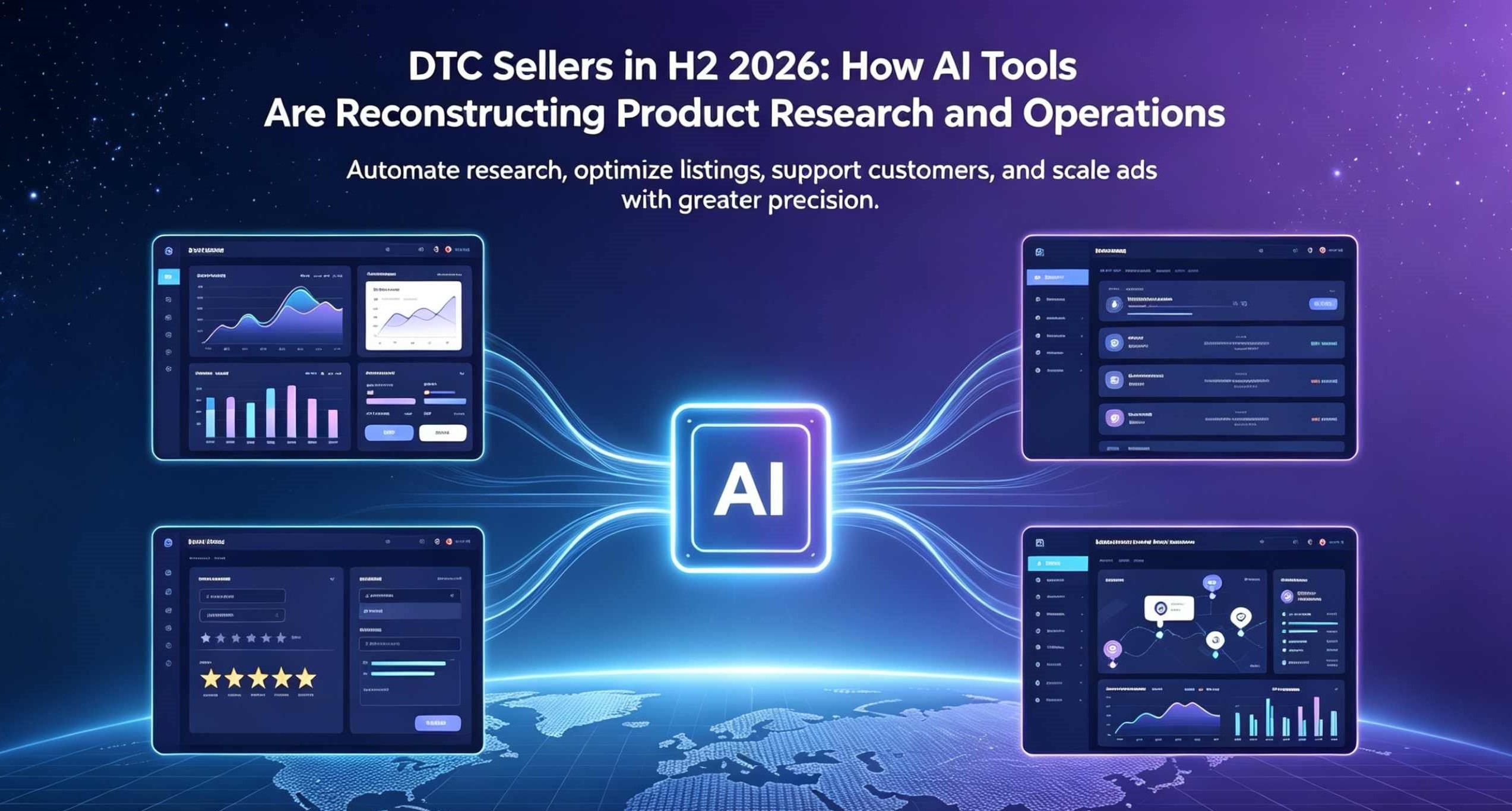
In product research, AI applications have evolved from simple keyword analysis into multi-dimensional market-intelligence systems. Traditional product selection relied on a seller’s personal market intuition, manual tracking of competitor stores, and platform bestseller rankings — an approach that was both inefficient and prone to subjective bias. Today’s AI-powered product-research tools can simultaneously process massive datasets from multiple e-commerce platforms, identify latent consumer needs embedded in reviews, analyze emerging trends across social media, and forecast demand shifts for specific categories over 30- to 90-day horizons. This multi-source approach enables sellers to capture market opportunities with greater precision while dramatically shortening the cycle from “trend identification” to “product listing.”
The impact of AI on listing generation and optimization is even more direct and significant. A DTC seller’s product descriptions, SEO metadata, image alt text, and structured data traditionally required substantial manual time to write and iterate. Today’s AI writing tools can automatically generate high- quality, localized content based on a product’s technical specifications, the linguistic conventions of the target market, and search-engine ranking rules. More importantly, these tools no longer simply “fill templates” — they perform competitive differentiation analysis, examining the top ten competing listings to identify commonalities and gaps in keyword coverage, selling-point articulation, and emotional appeal, then helping sellers craft product copy that is both search-optimized and competitively distinctive.
AI applications in customer service have also made substantive progress. DHL’s report data shows that Convenience shoppers — those who prioritize fast response and easy returns — represent 90% of global online consumers. Traditional customer service models, reliant on human agents, are costly and struggle to deliver fast response times across multiple languages and time zones. Current AI customer-service systems can handle over 70% of routine inquiries (shipping status, return policies, product specifications) and support real-time conversations in more than 20 languages. More critically, next-generation AI agents can understand conversational context and identify upsell and cross-sell opportunities during interactions, transforming the customer-service function from a “cost center” into a “profit center.”
In advertising optimization, AI’s value is shifting from “efficiency gains” to“strategic upgrade.” For DTC sellers running Google Ads and Meta Ads campaigns, traditional approaches relied on A/B testing and manual bid adjustments — a model that quickly reaches human limits when managing simultaneous multi-country, multi-language, multi-category campaigns. Current AI advertising tools can analyze performance data across millions of keyword and audience combinations in real time, automatically adjust bidding strategies, and dynamically allocate budgets to the best-performing channels and time slots. More cutting-edge applications include AI-driven creative generation — automatically producing customized ad creatives tailored to different markets and audiences, with continuous performance iteration.
However, the democratization of AI tools does not mean “everyone can become a top seller.” The barrier to tool access is lowering, but the requirement for strategic thinking is rising. When a DTC seller and its ten competitors all use the same AI tools, the deciding factor is no longer who has the better tool, but who possesses sharper market judgment, deeper category expertise, and a more systematic operational framework. AI is an amplifier — it amplifies not only efficiency but also the quality of a seller’s own cognition and decision-making. For DTC sellers heading into H2 2026, the true competitive advantage lies not in “whether to use AI” but in “how to use AI to amplify your unique competitive strengths.”
Final Thoughts
For DTC operations in H2 2026, AI is no longer a “nice-to-have” option — it is the baseline for competitive participation. From product research to listings, from customer service to advertising, AI is systematically reconstructing the efficiency and possibility frontier of every operational layer. But for sellers, the most important cognitive shift is this: AI is not here to replace you — it is here to amplify you. Your unique category insights, brand aesthetics, and customer understanding are the things AI cannot replicate. Delegate the repetitive work to AI, and keep the creative work for yourself — that may be the most important strategic principle for DTC sellers in 2026.