Introduction
Every week, another "successful" store goes viral, and entrepreneurs rush to copy its products, pricing, and ads. The problem: you rarely know whether the strategy you're copying is battle-tested—or a three-month-old gamble running on borrowed ad spend.
There's one data point that answers that question in seconds: when the store actually launched. A store's creation date tells you how long its strategy has survived real market conditions, and whether its results are worth replicating at all.
Why Store Creation Dates Matter
The creation date of an online store is more than a historical footnote—it's a shortcut to three strategic questions:
-
Growth pattern. A store that launched six months ago and already has a massive following likely bought that growth with paid ads or influencer deals. A store that grew steadily over five years probably earned it through retention and SEO. These are completely different playbooks—and they require completely different budgets to copy.
-
Strategy validation. Stores that have weathered multiple market cycles have proven, stress-tested business models. Newer winners may simply have perfect timing: copy their mechanics, not their timing.
-
Claim-checking. "Trusted since 2015" is easy to print in a footer. A verifiable creation date is much harder to fake—and it takes 30 seconds to check.
The 30-Second Trick: Find Any Store's Creation Date
Several free tools reveal a store's creation date the moment you paste in its URL. ShopFindBiz's Store Intelligence report, for example, shows the creation date instantly—alongside traffic estimates, product count, and platform data—with no registration required.
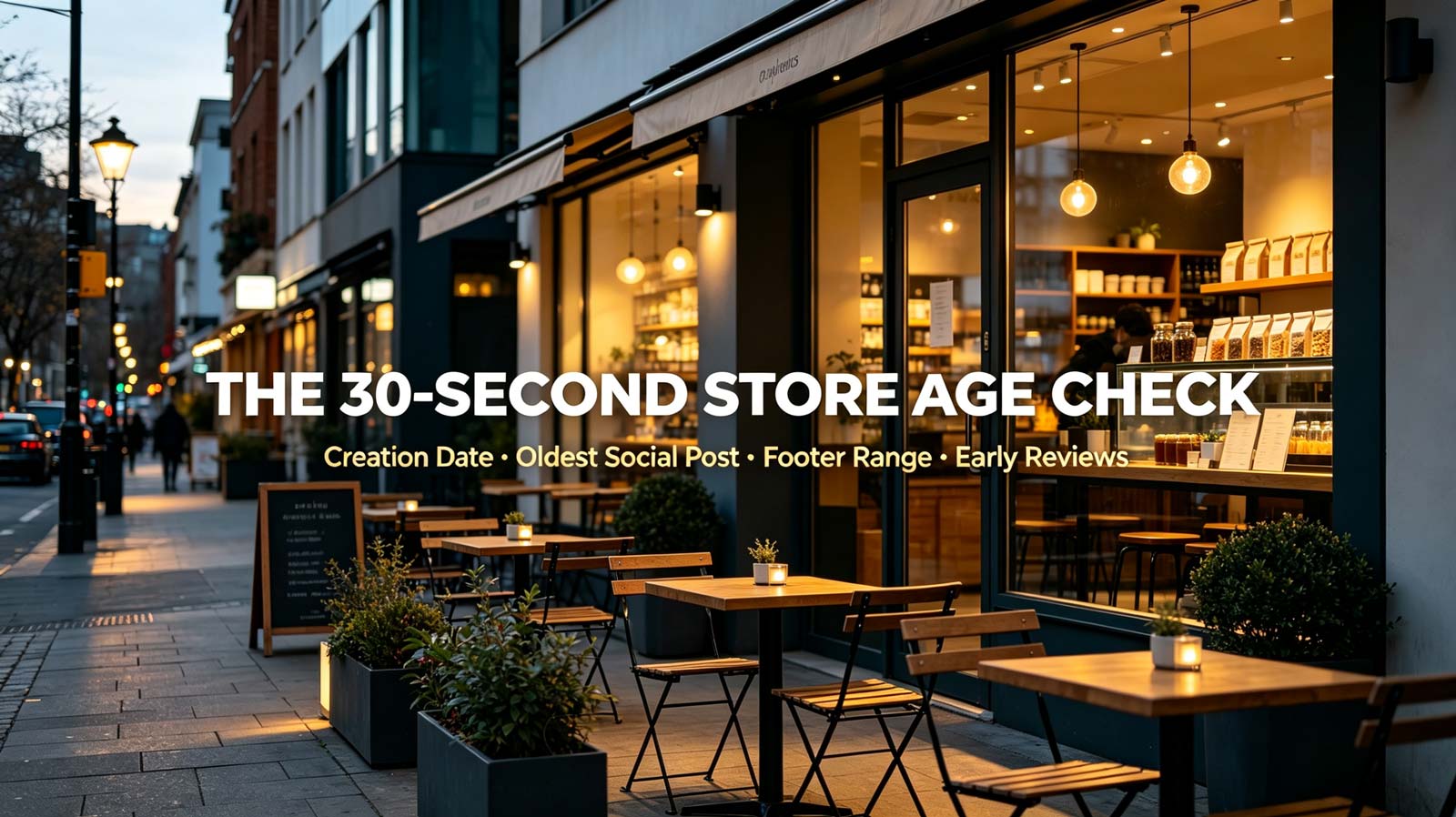
Prefer to verify manually? These are the signals, fastest first:
-
Domain WHOIS lookup. Enter the URL at lookup.icann.org, DomainTools, or Whoxy. The "created on" date shows when the domain was registered. One caveat: a domain is often registered months or even years before the store actually launches, and stores sometimes migrate to a new domain—so treat WHOIS as your starting point, not the final answer.
-
Footer copyright range. Look for a range like "© 2018–2026." If the footer shows only the current year, it's auto-generated and tells you nothing—skip this signal.
-
Oldest social post. Scroll to the very beginning of the store's Instagram or Facebook. The first post usually lands within weeks of launch.
-
About page and earliest reviews. Founding-year mentions on the About page, plus the date of the store's oldest product review, triangulate the rest.
Two or three of these signals will agree, and you'll have a reliable launch date—often in well under 30 seconds.
How to Read One Date: The Competitor Size-Up Framework
The date itself isn't the insight. What the date tells you about the strategy behind it is. Run every competitor through these three questions:
1. How old is the store—and how fast has it grown?
-
New (<1 year) + explosive growth: the engine is almost certainly paid acquisition or viral influencer marketing. Replicable, but only if you can match the ad budget. Run the customer-acquisition math before copying anything.
-
Mature (3+ years) + steady growth: the engine is retention, SEO, and email. Slower to copy, but far cheaper to sustain once it works.
2. Has it survived market cycles?
A store that launched years ago and is still growing has a model that works in bad times as well as good. A store that launched last quarter and is thriving may simply be riding a trend—profitable to study, dangerous to clone.
3. Old domain, sudden rebrand?
A domain registered in 2016 but branded like 2025 signals a pivot. Pivots leak customers: the audience the competitor is leaving behind is an acquisition opportunity for you.
Walkthrough: putting the framework to work. Suppose a fitness-accessories store is outranking you in your niche. A store analysis shows its domain was created in March 2021, with steady traffic growth and no viral spikes. Conclusion: its edge is four years of accumulated SEO authority and reviews—not ad spend. Your move: prioritize content and review generation rather than trying to outspend it on paid channels.
The same age-versus-growth logic explains why young brands like Owala could beat an incumbent like Stanley, and why century-old brands can suddenly pivot to a single product worth $750M a year—age tells you which playbook a competitor is running.
Best Practices: Don't Stop at One Date
-
Combine metrics. Pair the creation date with traffic trends (Google Trends, Similarweb), backlinks (Ahrefs, SEMrush), and social activity. Age alone informs; age plus trajectory tells the real story.
-
Don't assume older = better. Newer stores often exploit modern channels—TikTok, micro-influencers, UGC—that incumbents handle poorly. A young store beating old ones is a signal worth decoding, not dismissing.
-
Look for patterns across the niche. One creation date is a data point; ten is a pattern. Five successful stores launched within the same 12-month window suggests a demand boom. One dominant store in an otherwise quiet niche may signal untapped potential—or a moat you can't cross.
Conclusion
A competitor's creation date is the cheapest competitive intelligence you'll ever get. Find it in 30 seconds, read it with the three-question framework, and you'll know whether to copy a strategy, adapt it, or walk away from it. In a market where everyone is copying everyone, knowing when a store launched is often the only thing standing between you and a very expensive mistake.