Introduction
In 2021, a viral product could sustain peak demand for an entire season. In 2026, the average TikTok-driven product saturates in weeks. TikTok Shop's GMV doubled from $33 billion in 2024 to $66 billion in 2025 — and the #TikTokMadeMeBuyIt hashtag has passed 80 billion views. Every one of those views compresses the window between "nobody has it" and "everybody has it."
The sellers still winning aren't reacting faster. They're seeing signals earlier — often weeks before search volume spikes and months before the trend hits mainstream coverage. Here's how they do it, and what it means for your store.
The Numbers Behind the Shrinking Window
A product trend used to follow a predictable arc: early adopters, press coverage, retail distribution, mass adoption — a cycle measured in quarters or years. Social commerce has collapsed that arc. Discovery, evaluation, and purchase now happen inside a single 30-second video, and TikTok's algorithm can push a product from zero to millions of impressions within days, regardless of the brand's follower count.
The result is a demand curve that's taller and narrower than anything traditional retail was built for. Products like viral beauty gadgets, plush keychains, and kitchen tools have gone from unknown to oversaturated in as little as four to eight weeks. By the time a seller spots the trend on Google Trends, sources inventory, and launches a product page, the most profitable segment of the curve — the scarcity phase, where margins are highest and competition is lowest — is already over.
For Shopify sellers, this changes the definition of good product research. It's no longer about finding trending products. It's about finding them before they're trending.
Where Early Signals Actually Show Up
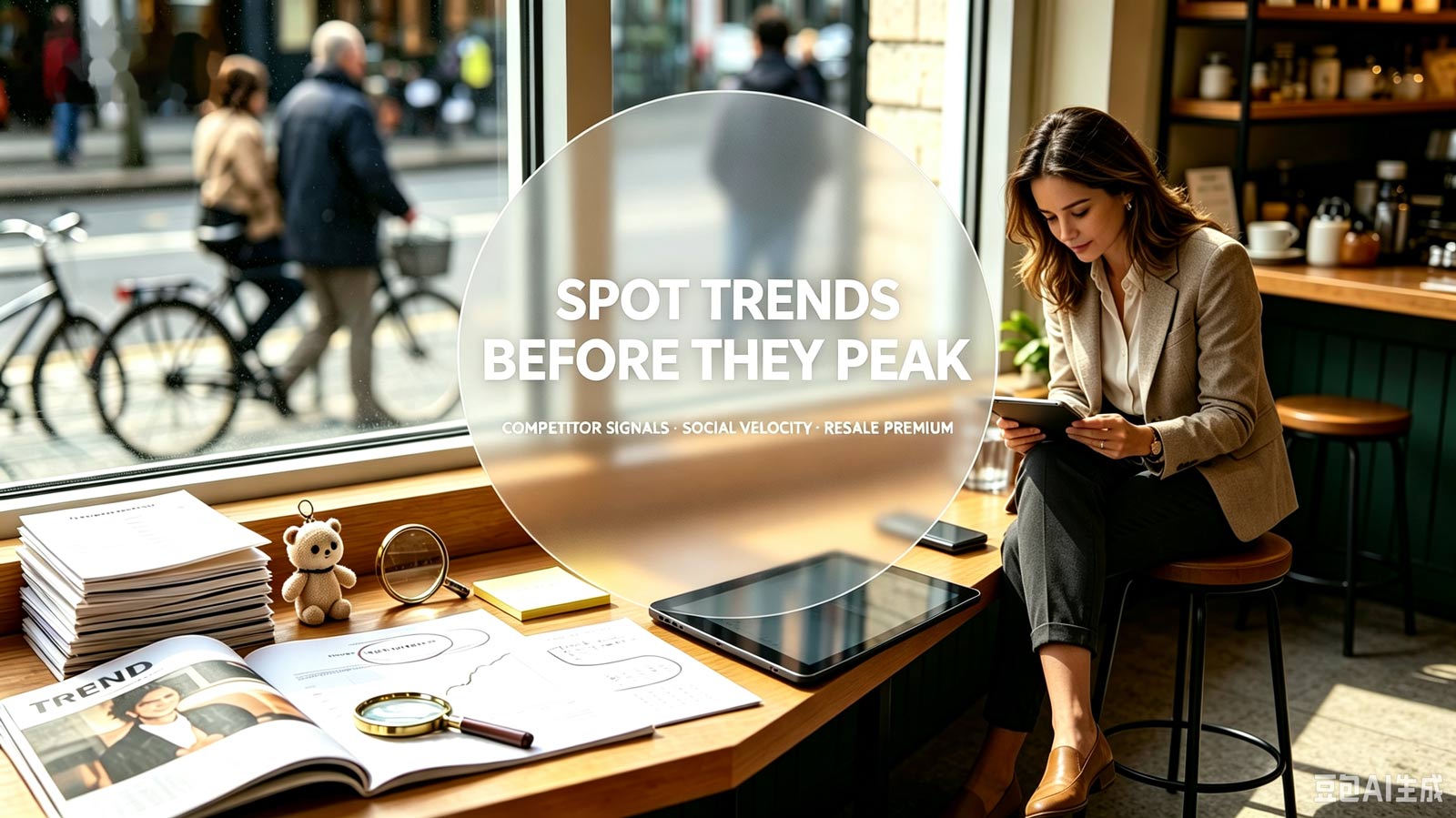
Search volume is a lagging indicator. By the time a keyword shows a spike in Google Trends, the sellers who moved first are already two supply-chain cycles ahead. The earlier — and more reliable — signals appear elsewhere:
Competitor catalogs. When top stores in your niche add a new product, adjust pricing on an existing line, or quietly expand a category, they're responding to data you can't see yet. A cluster of strong stores making the same move is one of the most reliable pre-trend signals that exists.
Ad activity. A sudden burst of new creatives around a product category — especially from stores that test aggressively — tells you someone has validated demand and is scaling into it. Ad libraries make this visible, but only if you're checking systematically.
Social proof velocity. A product going from 10,000 to 2 million hashtag views in a week behaves differently from steady organic growth. The slope matters more than the volume, and it moves weeks before it shows up in search data.
Resale premiums. When secondary-market prices for a product climb well above retail, demand has outstripped supply — a signal that primary sellers will rush in, and the window is about to close.
The common thread: all four signals are observable from the outside, without proprietary data. You just have to be watching the right stores.
Case Study: Labubu — Eighteen Months From Obscurity to Peak to Cooldown
Few trends illustrate the new math better than Labubu. The toothy plush character from Pop Mart's "The Monsters" line had existed since 2015. In April 2024, a single photo of BLACKPINK's Lisa carrying a Labubu keychain went viral — and the trend detonated.
The growth numbers were staggering. In the first half of 2025 alone, The Monsters line generated 4.81 billion yuan (roughly $677 million) for Pop Mart, up 668% year over year and accounting for 34.7% of the company's total revenue. For the full year 2025, the line reached 14.16 billion yuan, up 365.7%, and Pop Mart sold over 100 million Labubu units. Celebrities from Rihanna to David Beckham were photographed with one dangling from designer bags.
Then the window closed. Pop Mart ramped production capacity, secondary-market prices — which had traded at steep premiums — fell by roughly half, and by Q4 2025 the company's revenue declined quarter over quarter for the first time in the cycle. In early 2026, Pop Mart's market value dropped sharply as investors priced in the cooldown. The entire arc, from viral ignition to visible saturation: about 18 months.
For context: the sellers who made the most money from the Labubu wave weren't the ones who read about it in the news. They were the ones who noticed the celebrity sightings, the exploding hashtag slope, and the rapid sellouts across Pop Mart's retail channels in mid-2024 — and built their assortments while the mainstream was still asking "what's a Labubu?" Every major trend in 2026 follows a version of this pattern, just faster.
What Data-Driven Shopify Sellers Do Differently
The gap between early movers and late movers isn't budget or team size. It's process. Sellers who consistently catch trends early share four operational habits:
They watch specific competitors, not just the market. General trend reports tell everyone the same thing at the same time. Monitoring a curated set of top-performing stores in your niche gives you a lead the market averages never will.
They set alerts instead of doing periodic research. Weekly product research means you're always at least a week behind. Catalog changes, new product launches, and pricing moves need to surface the day they happen.
They validate before they source. Early signals are probabilistic, not certain. The discipline is to test demand with small batches, pre-orders, or ad tests before committing real inventory — catching the trend without betting the store on it.
They plan the exit when they plan the entry. Because windows are shorter, profit-taking discipline matters more than entry timing. Sellers who define their saturation trigger — a slowdown in social velocity, discounting appearing in competitor stores, resale premiums collapsing — leave with margins intact instead of holding dying inventory.
The Takeaway
Every signal described in this article — competitor catalog changes, new product launches, pricing shifts, the moves top stores make before a trend is visible anywhere else — is visible to anyone watching. Instead of discovering a trend when search volume explodes, you can see it when the strongest stores in your niche start moving. That's the difference between catching a product before it peaks and arriving after the margin is gone.
If you're still doing product research on a weekly schedule, the trend window has already outgrown your process. Start monitoring your competitors in real time.
Conclusion
The trend window isn't going to widen again. As social commerce keeps growing — TikTok Shop GMV is projected to reach $112 billion in 2026 — product cycles will keep compressing. The sellers who thrive won't be the ones with the biggest ad budgets or the fastest suppliers. They'll be the ones who see the earliest signal, validate quickly, and move while everyone else is still scrolling past it.